
Saving for Your Child’s Future in Ontario: RESPs, Government Grants, and a $20,000 Head Start
When you have a young child, the future can feel both very far away and surprisingly close. One minute you are buying diapers or packing a kindergarten lunch; the next, you are wondering how you will help with tuition, a first apartment, or the car they might need to get to work. You do not have to predict every detail of their adult life to start preparing for it. A manageable savings habit, combined with the right government benefits, can give them more choices when that time arrives.
For Ontario parents, the useful starting point is to separate education savings from money your child could eventually use more freely. An education account can qualify for government contributions, while a separate fund can help with the other costs of getting established. Both have a place, but their rules, ownership, and tax treatment differ. This guide explains the main options, what the often-mentioned “$1,000 baby bond” actually refers to, and how small monthly deposits could grow over 18 years.
First, What Are “Baby Bonds”?
The idea behind baby bonds is straightforward: give a child a financial starting point early in life and allow that money to grow before adulthood. Some American policy proposals use the term for government-funded accounts intended to help young adults build wealth. However, seeing “$1,000 at birth” in an article or video does not mean every Ontario newborn receives that payment. The country, the particular program, and its withdrawal rules matter.
One current American program is the Trump Account, which offers a US$1,000 government seed contribution for eligible U.S.-citizen children born from January 1, 2025, through December 31, 2028, with a valid Social Security number. It is a U.S. program with an application process, rather than a standard Ontario newborn benefit. Its special childhood restrictions end on January 1 of the calendar year the child turns 18, after which traditional individual retirement account rules generally apply. Withdrawals can involve income tax and an additional early-withdrawal tax unless an exception applies, so it should not be described as a freely spendable, tax-free car fund.
The broader lesson still applies to Canadian families: money invested early has more time to grow. For example, a single $1,000 deposit earning a hypothetical 5% annually, compounded once a year for 18 years, would become approximately $2,407 without further contributions. That is an illustration before fees, taxes, and inflation, not a promised return or a forecast for the American program. Regular deposits are what can turn a modest starting amount into a much larger head start.

The Ontario “Matching Program” Is Usually the Federal CESG
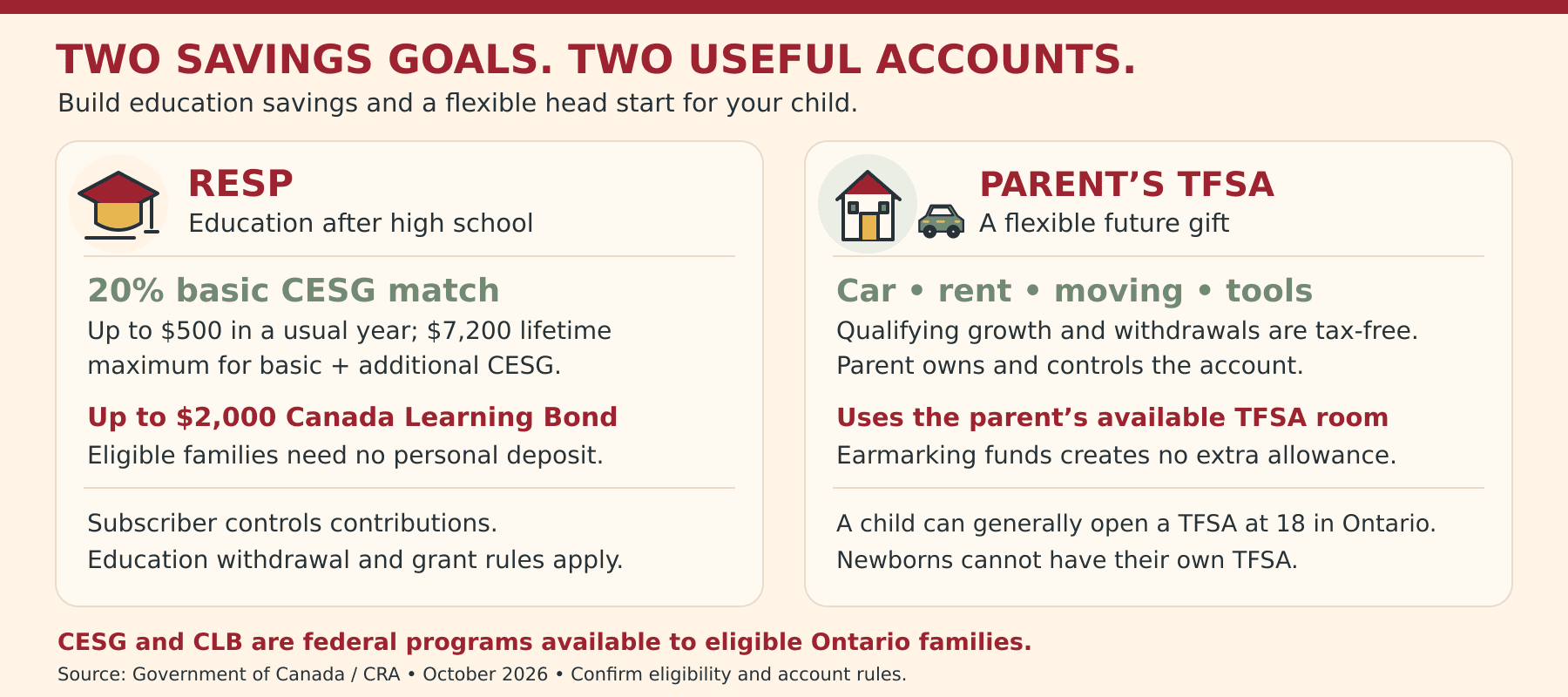
If you have heard that Ontario will match money you save for your child’s education, the program you probably mean is the Canada Education Savings Grant, or CESG. It is a federal benefit available to eligible children in Ontario and other provinces. It adds government money to eligible contributions made to a Registered Education Savings Plan, usually called an RESP. Ontario does not currently have a separate provincial RESP incentive comparable to the additional programs offered in British Columbia and Quebec.
This is why the first question is not simply, “Which savings account pays the most interest?” Parents also need to ask whether an account can receive the education benefits their child qualifies for. A regular savings account does not become an RESP because you write “college fund” on it. Likewise, putting money into an RESP does not automatically qualify the family for every available grant or bond.
What an RESP Actually Is
An RESP is a registered plan designed to help pay for education after high school. Think of it as the container holding the savings, rather than a particular investment that pays a fixed return. Depending on the provider, it can hold savings deposits, guaranteed investment certificates, mutual funds, or other permitted investments. The risk and potential growth depend on what you put inside it. Investment growth is sheltered from annual income tax while it remains in the plan.
The person opening the plan is the subscriber, often a parent or grandparent, and the child named to benefit is the beneficiary. Control of the subscriber’s contributions stays with the subscriber. Turning 18 does not automatically give the child unrestricted control of the entire RESP. That distinction matters if you are imagining handing over a lump sum on their eighteenth birthday.
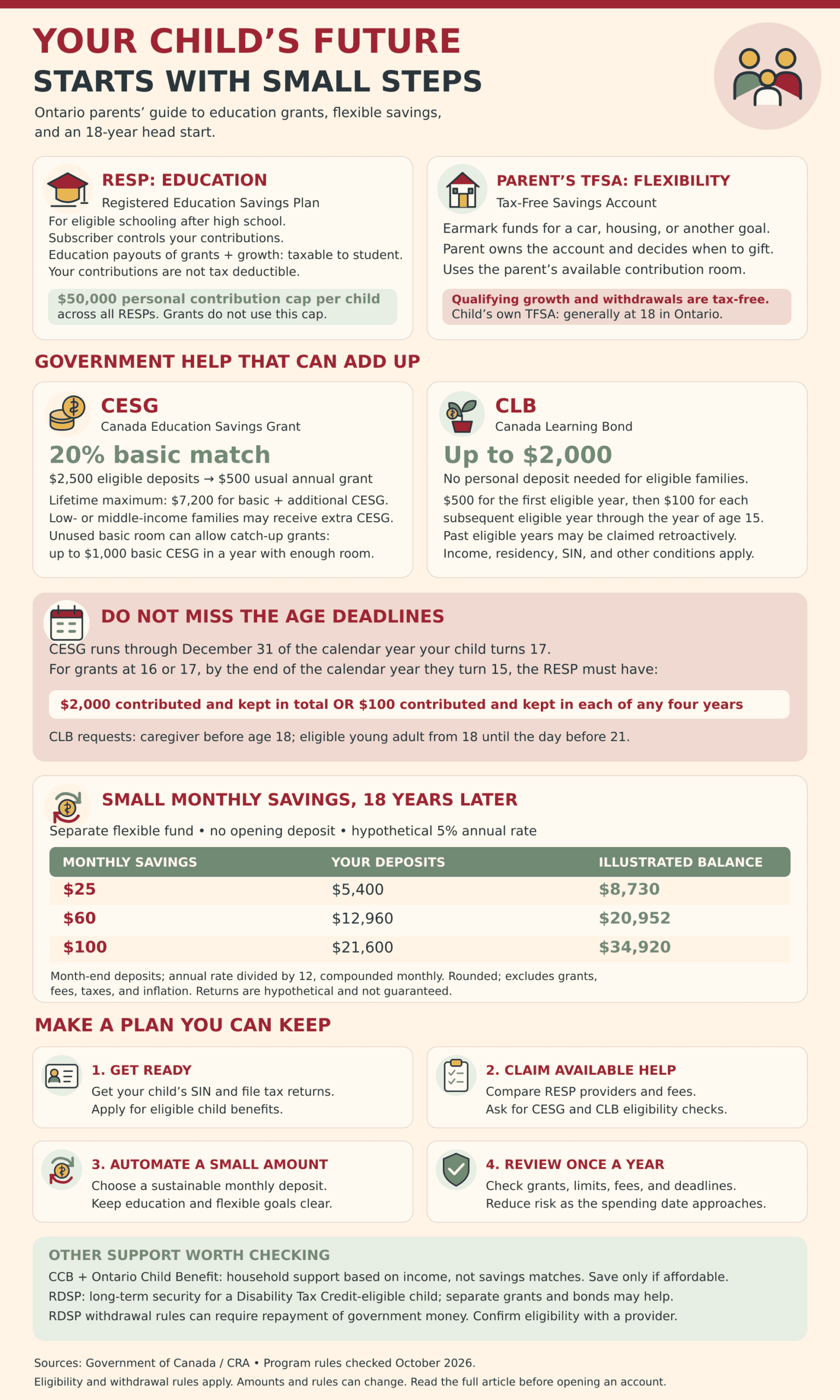
Your personal RESP contributions are not tax deductible, and the lifetime contribution limit is $50,000 per beneficiary across all their RESPs combined. That includes money contributed through different providers or by different relatives, while government grants and bonds do not use up that contribution limit. There is no annual personal contribution ceiling, but annual grant limits still apply. Excess contributions can trigger a tax of 1% per month, making coordination with grandparents and other contributors worthwhile.
How the Basic Education Grant Helps Your Savings Grow
The basic CESG normally contributes 20 cents for every eligible dollar you deposit, up to $500 in a year on $2,500 of contributions. Saving $2,500 annually works out to about $208 a month, but you do not have to reach that amount to benefit. If you put in $50 a month, your $600 annual contribution can attract $120 in basic CESG. Smaller deposits still count, provided the child and contributions meet the program’s requirements.
| Your annual eligible RESP contributions | Basic CESG at 20% | Combined amount added before investment growth |
|---|---|---|
| $300 — $25 a month | $60 | $360 |
| $600 — $50 a month | $120 | $720 |
| $1,200 — $100 a month | $240 | $1,440 |
| $2,500 — about $208 a month | $500 | $3,000 |
These examples show the ordinary basic grant, without additional income-based amounts or catch-up contributions. They assume sufficient eligibility and remaining grant room. The grant is a contribution to the account, rather than a guaranteed annual investment return, and the account’s investments can still rise or fall.
Some Families Qualify for an Additional Grant
Families with lower or middle incomes may receive an additional CESG amount on the first $500 contributed each year. The calculation uses adjusted family net income, which is a tax-based household income measure rather than simply one parent’s salary. For 2026, the extra amount follows the thresholds below.
| Adjusted family net income for 2026 | Additional CESG on the first $500 contributed | Maximum additional amount for the year |
|---|---|---|
| $58,523 or less | An extra 20% | $100 |
| More than $58,523, up to and including $117,045 | An extra 10% | $50 |
| More than $117,045 | No additional CESG | $0 |
For example, an eligible family in the lowest income band contributing $500 could receive $100 in basic CESG plus $100 in additional CESG. The combined lifetime maximum for basic and additional CESG is still $7,200 per child; the extra grant does not increase that cap. Unused additional CESG does not carry forward, although unused basic grant room can.
The Age Deadlines Parents Should Know
CESG is available through December 31 of the calendar year your child turns 17, with special requirements for contributions made when they are 16 or 17. By the end of the calendar year they turn 15, at least $2,000 must have been contributed and kept in their RESP, or at least $100 must have been contributed and kept in each of any four years. Meeting either condition can preserve grant eligibility at 16 and 17, subject to the remaining rules and limits. Opening a first RESP at 16 without the required contribution history can therefore be too late for CESG.
If you missed earlier years, unused basic CESG room can help you catch up. With enough unused room, $5,000 of eligible contributions in a year can receive up to $1,000 in basic CESG. You cannot deposit any amount you like and collect every missed year’s grant at once. Ask the provider to confirm your child’s remaining room and eligibility before making a large catch-up contribution.

The Canada Learning Bond: Help Even When You Cannot Contribute
The Canada Learning Bond, or CLB, is especially valuable because eligible families do not need to contribute their own money to receive it. It provides $500 for the first eligible year and $100 for each subsequent eligible year through the calendar year the child turns 15, up to $2,000 altogether. Eligibility can vary from year to year with the family’s circumstances. If a tight budget has made you postpone opening an RESP, this benefit is a reason to check your options now.
To qualify, the child must have been born on or after January 1, 2004, have a Social Insurance Number, be an RESP beneficiary, and be a Canadian resident before payment. The family must meet the income requirements, and the primary caregiver generally needs the relevant tax returns filed and eligibility for the Canada Child Benefit. Children in care receiving the Children’s Special Allowance can also qualify. A provider can help establish eligibility and submit the request.
For July 1, 2026, through June 30, 2027, a family with one to three qualifying children can meet the CLB income test with adjusted family income of $58,523 or less. The limit is below $66,036 for four children and below $73,577 for five, with higher limits for larger families. These thresholds apply to that benefit period and can change, so use current figures rather than an older social media post. Your provider should check the appropriate household size and income information.
The CLB is retroactive, meaning an eligible child may receive amounts for earlier qualifying years even if an RESP was not open then. A caregiver can request it before the child turns 18; eligible young adults must apply for themselves from 18 until the day before they turn 21. Automatic enrolment is scheduled to begin in April 2028 for certain eligible children born in 2024 or later who do not already have an RESP by age four. As of October 2026, parents should still take steps to request the benefit rather than assume an account has already been created.
Opening an RESP Without Making It Complicated
Start with a Social Insurance Number for yourself and your child, then compare RESP providers such as banks, credit unions, and investment firms. Ask whether the provider supports the basic CESG, additional CESG, and CLB, since the available benefits can differ between providers. The provider normally helps complete the grant and bond applications when you open the plan. Check your statements afterward to confirm that eligible government money actually arrives.
You will also choose a plan type. An individual RESP names one beneficiary, while a family RESP can include eligible beneficiaries related to the subscriber by blood or adoption. A family plan can be convenient when you have more than one child, but contribution records and each child’s benefit limits still matter. Do not assume every dollar can be moved between siblings without conditions.
Group RESPs, sometimes sold as scholarship plans, deserve a careful look at the contract. They can involve scheduled contributions, substantial sales charges, and consequences for missed payments, transfers, or leaving the plan. Those conditions do not apply in the same way to every RESP, so compare contribution flexibility and cancellation terms before signing. Ask for the total fees and the consequences of pausing payments in writing, especially if your income varies.
What the Education Money Can Pay For
An RESP is not restricted to a four-year university degree. Eligible college, trade-school, vocational, and apprenticeship education may qualify, depending on the institution and program. Education assistance can cover reasonable related costs such as tuition, books, tools, rent, and transportation. The provider will need proof of eligible enrolment and may require information about expenses.
RESP withdrawals also have different tax treatment depending on which money is coming out. Educational Assistance Payments, or EAPs, consist of government benefits and investment earnings and are taxable to the student. Students often have relatively low income, but that does not make every withdrawal automatically tax-free. Your original contributions can generally be returned without income tax, although withdrawing them before the child qualifies for educational payments can require grant repayment.
This is why an RESP should not be treated as an unrestricted “buy anything at 18” account. A transportation expense connected to eligible schooling is different from simply cashing out all the grants to buy a car after high school. Ask the provider to distinguish contributions from EAPs and explain repayment consequences before arranging withdrawals. Planning those payments can help preserve benefits and avoid unnecessary tax surprises.
What If Your Child Does Not Continue Their Education?
A child who is unsure about college at 18 has not necessarily made your RESP useless. You may be able to leave it open while they decide, or change the beneficiary or share eligible amounts with a sibling under the relevant rules. A normal RESP must terminate by the end of the 35th year following the year it was opened, rather than on the child’s thirty-fifth birthday. The Canada Learning Bond remains specific to its eligible beneficiary and cannot simply be reassigned to another child.
If you ultimately close the plan without eligible education withdrawals, your original contributions can generally come back tax-free, while unused government benefits generally have to be repaid. Investment earnings may qualify for an accumulated income payment, subject to conditions that usually include a plan at least 10 years old and all living current or former beneficiaries being at least 21 and not eligible for EAPs. In Ontario, this payment normally faces regular income tax plus an additional 20% tax. An eligible rollover of up to $50,000 into an RRSP can reduce or avoid immediate tax if you have enough RRSP deduction room and meet the other requirements.
The important takeaway is that “no university” does not automatically mean losing every dollar, but it does change the options. Education plans, sibling circumstances, grant rules, and the plan contract all affect the result. Contact the provider before withdrawing or closing the account so you can compare the available choices.
A Separate Fund for a Car, an Apartment, or Another Opportunity
Many parents want to help with more than education, and a separate flexible fund can serve that purpose. You might eventually use it for a used car, moving costs, a rental deposit, or the equipment needed to start working. Decide whether you want to retain control and help with specific purchases, or make an outright gift when your child is older. That decision matters just as much as choosing an investment.
One option is to earmark part of your own Tax-Free Savings Account, or TFSA, for your child’s future. Qualifying investment growth and withdrawals are generally tax-free, but it remains your account and uses your available contribution room. Calling it your child’s fund does not give them their own TFSA or a separate allowance. In Ontario, a child can generally open their own TFSA at 18 if they meet the Canadian residency and Social Insurance Number requirements.
The annual TFSA dollar limit for 2026 is $7,000, but your actual available room depends on unused room, previous-year withdrawals, and contributions already made across all your TFSAs. Money you withdraw is added back to your room on January 1 of the following year, rather than immediately. Keep your own transaction records because the CRA’s displayed room may not reflect recent activity. If you use a TFSA for both your retirement and your child’s fund, those savings share the same personal contribution limit.
When the time comes, a genuine personal cash gift to your child is generally not taxable income to them. However, future investment income outside a tax shelter can be taxable. A newly eligible 18-year-old also cannot automatically put an entire $20,000 gift into a TFSA if their available contribution room is smaller. Check the rules and limits applying in that future year before transferring money into their account.
What About an Account “In Trust” for a Child?
A regular child savings or investment account can be useful, but the tax rules are more complicated than putting a child’s name on the paperwork. Interest and dividends earned on money gifted by a parent to a minor can be attributed back to the parent for tax purposes. Capital gains generally follow different rules, and money originating from certain child benefits can have different treatment as well. Keep records of where contributions came from instead of assuming all income belongs on the child’s tax return.
An “in trust” label also does not answer every ownership question. Money irrevocably given to the child belongs to the child, while a formal trust can set out particular conditions for management and distribution. Do not assume an informal trust lets you permanently control how an adult child spends their money. Before putting substantial money into such an arrangement, clarify who legally owns it, who can withdraw it, and what reporting is required. Legal and tax advice can be useful here because the account paperwork and the actual arrangement need to agree.
Could Small Monthly Savings Become $20,000 by Age 18?
Yes, the arithmetic makes that goal possible, although the result depends on how much you save and what happens to the investments. Depositing $100 a month for 18 years adds up to $21,600 from your own contributions alone. Without investment growth, saving about $93 a month would reach roughly $20,000 over that period. With growth, a lower monthly amount could get there, but the return is uncertain.
The table below illustrates a separate savings fund with no opening deposit and contributions made at the end of each month for 18 years. The 3% and 5% scenarios use hypothetical nominal annual rates divided by 12 and compounded monthly. Figures are rounded and exclude government grants, fees, taxes, and inflation; they are calculations, not promised outcomes.
| Monthly savings | Your deposits over 18 years | At a hypothetical 3% annual rate | At a hypothetical 5% annual rate |
|---|---|---|---|
| $25 | $5,400 | $7,149 | $8,730 |
| $50 | $10,800 | $14,297 | $17,460 |
| $60 | $12,960 | $17,156 | $20,952 |
| $100 | $21,600 | $28,594 | $34,920 |
| $200 | $43,200 | $57,188 | $69,840 |
For example, $60 a month reaches approximately $20,952 in the hypothetical 5% scenario. That does not mean a $60 automatic transfer guarantees your child $20,000, since actual returns, fees, and tax treatment can change the result. Inflation matters too: at an illustrative 2% annual inflation rate, $20,000 received in 18 years would have purchasing power of about $14,003 today. Review the target periodically so it stays connected to what a car, education, or moving costs might actually cost.
You Can Save for Both Goals at Once
Imagine a family has $100 a month available after meeting its other needs. It might put $75 into an RESP and $25 into a separate fund held in a parent’s TFSA, assuming the parent has available room. The RESP would receive $900 in annual contributions and potentially $180 in basic CESG, while the flexible fund would receive $300 before growth. Additional CESG or CLB could help if the child qualifies, but the family has still contributed only $1,200 altogether.
There is no universally best split between those accounts. A family expecting significant education costs may place more emphasis on eligible RESP contributions, while another may value flexibility or have limited TFSA room. The projection table above applies only to the monthly amount actually placed in the separate fund, so splitting $100 between two goals does not produce the $100-row balance in each account. Choose a contribution level and allocation that you can maintain, then revisit them as your circumstances change.
The Canada Child Benefit and Ontario Child Benefit Can Help Your Budget
The Canada Child Benefit, or CCB, is a tax-free monthly payment to eligible families to help with the cost of raising children under 18. It is household support, rather than a savings account or an investment match. For July 2026 through June 2027, the maximum annual amount is $8,157 for a child under six and $6,883 for a child aged six through 17. Actual payments depend on family income and circumstances, and many families receive less than the maximum.
Ontario also provides the income-tested Ontario Child Benefit, administered by the CRA and paid together with the CCB. For July 2026 through June 2027, eligible families can receive up to $146.66 a month per child under 18, depending on adjusted family net income. If your budget allows, you can set aside part of these payments for future savings. If you need them for groceries, housing, or child care today, using them for those needs is entirely consistent with their purpose.
Keeping benefits flowing starts with tax filing. You and your spouse or common-law partner, if applicable, need to file annual income tax returns even if you have no income, and keep the CRA informed about relevant changes. For new parents, applying for child benefits can often be done through the birth registration process or directly with the CRA. Review eligibility before assuming a payment will arrive automatically.
If Your Child Has a Disability, Check the RDSP Too
For a child eligible for the Disability Tax Credit who meets the other requirements, a Registered Disability Savings Plan, or RDSP, can help build long-term financial security. It is separate from an RESP and has its own rules. Contributions are not tax deductible, and government benefits and investment earnings have specific withdrawal tax treatment. This is a program to examine alongside education planning when disability-related needs may extend well into adulthood.
Depending on eligibility and income, the Canada Disability Savings Grant can provide up to $3,500 for a current year’s contributions, with a $70,000 lifetime limit. The Canada Disability Savings Bond can provide up to $1,000 for an eligible year without personal contributions, with a $20,000 lifetime limit; catch-up rules can increase payments for past eligible years. Grants and bonds are generally available through the calendar year the beneficiary turns 49. Withdrawals can require repayment of recent government benefits, so an RDSP needs careful planning rather than treating it as a routine car fund at 18. Ask an RDSP provider to check eligibility and explain how to apply for the grant and bond.
Choose Investments That Fit When You Will Need the Money
The account type and the investment choice are two different decisions. With many years before the money is needed, a suitable diversified investment approach may offer growth potential, but its value can fluctuate and losses are possible. As the spending date approaches, review how much risk you can afford to take and whether to move money needed soon into less volatile holdings. A market decline shortly before the first tuition payment is harder to absorb than one early in the savings journey.
For goals within a year or two, protecting the money and having it accessible becomes especially important. Savings accounts and appropriately timed short-term GICs may fit that need better than volatile investments. Also consider your household finances before committing to a contribution schedule: expensive debt and a lack of emergency savings can make an aggressive savings target difficult to sustain. A modest plan you can keep going is more useful than one that forces you to borrow for ordinary expenses.
Fees can also take a meaningful bite out of long-term growth. Compare account, investment fund, advisory, trading, and transfer charges, and ask what they would cost in actual dollars at your expected balance. A quoted investment return is less useful if you do not understand which fees still have to come out. Choose a provider whose costs and service you understand, and review them as the balance grows.
If you want deposit protection, check both the institution and the product. CDIC covers eligible savings deposits and GICs at member institutions up to $100,000, including principal and interest, per insured category per member institution. Stocks, bonds, mutual funds, ETFs, and cryptocurrencies are not covered by CDIC. Simply holding something in a TFSA or RESP does not make the underlying investment insured.
A Practical Starting Plan for Parents
You do not have to open every possible account or make the largest contribution immediately. Start by checking the benefits your child could receive, then decide how much you can save without weakening your household budget. The following steps can turn a broad intention into a plan you can actually manage.
- Get the paperwork in place. Obtain your child’s SIN, file the necessary tax returns, and apply for child benefits if you have not already done so.
- Check for money that does not require a deposit. Ask about the Canada Learning Bond and, where relevant, the Canada Disability Savings Bond.
- Compare RESP providers and apply for grants. Confirm benefit availability, fees, contribution flexibility, and withdrawal terms before opening the account.
- Set a manageable automatic contribution. Start with an amount your budget supports, and increase it when circumstances permit rather than relying on occasional large deposits.
- Separate education savings from flexible savings. Decide who will own and control the money intended for a car, housing, or another adult-life expense.
- Review the plan annually. Check grant deposits, shared contribution limits, age deadlines, investment risk, and whether your savings target needs adjusting.
If your child is already older, start with the years remaining instead of dwelling on the years that have passed. There may still be basic CESG catch-up room or retroactive CLB eligibility, but the age conditions can limit what is available. Ask the provider to check those details before choosing a contribution amount. Saving for a teenager can still be worthwhile even when the account strategy differs from saving for a newborn.
Give Them Financial Skills Along With the Money
An account balance can help your child get started, but understanding money helps them keep that advantage. As they grow, show them what a deposit does, explain the difference between saving and investing, and talk about the ongoing costs that come with a car or apartment. Let them practise setting small goals and making choices with money they control. Those lessons make a future gift easier to use thoughtfully.
You do not need a perfect forecast or a huge sum on day one. Ontario families can combine eligible education grants, income-based benefits, and their own regular savings to build support over time. Start with the programs your child qualifies for, choose accounts that match your goals, and keep ownership and withdrawal rules clear. Whether the eventual balance pays for tuition, tools, a first home away from home, or another opportunity, a plan started today can give your child more room to choose their next step.
Program figures and rules checked in October 2026. Income thresholds, benefit amounts, and account rules can change. This article provides general information, and the best account and investment choices depend on your family’s circumstances.