
Government Money You Might Be Missing: Federal & Ontario Grants, Loans and Financial Programs
Last checked: October 7, 2026
There is a piece of financial advice that students sometimes hear when they apply to college or university: go through the school’s scholarships and bursaries and apply for everything that reasonably fits you. Do not assume you make too much money, your grades are too low, your circumstances are too ordinary or somebody else deserves the money more. Read the requirements, apply when you qualify and let the organization decide. That same philosophy can be surprisingly useful outside of school, because Canadian governments operate hundreds of programs that most people will never hear about unless they deliberately go looking for them.
The difference is that business and government funding requires a little more strategy than simply firing applications at everything. Some programs are grants, some are repayable loans, some reimburse specific project expenses, some reduce your taxes, some pay part of an employee’s wages and others offer financing that you still have to repay. Eligibility can depend on your age, income, location, industry, number of employees, whether you are incorporated, how long you have been operating and exactly what you plan to spend the money on. The better rule is therefore: search everything, shortlist aggressively and apply to every opportunity that genuinely fits.
There is far more available than most people realize. The federal government’s Business Benefits Finder currently pulls together more than 1,500 federal, provincial and territorial programs and services, including hundreds of grants and funding opportunities, loans, tax credits, wage subsidies, expert-advice programs and research partnerships. The federal Benefits Finder separately searches programs for ordinary Canadians dealing with school, children, housing, disability, job loss, training, retirement and other life situations.
No static webpage can honestly promise to contain every government program in Canada forever. A grant can open next Tuesday, exhaust its funding two weeks later and disappear until the following year, while another program may quietly change its eligibility requirements. The purpose of this page is therefore twofold: first, to show Ontario residents some of the most useful programs they may never have heard about; second, to show readers the official government databases where newly announced opportunities can always be found.
First, Understand What Kind of “Government Money” You Are Looking At
Before chasing funding, it helps to understand the language. A government announcement saying that a business can receive “up to $100,000 in funding” does not necessarily mean somebody will deposit $100,000 into your bank account with no strings attached. The structure of the assistance can completely change the value of the opportunity, the application process and what you are required to do afterward. This is exactly the kind of fine print that gets lost when programs are described online simply as “free government money.”
A grant is generally a payment made after you meet established eligibility requirements. Grants normally do not need to be repaid, although recipients can still be required to demonstrate that the project occurred and report the results. A contribution is usually more conditional: the government may reimburse specific eligible expenses after you incur them, require matching money from you, demand detailed reporting and potentially recover funding if the agreement is breached. Employment and Social Development Canada specifically distinguishes the two this way, which is worth understanding before assuming every funding program works like a cash prize.
A loan is borrowed money and must generally be repaid, even when a government agency is involved. A loan guarantee is different again: government assumes part of the lender’s risk, which can make a bank more willing to lend to you without government actually handing you the money. A tax credit reduces taxes you owe and can sometimes be refundable, meaning you may receive money even when the credit exceeds your tax liability. A wage subsidy covers some of the cost of hiring or training an employee, while a rebate generally pays you back after making an eligible purchase or improvement.
That distinction is important throughout this guide. A $5,000 grant, a $50,000 loan, a $50,000 contribution covering half of a project and a $50,000 refundable tax credit are four very different financial tools. None is automatically better than the others; the right one depends on what you are trying to accomplish.
Start Here: The 15-Minute Government Money Check
Before reading another 5,000 words about individual programs, there are several official websites every Ontario resident or entrepreneur should bookmark. If you only remember one lesson from this page, remember these. They are far more useful than a random “100 Canadian grants” article that has been circulating online unchanged since 2021.
The most important for a business owner is the Government of Canada Business Benefits Finder. You tell it what kind of company you have, your location, industry, goals and what assistance you are seeking, and it searches federal, provincial and territorial supports. The database currently contains roughly 1,500 programs, including more than 600 grants and funding programs alongside loans, tax credits, wage subsidies, advice, research facilities and partnerships. You can also save your profile and receive notifications when relevant programs or deadlines appear. Official tool: Business Benefits Finder.
If you are looking for personal assistance rather than business funding, use the Canada Benefits Finder. It currently lists 157 federal benefits and allows you to filter by categories such as education, disability, job loss, housing, family, training and business ownership, then points you toward corresponding provincial information. This is the tool I would run at least once a year or whenever something significant changes in your life — having a child, losing work, returning to school, developing a disability, becoming a caregiver or approaching retirement. Official tool: Canada Benefits Finder.
Ontario has another portal that deserves a bookmark: Transfer Payment Ontario, usually shortened to TPON. The province’s Available Funding Opportunities page lists current Ontario government calls and sends applicants into TPON when an application is available. Some opportunities are extremely specific, which is exactly why you should occasionally browse the page even when you assume nothing applies to you. As of October 7, 2026, for example, Ontario’s Great Lakes Local Action Fund is actively taking applications for community projects worth up to $100,000. Official page: Ontario Government Funding Opportunities.
Finally, organizations, charities, employers and community groups should periodically search Employment and Social Development Canada’s funding opportunities. These calls cover employment, youth, training, accessibility, seniors, social development and other community projects, and many appear only during specific application windows. Government funding is something you should monitor rather than search once and forget.

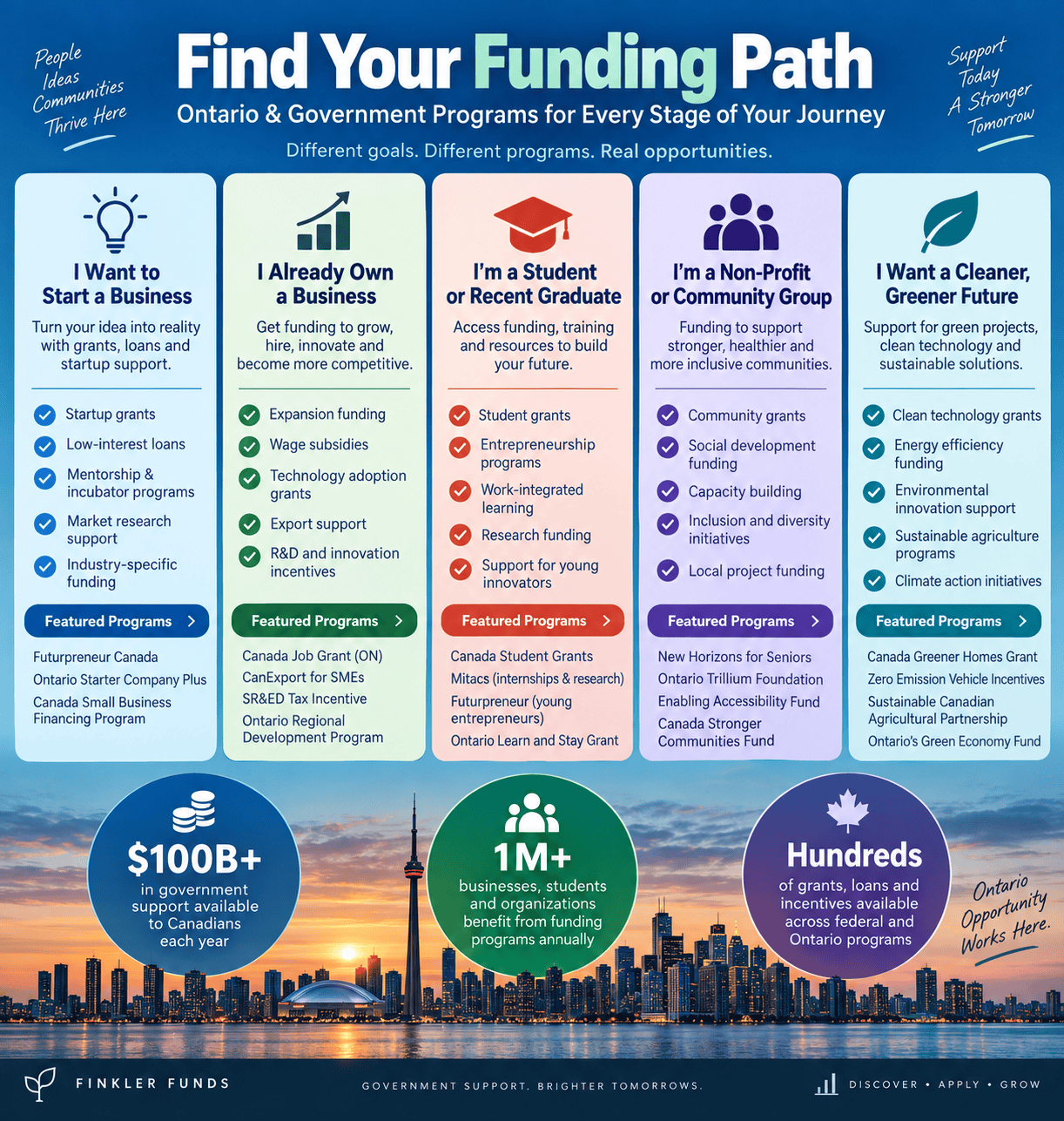
“I Want to Start a Business”
This is probably the category where expectations need the most adjustment. Canada does not generally hand every new entrepreneur a cheque simply because they registered a business number. The better programs usually combine financing, mentoring, training or funding for a specific project. That can actually be more useful than a small unrestricted grant, particularly when somebody is trying to turn a side hustle into a real business.
Starter Company Plus: Up to $5,000 in Ontario
One of the first programs an aspiring Ontario entrepreneur should check is Starter Company Plus. It provides business workshops, one-on-one guidance, mentoring and the possibility of a grant of up to $5,000 for somebody starting, expanding or buying a small business in Ontario. Eligible applicants generally need to be at least 18, live in Ontario, be a Canadian citizen or permanent resident and not be attending or returning to school full-time. Grant recipients must also contribute at least 25% of the grant amount themselves, either in cash or eligible in-kind support.
The interesting part is that this is delivered through Ontario’s local Small Business Advisory Centres rather than through one giant provincial application. That means application dates and local intake procedures can differ depending on where you live. Do not simply search “Ontario business grant” once, see no open application and conclude you missed it; contact the centre serving your municipality and ask when its next Starter Company Plus intake is running. Official page: Starter Company Plus.
Futurpreneur: Up to $75,000 Plus Mentorship
If you are between 18 and 39, Futurpreneur deserves a serious look. Its Core Startup Program provides up to $75,000 in equity-free startup loan financing, including financing through BDC, plus as much as two years of one-on-one mentorship. It is intended for Canadian citizens and permanent residents launching or buying businesses, and applicants need relevant experience or training connected to the business they intend to operate.
This is a loan rather than a grant, so “$75,000 available” should not be read as “$75,000 free.” Still, somebody who cannot obtain conventional startup financing may find the combination of capital and mentorship considerably more useful than a small one-time grant. Futurpreneur also operates a Side Hustle Program that can provide up to $25,000 in loan financing for eligible younger entrepreneurs building part-time businesses, which is particularly interesting for somebody trying to validate an idea before leaving their job. Official page: Futurpreneur Core Startup Program.
Canada Small Business Financing Program: Up to $1.15 Million
The Canada Small Business Financing Program, or CSBFP, is one of the biggest programs entrepreneurs regularly overlook because you do not apply to the government for the money. Instead, Ottawa shares some of the lender’s risk and eligible businesses apply through banks, credit unions and other participating financial institutions. Canadian startups and small businesses with annual gross revenues of $10 million or less can potentially finance up to $1.15 million, consisting of as much as $1 million in term loans and $150,000 through a line of credit.
The funding can cover things such as property, equipment, leasehold improvements, intangible assets and certain working-capital expenses. Agriculture businesses are excluded because farming has a separate federal financing program that we will get to later. This is a perfect example of why searching only for the word “grant” can make entrepreneurs miss useful assistance: the federal government may not give you the money, but its involvement can make financing possible when ordinary commercial lending would be harder to obtain. Official page: Canada Small Business Financing Program.
BDC Startup Financing: Up to $150,000
The Business Development Bank of Canada is a federal Crown corporation created specifically to finance and advise Canadian entrepreneurs. Its current startup financing product offers up to $150,000 and can be used for assets, startup fees, franchises, marketing, a website and consulting expenses. Unlike Futurpreneur, however, this is generally not for a brand-new idea with zero operating history: BDC currently lists at least 12 months in business, revenue generation and a reasonable credit record among the minimum requirements.
BDC also offers other lending products as companies mature, including small-business loans of up to $350,000 and specialized loans for technology, equipment, real estate and working capital. Again, these are loans rather than grants, but BDC can sometimes take risks that conventional lenders may be less interested in taking. Official financing page: BDC Business Financing.
“I’m a Student and I Want to Try Entrepreneurship”
Ontario has an unusually practical program for students who want to test entrepreneurship while they are still in school. Summer Company provides eligible students aged 15 to 29 with business coaching and up to $3,000, generally divided into as much as $1,500 for startup expenses and another $1,500 after successful completion of the program. Participants keep the profits from the business they build, which effectively turns a summer into a relatively low-risk entrepreneurship experiment.
The catch is that it is seasonal. The 2026 cycle has already passed by the time this page was updated, so a student reading this in autumn 2026 should bookmark it rather than assume the program disappeared. Applications are typically handled through local Small Business Advisory Centres before the summer operating period, and applicants generally need to be returning to school afterward. Official page: Ontario Summer Company.
Students should also make the same move that inspired this entire article: search the scholarships, bursaries, awards and emergency funds offered by their own institution. Those sources are separate from government student aid and can be shockingly underused, particularly smaller awards tied to a particular program, hometown, employer, family circumstance, volunteer activity or career goal. A student should not decide in advance that somebody else is more deserving; if the written eligibility requirements fit, submit the application and let the selection committee make that decision.
“I Need Money to Pay for School”
Do not assume student assistance means taking on debt. The federal Canada Student Grant for Full-Time Students can currently provide qualifying students with financial need up to $4,200 per academic year, or up to $525 per month of study, during the 2026–27 school year. Students are automatically assessed when they apply for student aid through their province, meaning an Ontario student applies through OSAP rather than submitting a completely separate federal grant application.
Part-time students are not excluded either. The Canada Student Grant for Part-Time Students can provide up to $2,520 per year for eligible students with financial need, with additional grants potentially available to some students with dependants or disabilities. This is why completing the actual student-aid application can matter even when you think you do not want a loan: grants and loans are separate forms of assistance, and the application determines what you qualify for.
Ontario also operates the Learn and Stay Grant for designated priority programs and communities. For eligible health-human-resources programs, the grant can cover tuition, compulsory fees, books and other direct educational expenses in exchange for a commitment to work in the region where the student studied after graduation. Beginning in 2026 there is also a medical-education version covering eligible education costs for qualifying Ontario family-medicine residents who agree to practise as family doctors in Ontario for at least five years. Official page: Ontario Learn and Stay Grant.
“I Want to Change Careers or Learn a Trade”
One of Ontario’s more substantial retraining programs is Better Jobs Ontario. Eligible applicants can receive up to $28,000 for programs lasting one year or less and up to $35,000 for programs lasting more than one year and no more than two years. Funding can cover tuition, books, instructional costs, electronic devices, transportation and a basic living allowance of up to $500 per week, with additional assistance potentially available for child care, disability-related support and living away from home.
This is aimed particularly at unemployed people, laid-off workers and some lower-income individuals who need training for occupations where jobs are available. Somebody considering a career change should therefore talk to an Employment Ontario service provider before assuming they need to personally finance an entire college program. Official page: Better Jobs Ontario.
Apprentices in designated Red Seal trades have another tool: the Canada Apprentice Loan. Eligible apprentices can borrow up to $4,000 interest-free for each period of technical training, and the money can cover tuition, tools, equipment, living expenses or lost wages while attending school. Payments are not required while the apprentice remains in qualifying training. Official page: Canada Apprentice Loan.
It is worth knowing that the old federal Apprenticeship Incentive Grant and Apprenticeship Completion Grant have effectively wound down for new applicants. Old internet articles still promote them, but the final application windows have passed. That is exactly why a current guide needs dates attached to programs rather than simply recycling grant lists indefinitely.
“I Already Own a Business and Want to Grow”
Once a company has employees, revenue and a documented growth project, the funding landscape becomes much larger. Programs that will not give $5,000 to somebody with an idea may be willing to contribute hundreds of thousands or even millions toward expansion, productivity improvements, export development or technology. The paperwork and expectations also become substantially more serious. This is the stage where a good accountant, bookkeeper or funding specialist can become useful because mistakes in project timing or eligible-cost documentation can cost far more than their fee.
FedDev Ontario: Serious Financing for Serious Expansion Projects
For established companies in southern Ontario, Federal Economic Development Agency for Southern Ontario — FedDev Ontario — is one of the first places I would investigate. Business projects normally request a minimum of $125,000 and up to $10 million, generally in the form of a repayable contribution, with FedDev typically covering no more than 50% of eligible project costs. Projects need to produce incremental results rather than simply subsidizing ordinary operating expenses.
This is not designed for somebody who wants $3,000 to buy a laptop. It becomes relevant when a growing company is adopting new technology, expanding production, increasing productivity, commercializing products, adding capacity or entering new markets. FedDev can also provide non-repayable contributions to eligible organizations that deliver business-growth services rather than to individual businesses themselves. Official program information: FedDev Ontario Business Funding.
Ontario Together Trade Fund
Companies facing trade disruptions should check Ontario’s Ontario Together Trade Fund. The program is intended to help businesses diversify markets, improve competitiveness, build domestic supply chains and make investments that reduce exposure to international trade disruptions, with particular emphasis on small and medium-sized enterprises. It can be relevant to manufacturers investing in equipment, technology, production capacity or new markets rather than companies seeking help with routine expenses.
This program illustrates why funding should be matched to a project before the company spends the money. Government contributions frequently require approval before costs are incurred, and starting a project first can make otherwise eligible expenses ineligible. Always read the program guide before signing a contract, placing an equipment order or assuming that money spent now can be reimbursed later. Official page: Ontario Together Trade Fund.
CanExport SMEs: Up to $50,000 Toward International Expansion
If an established Canadian company is ready to sell outside Canada, CanExport SMEs is another program worth bookmarking. Under the 2026–27 program rules, qualifying businesses can request between $10,000 and $50,000, with CanExport generally covering up to 50% of eligible project costs. The 2026–27 program has about $31 million available and is targeted at companies that already have some operating capacity, including minimum employee and revenue requirements.
The normal CanExport SME intake is competitive and can close after funding is allocated, so this should be treated as a recurring opportunity rather than money that is permanently waiting. There is also a specialized CanExport GAC-Led Delegations stream currently accepting eligible companies participating in selected government-led trade missions, with funding covering up to 50% of qualifying participation costs. Official information: CanExport SMEs Guide.
“I Want to Hire Someone or Train My Employees”
This is one of the areas where small-business owners leave serious money on the table. Governments frequently prefer subsidizing hiring or training because the benefit is shared: the employer lowers its labour cost while a worker gains skills and experience. Before hiring a student, apprentice or trainee entirely out of pocket, check whether the position fits a wage or training subsidy.
Ontario Job Grant: Up to $10,000 — Sometimes $15,000 — Per Trainee
The Ontario Job Grant is currently accepting applications and can cover eligible third-party training costs up to $10,000 per trainee. Employers with fewer than 100 employees normally contribute at least one-sixth of the training cost, while larger employers generally contribute half. Small employers training a newly hired person who was previously unemployed may qualify for as much as $15,000 per trainee and potentially 100% government coverage of qualifying training costs.
The training has to meet program rules and be delivered by an eligible third party, so this is not a blank cheque to pay yourself for showing an employee how your business works. Nevertheless, somebody planning certification, software training, technical upgrading or another legitimate skills program should check this before paying the entire invoice. Official page: Ontario Job Grant.
Student Work Placement Program: Up to $5,000 Per Student
The federal Student Work Placement Program operates year-round and allows eligible employers to receive wage subsidies of up to $5,000 for each post-secondary student work placement. Applications are administered through industry partner organizations covering fields ranging from technology and manufacturing to tourism, agriculture, culture, trucking, aviation, mining and other sectors.
That makes this particularly valuable for smaller businesses that need help but are unsure whether they can afford an intern or co-op student. Instead of assuming a student hire costs full market wages entirely out of pocket, check the program partners first and see whether the position is eligible. Official page: Student Work Placement Program.
Canada Summer Jobs: Watch October 27, 2026
Canada Summer Jobs subsidizes employers that create summer employment for youth aged 15 to 30. The 2027 application call opens October 27, 2026, and eligible not-for-profit employers can receive funding covering up to 100% of the applicable provincial or territorial minimum wage, while eligible public and private employers can receive up to 50%. Private-sector applicants generally must have 50 or fewer full-time employees.
This is one to put on the calendar rather than remember in April when you suddenly want summer help. The application is made months before most students begin working, which means employers who plan ahead have a better chance of using it. Official page: Canada Summer Jobs 2027.
Hiring an Apprentice Can Trigger Several Supports
Ontario employers who sponsor apprentices can receive payments through the Achievement Incentive Program as apprentices reach registration, classroom-training and certification milestones. Ontario says employers can receive as much as $17,000 in applicable circumstances, with additional payments linked to apprentices under 25 and those from under-represented groups. Employers may also qualify for the federal Apprenticeship Job Creation Tax Credit, worth 10% of qualifying apprentice salary up to $2,000 per year for each apprentice during the first two years of a Red Seal apprenticeship.
The federal Apprenticeship Service has historically provided $5,000 for eligible first-year apprentices and $10,000 for apprentices from specified equity-deserving groups. As of this update, however, the existing program is not currently accepting applications while the federal government works on renewal, so this belongs on the watchlist rather than in your immediate cash-flow forecast.
“My Business Builds Technology, Software or Something New”
Entrepreneurs sometimes assume research incentives apply only to pharmaceutical laboratories staffed by people in white coats. That can be a costly assumption. Software development, manufacturing processes, engineering problems and other technological work can potentially qualify when the work involves genuine technological uncertainty and systematic experimentation rather than ordinary product development. If your company spends serious money figuring out how to do something technically difficult, research incentives deserve a conversation with somebody who understands the rules.
NRC IRAP
The National Research Council Industrial Research Assistance Program, better known as NRC IRAP, works with incorporated Canadian for-profit companies with up to 500 employees that are developing and commercializing innovative, technology-driven products or services. Support includes technical and business advice, industry connections and, in suitable cases, direct financial assistance.
IRAP is especially interesting because the value is not limited to a cheque. Industrial Technology Advisors can help companies navigate technical challenges and other government resources, which can be valuable for a small company that has never dealt with Canada’s innovation ecosystem. Official page: NRC IRAP Financial Support.
SR&ED Tax Credits
The federal Scientific Research and Experimental Development tax incentive, usually called SR&ED, can be extremely valuable to businesses doing qualifying R&D in Canada. The basic federal investment tax credit is 15%, while many Canadian-controlled private corporations can receive an enhanced 35% credit on qualifying expenditures up to the applicable expenditure limit. Legislative changes now place the maximum annual expenditure limit for the enhanced rate at $6 million for qualifying tax years.
SR&ED is not a generic “technology company tax credit.” Work must meet the program’s scientific or technological requirements, and documentation matters enormously. But a company already paying developers, engineers or technical staff to experimentally solve genuine technological problems should investigate SR&ED before simply treating all of those salaries and development costs as ordinary expenses. Official information: CRA SR&ED Tax Incentives.
Ontario Can Add Its Own R&D Credits
Ontario layers several provincial incentives on top of federal SR&ED. The Ontario Innovation Tax Credit is an 8% refundable credit on qualifying Ontario SR&ED expenditures for eligible corporations, while the Ontario Research and Development Tax Credit provides a 3.5% non-refundable credit to qualifying corporations. A corporation contracting qualifying research to an eligible Ontario research institute can potentially access the Ontario Business-Research Institute Tax Credit, a refundable 20% credit with qualified expenditures capped at $20 million annually and a maximum annual credit of $4 million.
These programs demonstrate why the funding search should not stop when one government program is found. Federal and provincial incentives can sometimes interact, although assistance and “stacking” rules must be checked carefully so the same expense is not improperly claimed twice. This is an area where professional tax advice can easily pay for itself.
“I Run a Manufacturing Business”
Ontario currently has one particularly large manufacturing incentive: the Ontario Made Manufacturing Investment Tax Credit. For qualifying Canadian-controlled private corporations, the refundable credit is currently 15% of eligible investment, with up to $20 million in eligible expenditures and a maximum credit of $3 million per year. It applies to qualifying investments in buildings, machinery and equipment used for manufacturing or processing in Ontario.
The enhanced rate applies to qualifying property becoming available for use within the relevant period before 2030, so this is not something a manufacturer should discover three years after buying a new production line. Tax incentives can affect the economics of when equipment is ordered, installed and put into service. Official page: Ontario Made Manufacturing Investment Tax Credit.
There is also a time-sensitive Ontario credit worth knowing about if a corporation is making commercial or industrial property investments in certain regions. The Regional Opportunities Investment Tax Credit provides a 10% refundable credit on qualifying expenditures above $50,000 and up to $500,000, producing a maximum current credit of $45,000 per year. It is scheduled to expire January 1, 2027, although eligible expenditures incurred by December 31, 2026 can still qualify under the transition rules. Official page: Regional Opportunities Investment Tax Credit.
“I’m a Woman Entrepreneur”
The federal Women Entrepreneurship Loan Fund provides loans of up to $50,000 through approved delivery organizations, with particular emphasis on startups, sole proprietorships and entrepreneurs who may face greater difficulty accessing conventional financing. Ontario businesses can apply through participating providers listed by the federal government, including organizations serving southern and northern Ontario.
Again, this is financing rather than a grant, but access to capital is often the real barrier for a startup. A woman-owned business should also run the Business Benefits Finder rather than limiting the search to programs labelled specifically for women, because the company may simultaneously qualify for ordinary industry, hiring, exporting, innovation and regional programs. Official page: Women Entrepreneurship Loan Fund.
“I’m a Black Entrepreneur”
The Black Entrepreneurship Loan Fund provides financing of up to $250,000 to Black business owners and entrepreneurs across Canada. The fund is administered through the Federation of African Canadian Economics, commonly called FACE, with BDC participating in larger financings; applications for loans of $25,000 and above continue to be accepted.
The broader Black Entrepreneurship Program also supports Black-led organizations providing mentorship, business training, advisory services and other entrepreneurship support. Somebody using the program should therefore look beyond the loan itself and check what local ecosystem organizations can provide. Official information: Black Entrepreneurship Program.
“I’m an Indigenous Entrepreneur”
The federal government maintains a dedicated portal collecting business and economic-development programs for Indigenous entrepreneurs. These include the Aboriginal Entrepreneurship Program: Access to Capital, the Indigenous Entrepreneur Loan, Indigenous Financial Institutions and other business-development services. The exact financing depends on the entrepreneur, business, region and delivery organization rather than one universal cheque amount.
Indigenous founders aged 18 to 39 can also look at Futurpreneur’s Indigenous Entrepreneur Startup Program, which builds on its startup-financing and mentorship model with specialized Indigenous-led support. As with every targeted program in this guide, do not stop here; a qualifying Indigenous-owned company can also pursue normal federal, Ontario, sector and tax programs. Official federal portal: Indigenous Business and Economic Development Programs.
“I Run a Farm or Agri-Food Business”
Agriculture has its own funding ecosystem, and using a normal small-business search can cause producers to miss it. Ontario participates in the Sustainable Canadian Agricultural Partnership, a five-year federal-provincial-territorial agreement worth $3.5 billion nationally running from April 2023 through March 2028. Ontario periodically opens cost-share intakes covering areas such as productivity, environmental improvements, food safety, market diversification, innovation and resilience.
A very current example is the Food Safety and Growth Initiative Intake 2, which opens October 19, 2026 and is scheduled to accept applications until March 1, 2027 or until available money is committed. Up to $2 million has been allocated to help qualifying small Ontario agri-food businesses modernize food-safety and traceability systems, equipment and technology. Official page: Food Safety and Growth Initiative Intake 2.
Farmers also have access to financing programs built specifically around agricultural cash flow. The federal Advance Payments Program can provide producers with cash advances of up to $1 million based on eligible agricultural products. For 2026, the first $250,000 of eligible non-canola advances is interest-free, while eligible canola advances have an interest-free limit of $500,000, with preferential rates potentially applying above those limits. Official page: Advance Payments Program.
The Canadian Agricultural Loans Act Program works more like the small-business financing program. It can guarantee qualifying loans of up to $500,000 per farm operation and as much as $3 million for agricultural co-operatives, with the federal government guaranteeing 95% of an eligible lender loss. It can be used to establish, improve or expand a farm and contains special provisions for beginning farmers.
“I Have an Idea That Would Help My Community”
This is where government funding becomes much broader than business. Somebody may not own a company at all but could be involved with a charity, nonprofit, First Nation, municipality, community association, youth project or informal group partnered with an eligible organization. The important catch is that many community grants are issued to organizations rather than to random individuals, so you need to read the applicant requirements before building your entire project around the funding.
Ontario Trillium Foundation Seed Grants
The Ontario Trillium Foundation Seed Grant is designed to help organizations test new ideas, develop capacity or pilot new programs. Eligible applicants can request between $10,000 and $100,000 for projects lasting up to one year. Funding can support objectives such as developing organizational strategy, adopting digital technology, improving staff or volunteer skills and piloting an innovative service responding to a community need.
This is exactly the sort of opportunity somebody can miss because they assume “government grants” means business grants. If you belong to an eligible nonprofit or community organization and have a project that solves an identifiable local problem, this can be much more relevant than a small-business program. Official resources: Ontario Trillium Foundation Seed Grant Resources.
OTF Grow Grants
Organizations with a program that has already demonstrated success can look at Grow Grants. These range from $100,000 to $600,000 over two or three years, with annual requests generally ranging from $50,000 to $200,000. They are intended to expand or improve established programs and services rather than test an unproven idea from scratch.
That distinction between Seed and Grow is useful. A small pilot might begin under Seed, establish evidence that it works and later become the kind of established service a larger Grow project could expand. Official resources: Ontario Trillium Foundation Grow Grant Resources.
Great Lakes Local Action Fund: Open Right Now
As of this page’s October 7, 2026 update, Ontario’s Great Lakes Local Action Fund is open. The province has allocated $1.8 million to the current round, with qualifying projects eligible for up to $100,000 for work involving issues such as shoreline and wetland restoration, water quality, climate resilience and community-based environmental innovation. Applications are due November 6, 2026.
This is a perfect example of why I would bookmark the Ontario funding portal rather than memorize individual grants. Six months from now this particular intake may be closed, but another obscure provincial program may have replaced it that happens to fit a project you are already considering. Official page: Great Lakes Local Action Fund.
“I’m Young and I Have a Community Project Idea”
The federal Canada Service Corps has one of the clearest examples of government money that can reach an individual-led community idea. Through delivery organizations, youth can access micro-grants ranging from $250 to $5,000 to design and implement their own community-service projects. The broader Canada Service Corps serves young Canadians, permanent residents and youth with protected status, while individual micro-grant opportunities set their own detailed eligibility and application windows.
The project still needs to address a legitimate community need; it is not $5,000 to spend personally. But a young person wanting to organize an environmental cleanup, community event, peer-support project or other local initiative should absolutely look through the live listings. Some current delivery partners have opportunities running into 2027. Official listings: Canada Service Corps Micro-Grants.
“My Organization Helps Seniors”
The federal New Horizons for Seniors Program provides another good example of recurring community funding. Its 2026 community-based call offered up to $50,000 for projects lasting up to one year that promote seniors’ participation and social inclusion. Eligible applicants included nonprofits, Indigenous organizations and municipal governments.
The 2026 application window closed July 14, so this is currently a bookmark-and-watch program rather than something readers can apply to today. Organizations working with seniors should still put it on their annual funding calendar because recurring calls can represent meaningful money for programs that would otherwise depend completely on donations. Official page: New Horizons for Seniors Program.
“My Workplace or Community Space Needs Accessibility Improvements”
The federal Enabling Accessibility Fund supports renovations and other projects that remove accessibility barriers in workplaces and community spaces. A recent small-project stream allowed eligible organizations to request up to $125,000 per project, while the 2026 larger-project call offered between $500,000 and $1 million for qualifying projects.
The 2026 calls are closed, so once again this is something to monitor rather than money available on demand today. The broader lesson is important, however: a nonprofit, community organization or employer planning an accessibility renovation should check government programs before construction begins, because starting too early can make expenses ineligible when the next funding intake arrives. Official information: Enabling Accessibility Fund.
“I’m Struggling With Student-Loan Payments”
Government assistance does not stop when school ends. Through the federal Repayment Assistance Plan, borrowers experiencing financial difficulty can qualify for reduced student-loan payments or, depending on income and family size, potentially no required payment for a six-month period. Borrowers have to reapply every six months if they continue to need assistance.
This is one of those programs people sometimes discover only after missing payments and damaging their finances. If federal student-loan payments are becoming unmanageable, investigate RAP before deciding the only options are credit cards, payday loans or simply falling behind. Official page: Repayment Assistance Plan.
“I’m Not a Business Owner — Is There Anything Here for Me?”
Absolutely, and this may be one of the most important parts of the entire page. Some of the largest financial programs available to Ontario residents are not described as grants at all. They arrive through the tax system, registered savings plans, rebates or government benefit programs, which means someone searching only “Ontario grants” could completely miss them.
Canada Child Benefit
For the July 2026 to June 2027 benefit year, the Canada Child Benefit can provide eligible families with up to $8,157 per child under six and up to $6,883 for each child aged six through 17, with payments reducing as family income rises. The benefit is tax-free and is determined using information from filed tax returns.
The lesson here is simple: filing your tax return matters even when you earn little enough that you believe you “do not owe taxes.” Many federal and provincial benefits depend on the CRA having current income and family information. Failing to file can mean failing to trigger money you otherwise qualify to receive.
Ontario Trillium Benefit
The Ontario Trillium Benefit combines several provincial credits, including the Ontario Energy and Property Tax Credit, Ontario Sales Tax Credit and, where applicable, the Northern Ontario Energy Credit. Eligibility and amounts depend on factors such as income, rent or property tax paid and family circumstances.
Again, this is not something most people think of when somebody says “government funding.” It generally arrives through the tax-and-benefit system rather than through a competitive grant application. Official page: Ontario Trillium Benefit.
Canada Workers Benefit
The Canada Workers Benefit is a refundable federal tax credit for people and families earning lower employment income. If you qualify based on your previous tax return, the CRA can automatically issue part of the benefit in advance payments during the year, with payments generally arriving in July, October and January.
This one is worth checking for people whose income is modest but who are still working — precisely the group that can fall into the gap between traditional social assistance and financial comfort. Official page: Canada Workers Benefit.
Canadian Dental Care Plan
Applications are currently open for the 2026–27 Canadian Dental Care Plan benefit period. To qualify, applicants generally need to have no access to private dental coverage, have filed their Canadian tax returns, have adjusted family net income below $90,000 and be Canadian residents for tax purposes.
This is not cash deposited into your account, but financial assistance does not need to arrive as cash to improve household finances. Avoiding or substantially reducing a large dental bill can be worth far more than a small one-time grant. Official page: Canadian Dental Care Plan.
“I Own a Home and Need to Make Improvements”
Ontario’s Home Renovation Savings Program is currently one of the better examples of a rebate program that homeowners can easily overlook. Depending on the upgrade and program route, current incentives include up to $7,700 for insulation, $7,500 for a cold-climate air-source heat pump, $12,000 for a ground-source heat pump and $10,000 for solar panels and battery storage, alongside smaller rebates for windows, doors, smart thermostats, heat-pump water heaters, appliances and attic insulation.
Some rebates require a home-energy assessment and multiple upgrades, while others can be accessed as standalone measures. Anyone planning a major energy renovation should therefore check the program before buying equipment, because product qualifications and installation rules matter. Official page: Ontario Home Renovation Savings Program.
Lower-income households facing disconnection may also qualify for Ontario’s Low-Income Energy Assistance Program, or LEAP. Current emergency assistance can reach $650 toward electricity arrears, $780 where a home is electrically heated and $650 toward natural-gas bills, subject to eligibility.
Be particularly suspicious of old online articles telling you to apply for the federal Canada Greener Homes Loan. That program stopped taking new applications in 2025 after its available funding was committed. Grant pages age badly, which is another reason this guide includes a “last checked” date.
“I’m Saving for a Child’s Education”
RESPs contain two government incentives that many families never fully use. The Canada Education Savings Grant normally contributes 20% of the first $2,500 placed into an RESP each year, producing up to $500 annually, with additional assistance available for eligible lower- and middle-income families. Unused grant room can permit up to $1,000 of basic grant in a catch-up year, and the lifetime CESG maximum is $7,200 per beneficiary.
The second program is even easier to miss because it may require no family contribution at all. The Canada Learning Bond can provide up to $2,000 to an RESP for an eligible child from a lower-income family, beginning with $500 for the first eligible year and additional $100 amounts for later eligible years. Young adults who were eligible but never received it may also be able to open an RESP themselves and retroactively claim the bond before the applicable age limit.
This is exactly the kind of opportunity this page exists to uncover. A family might understandably say, “We cannot afford to contribute to an RESP, so there is no point opening one.” If the child qualifies for the Canada Learning Bond, that assumption can leave government education money unclaimed.
“I Qualify for the Disability Tax Credit”
People eligible for the Disability Tax Credit should investigate the Registered Disability Savings Plan, because its government matching can be unusually generous. Through the Canada Disability Savings Grant, the federal government can match eligible RDSP contributions at rates of 100%, 200% or 300% depending on family income, with a maximum regular annual grant of $3,500 and lifetime grants of as much as $70,000.
Lower- and modest-income beneficiaries may additionally qualify for the Canada Disability Savings Bond, which requires no personal contribution. The bond can provide up to $1,000 per year and $20,000 over a lifetime, while 2026 income thresholds determine whether the full or partial bond is received.
For somebody who qualifies, ignoring an RDSP can potentially mean leaving tens of thousands of dollars of long-term government support unclaimed. The rules surrounding withdrawals, repayment periods and Disability Tax Credit eligibility make this a product worth understanding properly rather than opening blindly, but it belongs high on the checklist. Official information: RDSP Grants and Bonds.
Stop Searching Only for the Word “Grant”
This may be the biggest practical takeaway from the entire guide. Someone who types “Ontario free business grants” into Google can easily conclude that very little help exists, while the same person may actually qualify for a wage subsidy, government-backed loan, training contribution, refundable tax credit, export reimbursement or heavily subsidized student placement. Government assistance is organized around policy objectives, not around making the search convenient for you.
Ask what you are trying to accomplish instead. Are you hiring someone? Search wage subsidies. Buying manufacturing equipment? Search investment tax credits. Developing software? Search SR&ED and IRAP. Exporting? Search CanExport. Training workers? Search the Ontario Job Grant. Making your building accessible? Search accessibility funding. Starting a farm? Search agricultural finance rather than generic startup grants.
That simple shift from “Where can I get free money?” to “What is government currently trying to encourage that overlaps with something I already need to do?” produces much better results.
Do Not Ignore Programs Just Because They Are Closed Today
Several programs in this guide are currently closed, and that is intentional. A closed recurring program is not necessarily useless information; it may be the most valuable item on your calendar six months from now. Summer Company, New Horizons for Seniors, CanExport intakes and many project grants operate in cycles, and the strongest applications are often prepared before the intake opens rather than the night before it closes.
Create a simple funding calendar. Add the programs that fit you, note their usual application period and check the official site a month or two before the expected opening. The federal Business Benefits Finder even allows users to save results and receive notifications when relevant programs change or deadlines approach.
Can You Combine More Than One Government Program?
Sometimes, yes, but never assume you can. Government programs often refer to stacking limits, which control how much of a project’s cost can be covered by different government sources combined. A company may be permitted to use a provincial tax credit alongside a federal program, for example, while another contribution agreement may reduce its payment if the same expense receives assistance elsewhere.
The safe rule is to disclose every source of government assistance when an application asks. Never attempt to submit the exact same invoice to multiple programs as though each were paying it independently. If two opportunities appear compatible, ask the program officers directly and get the answer in writing before constructing the project budget.
Build a “Funding Folder” Before You Need One
If you are serious about using government programs, prepare the paperwork once rather than rebuilding your business every time an application opens. Many applications ask for variations of the same information, and having it ready can be the difference between completing a strong application in two evenings and abandoning it halfway through because the deadline is Friday.
A useful funding folder should contain:
- your business number, incorporation or registration documents
- recent financial statements and tax information
- a short company history and description
- number of employees and payroll information
- ownership information where relevant
- a current business plan
- a 12–24 month cash-flow forecast
- project budget and supplier quotes
- description of what the project will accomplish
- expected jobs created or maintained
- sales, productivity or export projections
- permits, licences and insurance where relevant
- a reusable biography of the founders and management team
- prior government assistance received
- letters of support where they genuinely strengthen the project
This is not glamorous work, but neither is discovering a $50,000 program four days before the deadline and realizing your accountant is away and your financial statements are six months behind. Treat funding readiness as part of running the business rather than as an emergency task performed whenever somebody sends you a grant link.
The Best Funding Strategy Is Surprisingly Simple
For an Ontario entrepreneur, I would establish a recurring routine rather than spend days obsessively searching once. Every three months, rerun the Business Benefits Finder, check Ontario’s Available Funding Opportunities page and search any sector-specific system that applies to you. If you employ people, also check hiring and training programs; if you do R&D, review innovation incentives; if you export, check the Trade Commissioner Service; if you farm, review Sustainable CAP opportunities.
For an individual or family, run the Canada Benefits Finder whenever your circumstances change and at least occasionally even when they do not. File your tax return every year, because many benefits use tax information to establish eligibility. If you are a student, check government student aid and then separately search every award, grant and bursary offered by your school.
This entire process can take less than an hour every few months. One useful result can make those hours extraordinarily profitable.
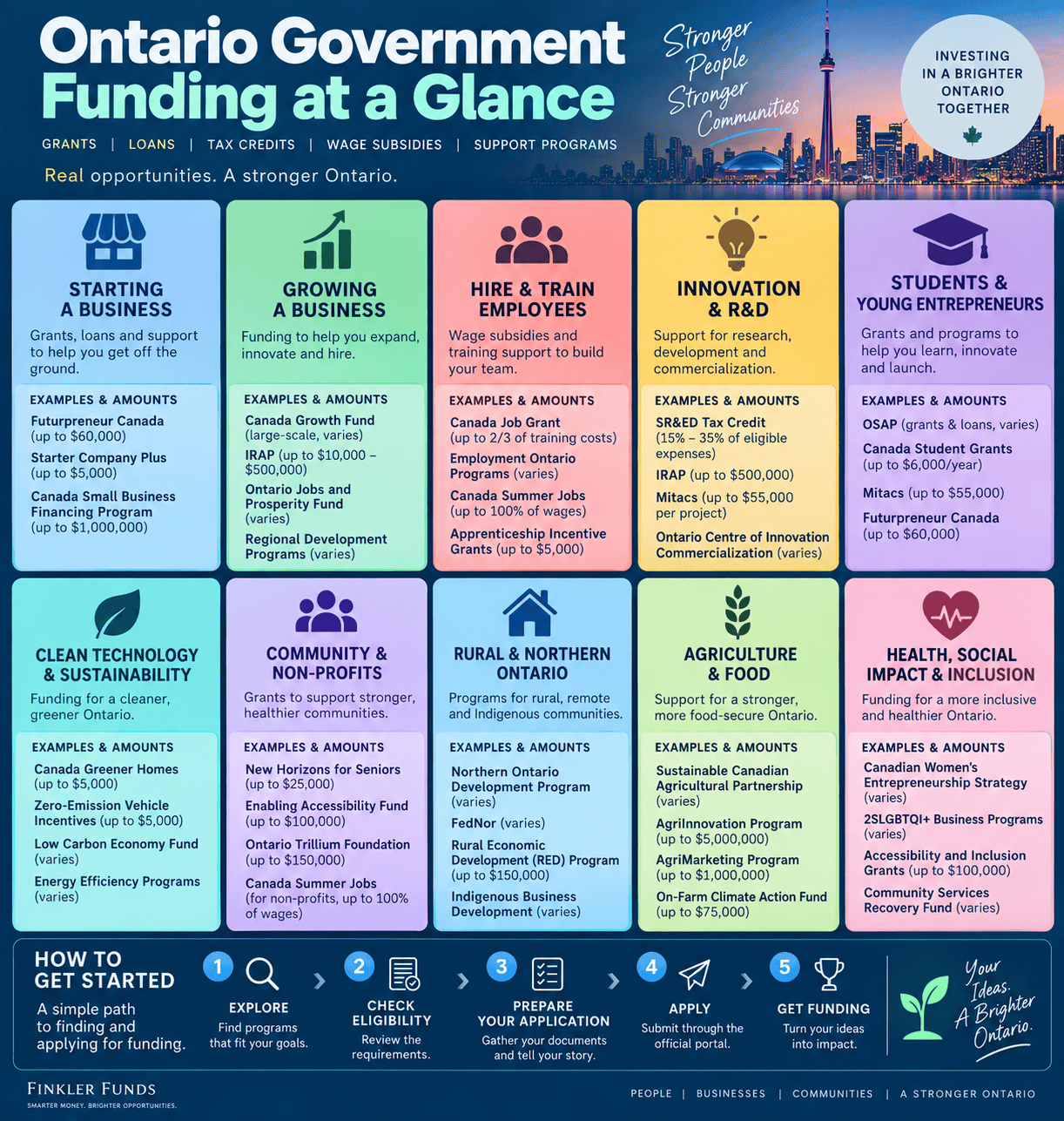
A Quick “Where Should I Look?” Cheat Sheet
If you are overwhelmed by everything above, start with your situation rather than the name of a government department:
- Starting a business: Starter Company Plus, Futurpreneur, CSBFP, BDC and the Business Benefits Finder.
- Student entrepreneur: Summer Company plus your school’s bursaries and awards.
- Growing an established business: FedDev Ontario, BDC, Ontario Together Trade Fund and the Business Benefits Finder.
- Exporting: CanExport and the Trade Commissioner Service.
- Hiring students: Student Work Placement Program and Canada Summer Jobs.
- Training workers: Ontario Job Grant.
- Hiring apprentices: Ontario Achievement Incentive and federal apprenticeship supports.
- Developing technology: NRC IRAP and SR&ED.
- Manufacturing: Ontario Made Manufacturing Investment Tax Credit plus other productivity programs.
- Woman entrepreneur: Women Entrepreneurship Loan Fund plus normal business programs.
- Black entrepreneur: Black Entrepreneurship Loan Fund plus normal business programs.
- Indigenous entrepreneur: Indigenous business-development programs, Indigenous Financial Institutions and normal business programs.
- Farm or food business: Sustainable CAP, Advance Payments Program and Canadian Agricultural Loans Act financing.
- Nonprofit/community group: Ontario Trillium Foundation, TPON and ESDC funding calls.
- Youth community idea: Canada Service Corps micro-grants.
- Retraining: Better Jobs Ontario.
- College or university: OSAP and Canada Student Grants plus institution-specific awards.
- Apprenticeship: Canada Apprentice Loan and Employment Ontario supports.
- Home energy upgrades: Home Renovation Savings Program.
- Family benefits: Canada Benefits Finder, Canada Child Benefit and Ontario Trillium Benefit.
- Lower-income worker: Canada Workers Benefit.
- No dental insurance: Canadian Dental Care Plan.
- Saving for a child’s education: CESG and Canada Learning Bond.
- Eligible for the Disability Tax Credit: RDSP, Canada Disability Savings Grant and Canada Disability Savings Bond.
You will notice that the answer is rarely one program. The person who receives the most value is often the person who understands how their circumstances overlap: a 28-year-old Ontario entrepreneur developing innovative technology and hiring a co-op student could potentially be looking at youth entrepreneurship financing, a student wage subsidy, SR&ED tax credits, Ontario R&D incentives, NRC IRAP and general small-business financing at the same time. Eligibility for one does not automatically mean eligibility for the others, but that is why running the full search matters.
The “Free Money” Myth Can Cost You Money Too
There is a strange irony surrounding government funding. Some people assume government hands out money to anybody who asks, while other people assume grants are practically mythical and never bother applying at all. Both views can be expensive.
There is real money available, and some of it genuinely does not have to be repaid. But the money usually exists because government is trying to produce a particular result: create jobs, increase exports, develop technology, train workers, build affordable housing, strengthen communities, improve accessibility, save energy or help somebody complete an education. Your chances improve enormously when your project already advances the objective the program was designed to support.
Do not invent a $100,000 project because you found a $50,000 grant. Start with something useful that you were genuinely considering, then ask whether government assistance can make that project cheaper, faster or larger. Spending $50,000 you never intended to spend just to receive $25,000 from government is not a financial victory.
The Biggest Mistake Is Assuming You Will Not Qualify
A surprising number of these programs exist for circumstances people would not immediately associate with government funding. A teenager can receive money to test a summer business. A young person can receive several thousand dollars to run a community-service project. A homeowner can receive thousands toward a heat pump or solar system. A low-income family can receive education money without contributing anything to an RESP, and an eligible person with a disability can potentially receive substantial government contributions through an RDSP.
An employer can be subsidized for training workers, hiring students or sponsoring apprentices. A manufacturer can receive millions in tax support for qualifying investments. A small technology company may be eligible for both federal and Ontario research incentives. A nonprofit can receive six figures to expand a community service that already works.
You should not interpret those examples as a promise that money is waiting for everyone. The lesson is the opposite: eligibility is specific enough that you should stop guessing and actually check.
Final Thoughts: Search Before You Spend
The most important habit this page can create is remarkably simple. Before paying the full cost of something significant — starting a business, hiring an employee, training your staff, exporting a product, developing technology, going back to school, renovating a building or launching a community project — spend 15 minutes checking whether a legitimate government program overlaps with what you are about to do.
Sometimes the answer will be no. Sometimes you will find a program but discover that your business is too young, your project is too small, your income is too high or the application period just closed. That is normal, and it is still better than structuring your finances around imaginary “free money.”
But every once in a while, that search may uncover $3,000 to help a student start a business, $5,000 toward a startup, $5,000 for a student employee, $10,000 for worker training, tens of thousands toward exporting or innovation, a six-figure community grant, a substantial tax credit or financing that allows a business project to happen years sooner than it otherwise could.
And those opportunities are easy to miss if nobody tells you they exist.
The best place to start is not a Facebook post claiming that “Canadians can get $50,000 from the government.” It is the government’s own databases. Run the Business Benefits Finder. Run the Canada Benefits Finder. Check Ontario’s live funding portal. Bookmark the programs that match your situation, put the recurring ones on your calendar and apply when there is a genuine fit.
You already pay into the system.
At the very least, it is worth finding out which parts of it were designed to help someone in your situation.