
Sole Proprietorship in Ontario: Benefits, Taxes, Write-Offs, and When to Incorporate
You sell your first handmade item, land a freelance client, or get paid to do a job using skills you already have. The money feels good, but a few questions follow close behind: Does this count as a business? Do you need to register something, charge HST, or put “Inc.” after your name? Starting a business in Ontario can be fairly straightforward once you understand which rules apply to what you are doing.
A sole proprietorship is often a practical starting point because it gives one person a simple way to own and operate a business. You can build a brand, serve customers, and earn business income without creating a corporation. The catch is that the business and its owner share a legal identity, which affects both taxes and financial responsibility. Understanding that relationship makes the rest of the decisions much easier.
The figures below apply to Ontario and the 2026 tax year, with information checked in October 2026. All dollar amounts are Canadian dollars. Examples use simplified assumptions to explain the rules, rather than calculate a particular reader’s final tax bill. Keep the tax year in mind when returning to these tables in the future.
What a sole proprietorship means in everyday life
A sole proprietorship is an unincorporated business owned by one individual. Imagine Maya, who starts making custom shelves and selling them under the name Maple Bench Woodworking. Maya owns the business, makes its decisions, receives its profits, and is personally responsible for its obligations. Registering Maple Bench Woodworking gives her a registered business name, but it does not create a second legal person separate from Maya.
The word “sole” refers to ownership, so a sole proprietor can still hire employees. However, if someone else becomes a co-owner, the arrangement needs a different structure, such as a partnership or corporation. A corporation, meanwhile, can have just one shareholder; incorporation does not require a team of owners. Ownership structure and the number of people doing the work are different questions.

Why a sole proprietorship appeals to small business owners
For someone testing a service or building a side business, simplicity has real value. Ontario business-name registration currently costs $60 when filed directly with the government, and the owner does not need to create a corporation simply to start trading. Business income and expenses generally flow into the owner’s personal tax return, rather than a separate corporate income-tax return. That can leave fewer administrative tasks competing with the work of finding customers and delivering a good product.
You also keep control over pricing, scheduling, purchases, and the direction of the business. Qualifying expenses reduce business profit, and a genuine allowable business loss can generally reduce other income in your personal tax calculation, subject to the applicable rules. Corporations can claim business expenses too, so deductions are not an exclusive reward for choosing a sole proprietorship. The advantage is having a relatively straightforward structure while you establish whether the business works.
The main drawback deserves just as much attention as the low setup cost. If the business owes money or faces a valid claim, the owner’s personal assets can be exposed because the business has no separate legal identity. Consider the risks of the work you perform, the contracts you sign, and the insurance available for those risks when choosing a structure. A business with significant borrowing or potential claims may have different needs from a small freelance operation.
Sole proprietorship, partnership, and corporation compared
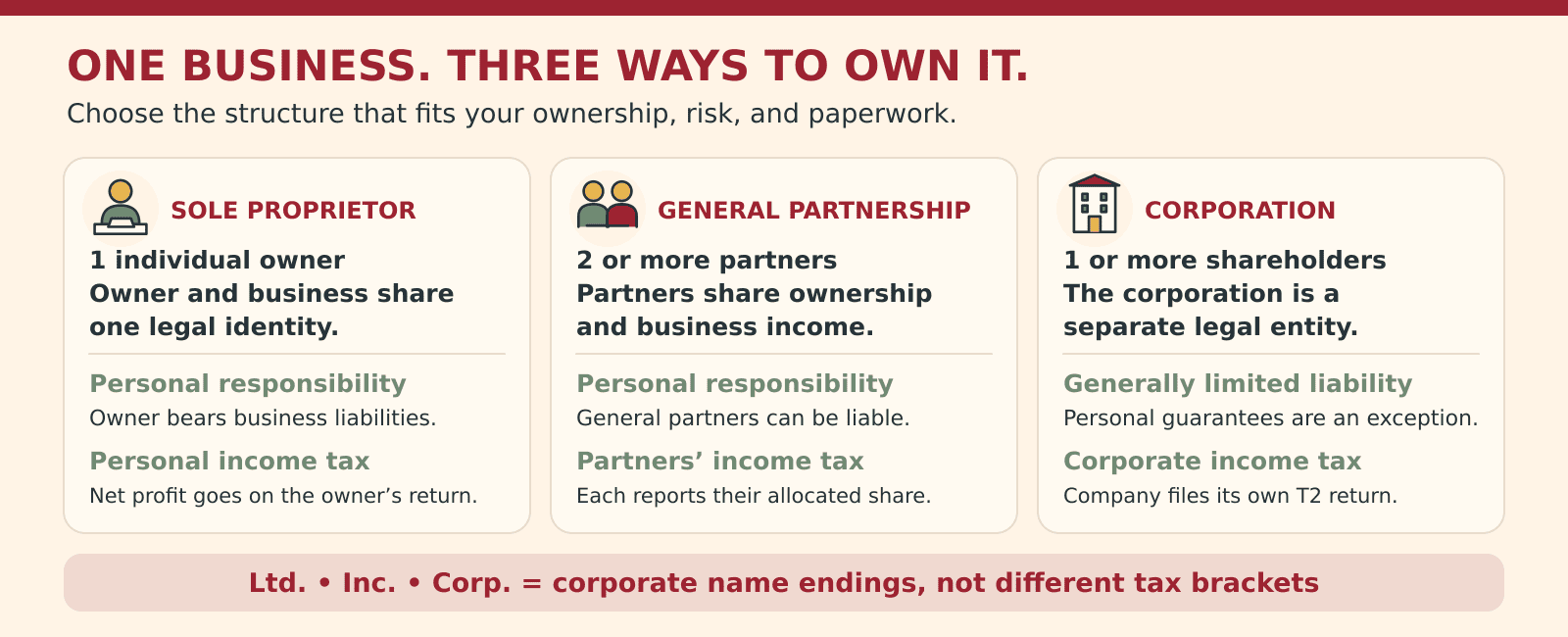
Most beginners are choosing among three familiar structures: sole proprietorship, partnership, and corporation. A general partnership involves two or more parties carrying on business together, with profits or losses generally allocated to the partners. A corporation is a separate legal entity that can own property and enter contracts in its own name. The differences matter more than how impressive a business name sounds.
| Feature | Sole proprietorship | General partnership | Corporation |
|---|---|---|---|
| Ownership | One individual | Two or more partners | One or more shareholders |
| Separate legal identity | Owner and business are the same legal person | Generally not separate from its partners | Separate legal entity |
| Income tax | Owner reports net business income personally | Partners report their allocated shares | Corporation files its own T2 return; owners report personal income received |
| Personal responsibility | Owner bears business liabilities | General partners can bear personal liability | Shareholders generally have limited liability, with exceptions |
| Practical appeal | Simple ownership and administration | Shared ownership and resources | Liability separation, share ownership, and continuity |
A written partnership agreement is a sensible step when two people go into business together. It can address who contributes money, who does which work, how profits are divided, and what happens if one partner wants to leave. Specialized arrangements such as limited partnerships and limited liability partnerships have their own rules. In Ontario, LLPs are restricted to qualifying regulated professions, so “LLP” is not a general shortcut available to any two friends starting a business.
What Limited, Inc., Corp., and numbered companies mean
In a Canadian business corporation’s name, “Limited” or “Ltd.,” “Incorporated” or “Inc.,” and “Corporation” or “Corp.” are alternative legal endings. They identify the business as incorporated; choosing one does not create a different tax bracket or indicate a larger company. Maple Bench Woodworking Inc. could be owned entirely by Maya. A sole proprietor cannot simply add “Inc.” or “Ltd.” to a business name and acquire corporate status.
“Limited” relates to the shareholders’ generally limited responsibility for the corporation’s debts. That protection has exceptions, including a loan the owner personally guarantees and certain liabilities directors can face for unpaid tax remittances. A lender’s personal-guarantee clause can therefore matter more than the ending on your letterhead. Incorporation provides a legal distinction, but the contracts and obligations behind it still need attention.
A numbered corporation is the same basic corporate structure with an assigned legal name, such as 12345678 Canada Inc. It can register an operating name that customers recognize, while using its proper legal identity on contracts and invoices. The number in that legal name is different from a CRA tax-account number. A numbered name offers a straightforward naming option without requiring the owner to make the number their public brand.
You may also encounter “LLC” in American business advice. An Ontario corporation using “Ltd.” is not the same legal structure as a U.S. limited liability company, and Ontario does not offer a domestic LLC formation route. An LLC formed elsewhere must register its company name under Ontario’s rules before carrying on business here. Use Ontario and Canadian guidance when choosing your structure, since U.S. business labels and tax elections do not map neatly onto Canadian rules.

How to register a sole proprietorship in Ontario
Start by deciding whether you will trade under your full individual name or another business name. Operating as “Maya Patel” generally does not require business-name registration under Ontario’s Business Names Act, while “Maya Patel Woodworking” or “Maple Bench Woodworking” does. The requirement is about the name you use, rather than waiting to earn a certain amount of money. Tax reporting and any necessary licences still apply when you operate under your own name.
For a different business name, begin at the official Ontario Business Registry and select the sole-proprietorship registration option. The online process uses an Ontario.ca Login and Ontario Business Account. Have your proposed name, contact details, business email, principal business address, owner information, and payment ready. You will also select a NAICS code describing your main business activity; it is an industry classification, rather than a professional qualification.
Search existing business names and consider whether your proposed name could be confused with another business or trademark before paying to register it. Ontario business-name registration does not give you exclusive ownership of the name, and registering an available domain name does not settle trademark rights. Once registered, retain the certificate, receipt, and registry information, and keep the company key confidential because it authorizes registry access. The registration lasts five years, so put its renewal date somewhere you will actually notice it. Keep registered information current, too: changes such as business addresses generally require an amended registration within 15 days.
The $60 government fee covers the registration itself, rather than every cost of starting the business. Banking, insurance, equipment, professional advice, or activity-specific permits may add to your budget. A private registration service may also charge a service fee above the government amount. For a straightforward registration, using the official government route gives you a clear view of what you are paying for.
Ontario registration and federal tax accounts are different
You do not need to incorporate federally to operate a legitimate sole proprietorship. Provincial business registration and federal tax administration serve different purposes, and neither is a general certificate proving expertise in your trade. A CRA Business Number identifies a business or legal entity, with relevant program accounts added to it. CRA says Ontario registration can issue that federal number as part of the provincial process, so check what you already received before applying for another number.
| Term | What it means |
|---|---|
| Ontario BIN | Business Identification Number associated with an Ontario business-name registration |
| CRA BN | Nine-digit federal Business Number used for CRA program accounts |
| GST/HST account | A tax program account attached to the BN, commonly shown as the BN followed by RT0001 |
| Ontario OCN | Ontario Corporation Number identifying a corporation in the provincial registry |
| Company key | Registry access credential used to manage Ontario filings |
| NAICS code | Classification describing the business’s primary activity |
Having an Ontario BIN does not, by itself, mean you are registered to collect HST. You may need a GST/HST account, a payroll account if you hire employees, or other accounts depending on your activities. An unincorporated business that does not need CRA program accounts may not need to obtain a BN separately. None of this removes the obligation to report taxable business income on your personal return.
Federal incorporation is a separate decision that creates a corporation under federal law. It can provide a Canada-wide right to use an approved corporate word name, although name approval is not trademark registration or a guarantee against every prior right. A federal corporation must still meet applicable provincial registration requirements where it carries on business. Provincial incorporation also does not automatically confine a business’s customers to that province; requirements in the places where it operates still matter.
Do you need a certification, licence, or permit?
There is no general examination or professional certification you must pass simply to become a sole proprietor. The requirements come from what you do and where you do it. Regulated trades, professional services, food businesses, and other activities may require qualifications, licences, inspections, or permits. Your legal structure does not replace those requirements.
Use BizPaL and your municipality’s business resources to check the federal, provincial, and local requirements relevant to your activities. For a home business, check zoning and any rules affecting customer visits, signage, storage, or production. Review insurance suited to the work and property involved, especially if customers rely on your advice or you work at their premises. A registered name, appropriate permissions, and suitable insurance each solve a different problem.
How a sole proprietor pays income tax
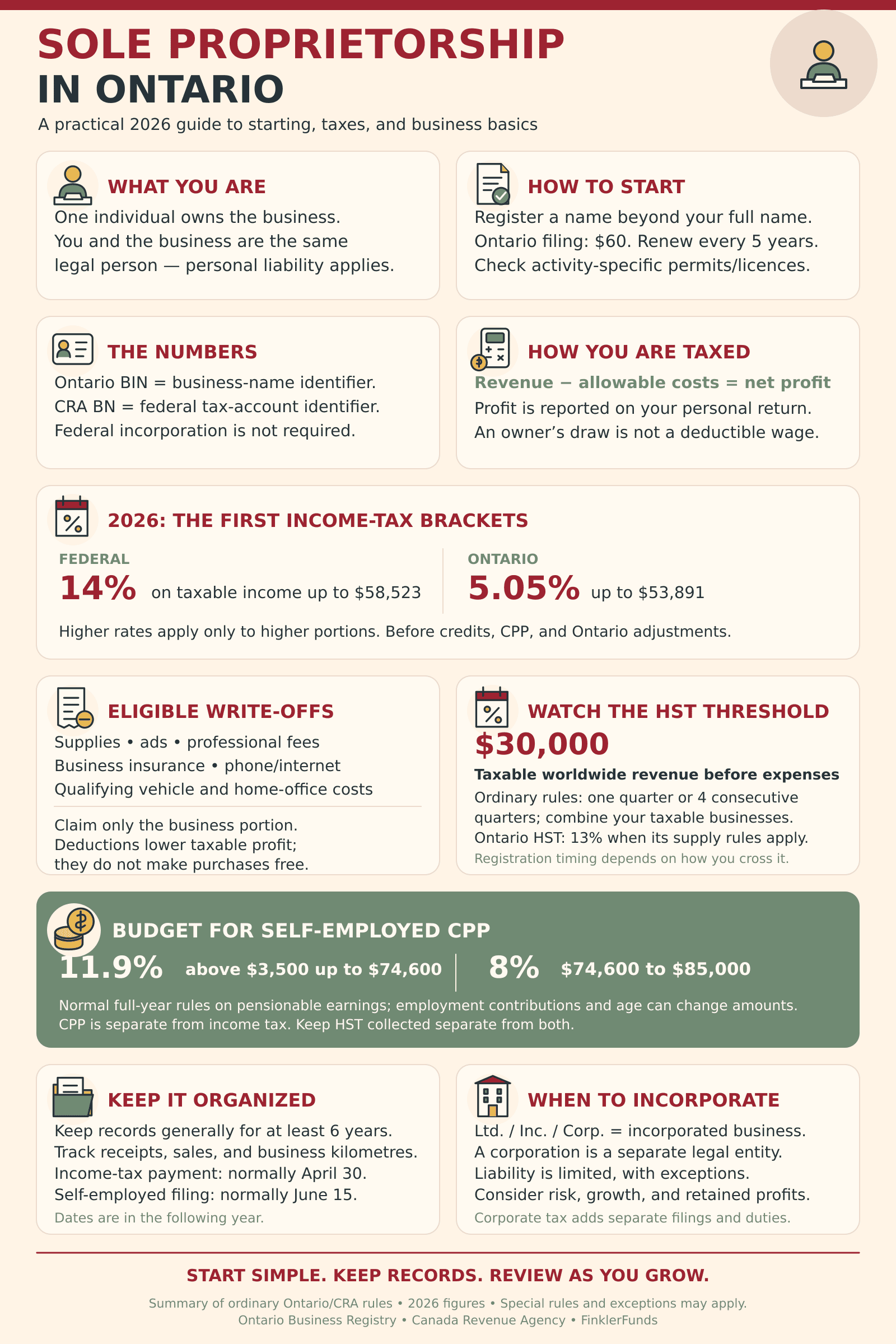
The starting point is business profit: revenue minus allowable business costs. Suppose Maya earns $40,000 in sales and has $8,000 in deductible operating costs, with no other business adjustments. Her business profit is $32,000 before personal-return deductions and credits. That $32,000 enters her personal tax calculation, generally through Form T2125 filed with her T1 return.
Money transferred from the business account to the owner’s personal account is called an owner’s draw. It does not reduce business profit like an employee’s wage would, and the owner cannot deduct a salary paid to themselves. Leaving profit in a sole-proprietorship bank account also does not postpone personal income tax on it. The tax calculation follows the business’s net income, rather than how much the owner withdraws.
For 2026, federal and Ontario income tax apply using separate sets of brackets. Each percentage applies only to the portion of taxable income within its bracket. At $60,000 of taxable income, for example, only the $1,477 above the federal $58,523 threshold falls into the 20.5% federal bracket. Your earlier dollars remain in the lower bracket.
| Federal taxable-income portion for 2026 | Rate |
|---|---|
| Up to $58,523 | 14% |
| Over $58,523 to $117,045 | 20.5% |
| Over $117,045 to $181,440 | 26% |
| Over $181,440 to $258,482 | 29% |
| Over $258,482 | 33% |
| Ontario taxable-income portion for 2026 | Rate |
|---|---|
| Up to $53,891 | 5.05% |
| Over $53,891 to $107,785 | 9.15% |
| Over $107,785 to $150,000 | 11.16% |
| Over $150,000 to $220,000 | 12.16% |
| Over $220,000 | 13.16% |
These tables describe income-tax rates before the full calculation of credits and other adjustments. Basic personal tax credits can reduce tax payable, while Ontario’s health premium can add up to $900 depending on taxable income. Ontario also applies a surtax once basic provincial tax exceeds specified thresholds, so adding two headline bracket rates will not always give the complete marginal rate. Your final bill also depends on factors such as deductions, credits, other income, and payments already made.
If you have a regular job, the business does not receive a separate set of low personal tax brackets. For example, $40,000 of employment income and $10,000 of net business income contribute to the same personal income calculation before other adjustments. In this simplified example, the extra business profit falls within the lowest federal and Ontario brackets, whose rates total 19.05%, before considering other effects. Someone with a higher-paying job could face a higher marginal income-tax rate on the same side-business profit.
Remember CPP when planning what to set aside
Self-employed people generally pay both the employee and employer portions of Canada Pension Plan contributions. For 2026, the combined rate is 11.9% on pensionable self-employment earnings above the $3,500 basic exemption, up to the $74,600 first earnings ceiling. An additional 8% CPP2 contribution applies to earnings between $74,600 and $85,000. These contributions are separate from income tax, which is why using only a tax-bracket percentage can leave you short.
Using Maya’s $32,000 profit, assume she has no employment income and is subject to normal full-year CPP rules. The simplified CPP calculation is ($32,000 minus $3,500) multiplied by 11.9%, which equals $3,391.50. Employment contributions, age-related rules, and other circumstances can change the final calculation, and parts of CPP receive deduction or credit treatment on the tax return. Plan for income tax and CPP together, and keep any HST collected in a separate category from both.
What you can write off and what that actually saves
A deductible business expense reduces the income on which tax is calculated. It does not make the purchase free or guarantee a refund of its price. For a simple income-tax-only illustration, if a fully deductible $1,000 expense reduces income taxed at an assumed 30% marginal rate, the tax saving is $300. You have still spent $1,000 and are $700 out of pocket after that saving, ignoring HST, CPP, and other effects.
CRA generally allows reasonable current expenses incurred to earn business income, with only the business portion claimed when something also has a personal use. A phone used for both customer calls and family life needs a supportable allocation. Buying something through a business account does not establish deductibility on its own. Keep the receipt and a clear explanation of how the purchase relates to earning business income. If you recover GST/HST through an input tax credit, exclude that recovered amount from the expense deducted for income-tax purposes.
| Expense area | Potential claim and key condition |
|---|---|
| Materials and supplies | Business supplies and applicable cost-of-goods-sold amounts; inventory rules matter |
| Advertising and online services | Qualifying advertising, hosting, and ongoing services used for the business |
| Professional and financial costs | Eligible accounting, legal, banking, and processing fees |
| Insurance | Qualifying business coverage |
| Phone and internet | Reasonable business-use portion |
| Vehicle use | Eligible actual costs allocated to business travel |
| Home workspace | Eligible portion, subject to the home-business rules |
| Equipment and other lasting assets | May require capital-cost-allowance treatment |
Vehicle deductions are especially useful to understand before your first busy season. Keep records of total kilometres, business kilometres, and the date, destination, purpose, and distance of each business trip. If supported records show 8,000 business kilometres out of 20,000 total kilometres, the business-use share is 40%. Apply that share to eligible actual vehicle expenses, subject to the applicable limits; do not automatically substitute the employee kilometre-allowance rate for a sole proprietor’s own vehicle claim.
A home workspace can qualify if it is your principal place of business, or if it is used exclusively to earn business income and regularly to meet clients, customers, or patients. Allocate eligible expenses reasonably by space, with a time adjustment for shared personal use; mortgage interest and principal are different, and principal is not a home-office expense. These deductions cannot create or increase a business loss, although unused qualifying amounts may carry forward. Claiming CCA on part of your home can affect its tax treatment when sold, so check those consequences before doing it.
Equipment needs a little more care than everyday supplies. A lasting asset such as a computer, machine, or vehicle may fall under capital cost allowance, or CCA, rather than ordinary operating-expense treatment. The deductible amount in the first year depends on the asset, its business use, and the rules that apply, including any eligible enhanced allowances. Avoid assuming that every purchase is fully deductible immediately or that every asset must follow the same slow deduction schedule.
Meals are another common source of confusion. Qualifying business meals and entertainment are generally subject to a 50% limit, with specific exceptions, while an ordinary personal lunch does not become a business expense because you ate it during work. Personal groceries, family purchases, and living expenses remain personal expenses. For a sole proprietor, paying yourself or assigning a dollar value to your own unpaid labour also does not create a deduction.
When you must register for GST and HST
Income tax and HST measure different things: income tax starts with profit, while the usual GST/HST small-supplier test uses worldwide revenue from taxable supplies before expenses. For most businesses, exceeding $30,000 in one calendar quarter or across four consecutive calendar quarters triggers registration rules. A sole proprietor combines taxable revenue across their businesses, including applicable associated-business revenue. Maya cannot treat woodworking and a second taxable business as two separate $30,000 allowances simply because they have different names. Being below that threshold also does not exempt business profit from income-tax reporting.
| How the usual $30,000 threshold is exceeded | What changes |
|---|---|
| In one calendar quarter | Charge GST/HST on the sale that takes you over; register within 29 days of that sale |
| Across four or fewer consecutive quarters, without exceeding it in one quarter | Small-supplier status ends at the end of the month following the quarter in which you exceed the threshold; required registration is effective no later than the first taxable supply after that, with registration within 29 days of the effective date |
Ontario’s HST rate is 13% when Ontario place-of-supply rules apply. For example, a $100 service subject to Ontario HST becomes a $113 invoice once you are required or voluntarily registered to charge it. The $13 is tax collected for remittance rather than an extra $13 of sales earnings. The appropriate rate for customers elsewhere depends on the supply rules, and exempt and zero-rated supplies need their own treatment.
Small suppliers making eligible taxable supplies can choose to register voluntarily. Registration can allow input tax credits for qualifying GST/HST paid on business purchases, but it also brings charging, filing, and remittance obligations. Under the usual system, those credits help determine how much collected tax you remit. Watch revenue throughout the year and compare voluntary registration’s benefits with the added administration and effect on customer pricing.
Records, filing deadlines, and keeping the money organized
Set up a habit for recording sales, saving purchase documents, and reviewing expenses from the start. CRA generally requires records for at least six years from the end of the last tax year to which they relate, and separate records for each business you run. A spreadsheet can be a workable starting point if it captures income, expenses, supporting documents, and the details needed for your claims. Keep copies you can retrieve, rather than relying on memory or a bank balance to reconstruct a year of activity.
A dedicated bank account is a practical way to make those records easier to follow. It helps separate customer payments, business purchases, tax savings, and owner withdrawals. Ask your bank what account it requires for a registered operating name, since its account terms matter too. Whatever banking arrangement you use, keep your business records clear enough to distinguish revenue, expenses, and money transferred by the owner.
Self-employed individuals normally have until June 15 of the following year to file their personal income-tax return, but an amount owing is normally due April 30. That means 2026 business income is generally reported in a return filed in 2027; filing later does not extend the payment deadline. Tax instalments can also become required when net tax owing exceeds $3,000 in the current year and either of the two previous years, under the Ontario-resident rule. Review CRA notices and your projected income instead of assuming taxes are always one annual payment.
When incorporation starts to make sense
Incorporation deserves consideration when liability exposure, shared ownership, investment, continuity, or retained profits make a separate entity useful. It brings corporate records, annual registry filings, a separate T2 income-tax return, and other obligations. The current basic government filing fee is $300 for Ontario incorporation or $200 for standard federal incorporation online, before applicable extras. The ongoing accounting and legal work belongs in the decision alongside the upfront fee.
The tax comparison requires care because a corporation and its owner are different taxpayers. Eligible Canadian-controlled private corporations can claim the federal small-business rate of 9%, generally within a $500,000 business limit that is subject to eligibility and reduction rules. Ontario reduced its qualifying small-business corporate rate from 3.2% to 2.2% effective July 1, 2026, giving a combined 11.2% rate for the post-change period. Corporate tax years spanning that date require prorating, so 11.2% is not the blanket rate for all qualifying income throughout 2026.
That lower corporate rate does not mean the owner can withdraw all the profits and personally pay only 11.2%. Salary pays you as an employee of your corporation, while a dividend distributes earnings to you as a shareholder. Each has its own tax and reporting treatment, so a corporate withdrawal is different from a sole proprietor’s draw. Keeping eligible profits in the company can defer some personal tax, leaving more money available inside the business for its plans. If you need to withdraw nearly everything for living costs, the benefit of that retention-based deferral is smaller, although other reasons to incorporate may remain.
There is also no universal income level at which every owner must incorporate. A growing business with substantial risk might consider it before a low-risk freelancer earning more money. An incorporated worker who would otherwise be a client’s employee can also fall under personal-services-business rules, which restrict deductions and deny the usual small-business tax treatment. Registering a sole proprietorship likewise does not settle whether a working relationship is employment; the actual arrangement matters.
When comparing structures, bring concrete figures to an accountant: expected profit, other personal income, how much you need to withdraw, what you plan to retain, and the cost of maintaining a corporation. Consider the contracts, financing, ownership arrangements, and liability questions with appropriate legal advice. Moving an existing business into a corporation can require new registrations, tax accounts, contracts, and careful treatment of transferred assets. You can begin with a sole proprietorship and revisit the structure as the business develops, rather than making an irreversible lifetime choice on day one.
A practical starting checklist
Before taking the next job or listing the next product, use this checklist to turn the information into action. Some items are legal requirements, while others are useful operating habits. The exact permits, insurance, and tax accounts depend on your activities. Check the ones that apply to your business and keep the results with your records.
- Choose a structure that fits the ownership and risks.
- Register the business name if it differs from your full individual name.
- Check relevant licences, professional requirements, and municipal rules.
- Confirm which Ontario and CRA identifiers and tax accounts you already have.
- Set up clear income and expense records, including mileage where relevant.
- Monitor combined taxable revenue for GST/HST registration.
- Plan cash reserves for income tax, CPP, and any HST collected.
- Review profit, cash needs, insurance, and the business structure as the work grows.
Getting the structure right is part of building a business you can manage with confidence. A sole proprietorship can provide a straightforward way to begin, provided you understand the personal responsibility that comes with it. Keep the records, price the work to cover its real costs, and review the numbers regularly. Those habits will serve you whether the business remains a one-person operation or eventually becomes a corporation.