
From a $200 Tool to Side-Hustle Income: How to Find Your First 10 Customers
Buying the equipment is usually the easy part. You spend a few hundred dollars on a pressure washer, buy a headlight-restoration kit and polisher, pick up a carpet cleaner, or realize that the lawn mower, snowblower, trailer or tools sitting in your garage could actually be used to make money. Suddenly you have the ability to perform a service that other people either cannot do themselves or simply do not want to do.
Then comes the question that stops a lot of promising side hustles before they ever become businesses: Where do the customers come from? You can own the best pressure washer in town and still earn exactly $0 with it. A useful tool only becomes financially valuable when someone who needs the job done discovers you, trusts you enough to hire you and agrees to pay your price.
That is really what this entire business model is about. You are not simply buying equipment; you are trying to create a connection between a problem, a solution and a paying customer. Once you learn how to repeatedly make that connection, a relatively small initial investment can become something much more interesting: an income-producing asset.
The Real Investment Is Not Just the Tool
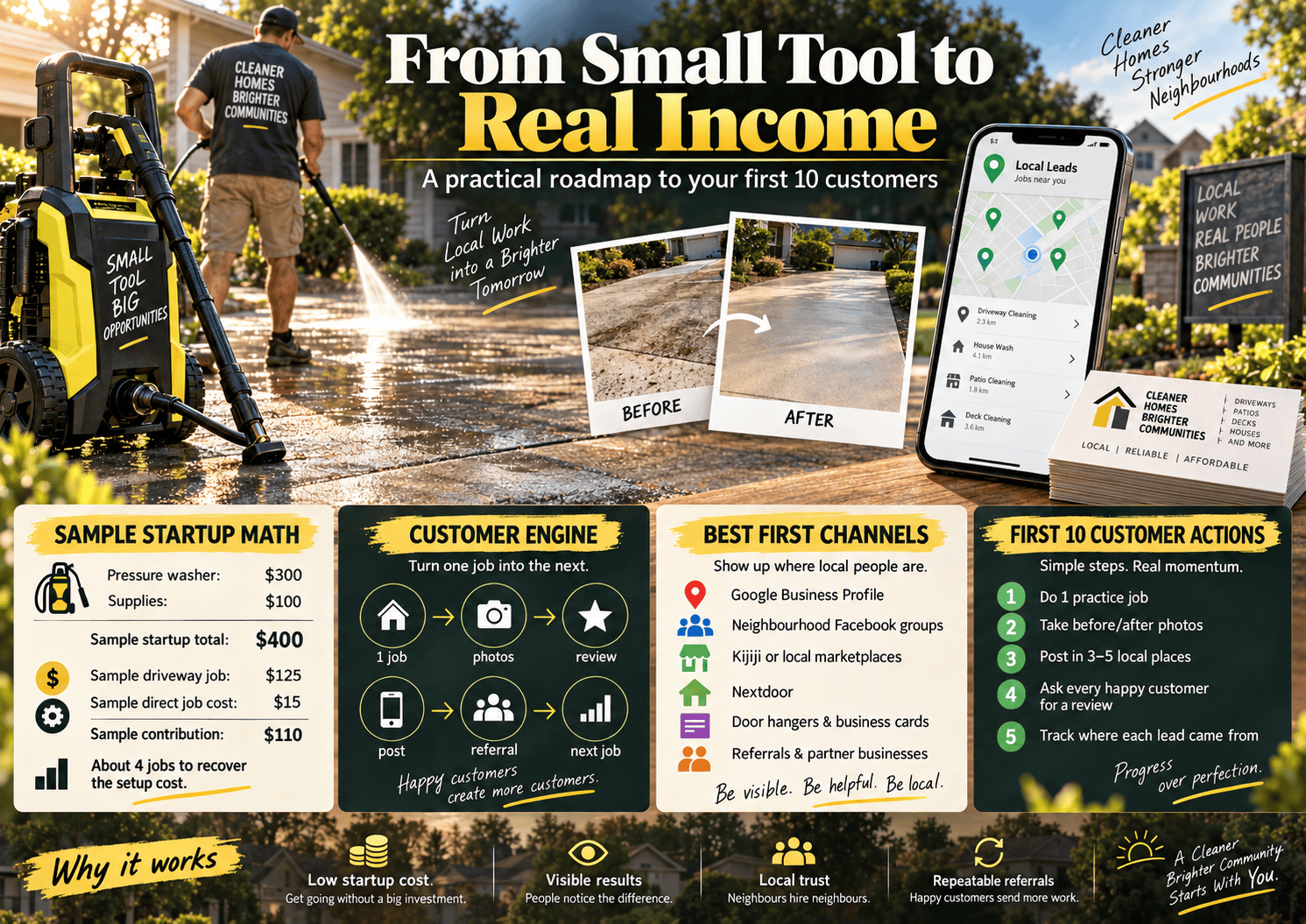
Imagine you spend $300 on a decent pressure washer and another $100 on hoses, cleaning products, fittings and basic supplies. Technically, you have spent $400 on equipment. Financially, however, you may have purchased the ability to generate hundreds or thousands of dollars of future revenue if you can consistently find people willing to pay for the service.
Suppose you charge $125 to pressure wash a driveway and your fuel, cleaning products and other direct costs average roughly $15 per job. For this simplified example, that leaves about $110 per job before taxes, insurance, equipment depreciation and other overhead. After roughly four jobs, the original $400 equipment investment has essentially been recovered, while the pressure washer remains available to produce additional jobs.
The same idea applies to many inexpensive service businesses. A $150 headlight-restoration setup could potentially pay for itself after only a handful of vehicles. A carpet cleaner, snowblower, lawn mower, detailing setup or collection of woodworking tools may already be sitting in someone’s house waiting to become productive rather than purely personal property.
The hard part is rarely understanding that the math can work. The hard part is getting customer number one.
You Do Not Really Have a Business Until Someone Pays You
Entrepreneurship can become strangely backwards. People spend weeks choosing names, designing logos, ordering shirts, creating social-media profiles and deciding which accounting software to use before anybody has ever paid them a dollar. Those things eventually matter, but they are not the first proof that a business exists.
For a tiny local service company, the first real milestone is much simpler: can you persuade a stranger to exchange money for the result you provide? Then can you do it again? Once five or ten genuine customers have paid you, you suddenly know much more about the business than you knew while designing the logo.
You learn what people are actually willing to pay, which questions they ask before hiring you, how long the work really takes and which parts of the job cost more than you expected. You also learn whether customers are happy enough to recommend you afterward. Those lessons are extremely valuable because they come from the real market rather than from assumptions.
That is why the first goal should not be to look like a huge established company. It should be to prove that demand exists.
Start With a Clear Offer, Not a Vague Advertisement
“Pressure washing available” is technically advertising, but it does not give a potential customer much reason to care. Neither does “professional headlight restoration — message for details.” The customer is still being asked to figure out exactly what you do, how much it costs, whether the service applies to them and why they should trust you.
A much stronger offer might be: Cloudy headlights? I restore both headlights for $79. Mobile service available locally, and most vehicles take about an hour. See the before-and-after photos below. Now the customer immediately understands the problem, the solution, the approximate price and the convenience.
The same principle works for pressure washing. Instead of saying “pressure-washing services,” say something closer to: Driveway pressure washing starting at $129. I bring the equipment and come to you. The offer does not need to be complicated. In fact, the simpler it is, the easier it is for someone to understand quickly.
A good small-business offer should answer four questions without forcing the customer to work for the information: What problem do you solve? What exactly does the customer receive? Roughly what will it cost? Why should the customer believe you can do it?
Your First Job Should Become Your First Advertisement
If you have never restored headlights professionally, start with your own vehicle, a family member’s car or somebody willing to let you practise. If you are starting a pressure-washing service, clean your own walkway or driveway. Treat that first practice project as though you were already working for a real customer, because the photographs and experience you gain from it may become your first serious marketing material.
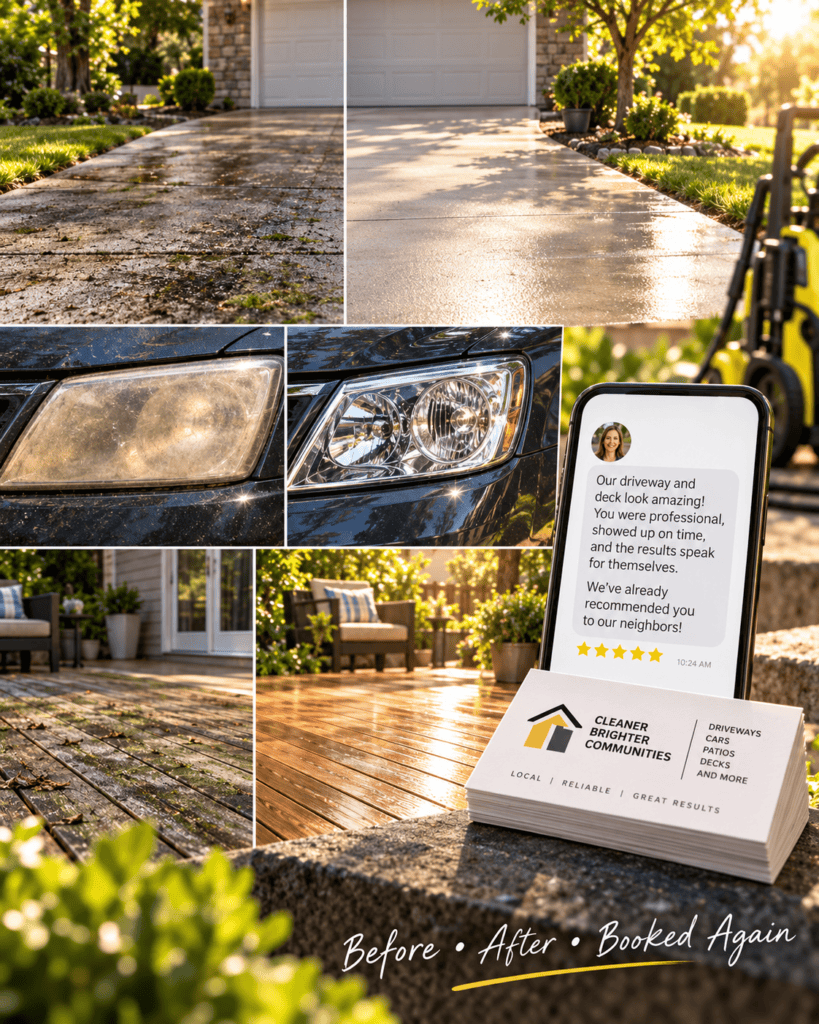
Take good before-and-after pictures. Photograph the dirty or damaged surface clearly before you begin, take a few shots during the work and then photograph the finished result from the same angles. Good lighting matters, and so does honesty; the goal is not to manipulate the picture but to make the improvement obvious.
Local service businesses have an enormous marketing advantage because many of their results are visually satisfying. Dirty concrete becomes bright. Cloudy headlights become clear. A neglected deck looks restored. An overgrown lawn becomes tidy, and a filthy vehicle interior suddenly looks respectable again.
That means every completed job can generate more than money. It can generate the marketing material that helps win the next customer.
Build a Before-and-After Machine
If your service produces a visible transformation, make that transformation the centre of your marketing. Do not merely tell people that you do high-quality work. Show them the evidence.
A 15-second pressure-washing clip in which a surface cleaner passes across filthy concrete and leaves a clean strip behind can explain your service better than a paragraph of sales copy. A photograph showing one restored headlight beside one oxidized headlight instantly demonstrates the value of what you do. The same applies to detailing, lawn care, deck cleaning, painting, landscaping and dozens of other local services.
This also gives you a simple content system. One job produces a before photograph, an after photograph, perhaps a short video, a customer review and a social post. That post may produce another customer, who then gives you another job to photograph, creating more reviews and more marketing material.
One completed job can therefore create both revenue and the advertisement for the next job. That is one of the most powerful advantages of starting a visual local service.
Google Can Become One of Your Most Valuable Assets
For many service businesses, one of the first online assets worth creating is a Google Business Profile. Google supports service-area businesses that travel to customers rather than operating from a public storefront, and qualifying businesses can define the areas they serve while keeping a residential address hidden from the public.
The reason Google matters is intent. Somebody scrolling through social media may or may not care about pressure washing, but somebody searching “pressure washing near me” is already telling you that they have a problem and are actively looking for a solution. The same is true for searches such as “headlight restoration near me,” “lawn service near me” or “mobile detailing near me.”
Your profile can gradually become more useful as the business develops. Add real photographs, list your actual services, keep the contact information accurate and encourage satisfied customers to leave honest reviews. Over time, those photos and reviews create something you did not possess when you started: visible local credibility.
That credibility becomes an asset of its own.
Use Local Marketplaces Without Depending on Them Completely
Classified marketplaces can still be useful for finding early customers because the audience is already accustomed to buying things and hiring people locally. In Canada, platforms such as Kijiji continue to carry service listings, and similar local marketplaces exist in many regions. The goal is not necessarily to make one platform the entire business, but to give potential customers multiple ways to discover you.
The headline of the listing should explain the offer quickly. Mobile Headlight Restoration – Clear Cloudy Headlights – $79 is much more useful than Professional Automotive Services. Driveway Pressure Washing – Before & After Photos – Local Service tells someone exactly what they are looking at before they even open the ad.
Inside the listing, get to the useful information quickly. Explain what is included, provide a price or starting price, list the area you serve, mention roughly how long the job takes and show photographs of real work. Most people searching for somebody to wash a driveway do not need to read a corporate mission statement about your commitment to excellence.
They want to know whether you can make their driveway clean, when you can come and how much it will cost.
Neighbourhood Platforms Can Be Surprisingly Powerful
Nextdoor and similar neighbourhood-focused platforms can be particularly useful for local service businesses because their audience is already organized around geographic communities. That is exactly where businesses such as pressure washing, lawn maintenance, snow removal, mobile detailing and small home services operate.
The most valuable part is often not the advertisement itself but the recommendations. Someone asks their neighbourhood, “Does anybody know someone who does pressure washing?” and several residents mention the same person. That is far more persuasive than the business owner repeatedly telling everyone how great the company is.
This is called transferred trust. A homeowner trusts a neighbour, a customer trusts a mechanic, a client trusts a realtor, and those people recommend somebody they already had a good experience with. Local businesses can grow rapidly once enough people begin introducing them instead of forcing the owner to constantly introduce the business.
Your objective is eventually to become the answer to the sentence, “Do you know someone who does that?”
Facebook Groups Can Beat a Huge Social-Media Following
You do not necessarily need 20,000 followers to launch a local business. In many cases, 2,000 people who live within a few kilometres of you are dramatically more useful.
Neighbourhood Facebook groups can put your work directly in front of the people most likely to hire you, provided the group’s rules allow promotional posts. The best posts usually do not look like screaming advertisements. They show something real.
Instead of posting “BEST PRESSURE WASHING! CALL TODAY!”, you might write that you cleaned a driveway in the neighbourhood, include an impressive before-and-after photograph and mention that you have two openings remaining that weekend. The post now contains proof, location and a specific reason to contact you.
The same strategy works for headlight restoration. Show the cloudy headlight beside the restored one, mention that you are doing a few vehicles locally on Saturday and provide the price. People can instantly decide whether the service applies to them.
Do not spam groups. Follow their rules and behave like somebody who actually lives and works in the community.
Old-Fashioned Print Marketing Still Has a Place
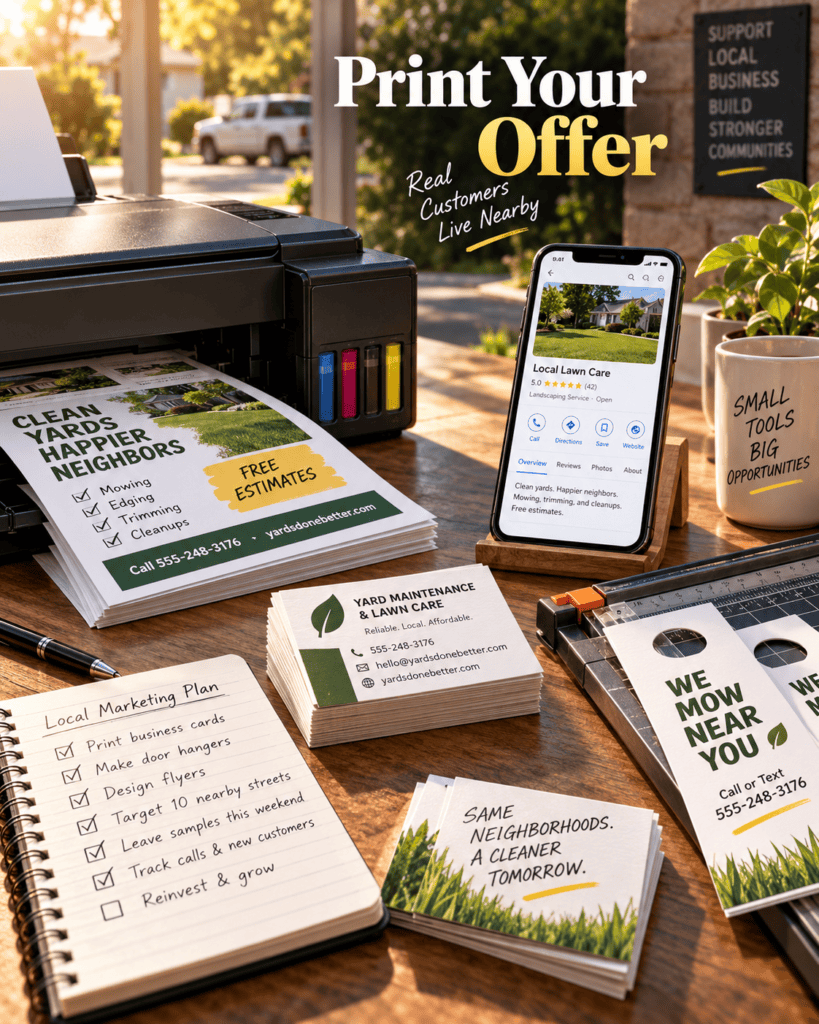
Digital marketing gets most of the attention today, but local service businesses operate in physical neighbourhoods. That means simple printed material can still make sense, especially when you can produce it cheaply yourself.
If you own an economical ink-tank printer, basic business cards, small flyers and door hangers can cost surprisingly little to produce. You can design a sheet containing several cards, print them on heavier stock and cut them yourself, or make simple quarter-page flyers containing your service, phone number, email address, website or QR code.
The important thing is not to make the material look like a miniature corporate annual report. Keep it simple. A strong before-and-after photo, a clear service, a price or starting price, your contact information and a short call to action are enough.
A printed card can also follow the customer after an in-person conversation. Somebody may not need their driveway cleaned today, but they might put the card on the fridge and call two months later.
Door Hangers Can Target the Exact Streets You Want
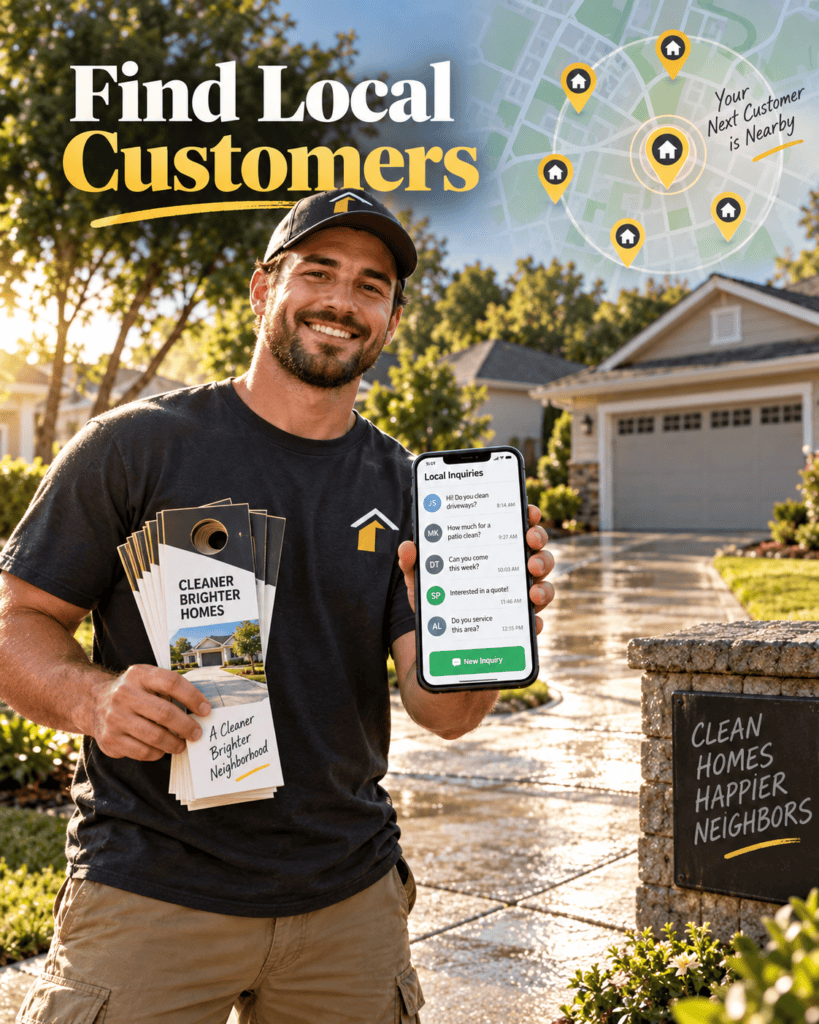
One reason printing your own marketing material can be useful is that it lets you advertise extremely locally. Instead of paying to show an online ad across an entire city, you can distribute 50 door hangers around a street where you are already working.
Imagine cleaning a driveway and then placing permitted flyers or door hangers on nearby properties. Your message can truthfully say that you are already working in the neighbourhood and are booking additional jobs nearby. That creates immediate relevance.
The economics can also be attractive if you print cheaply. Even if only one person out of dozens contacts you, a single $125 or $200 job can pay for a large amount of printed material. The key is to track what happens rather than assume that printing thousands of flyers automatically produces customers.
Whenever possible, include a unique QR code, offer code or simply ask new customers where they heard about you. Then you can measure whether the cards are actually working.
Door Knocking Can Work Better When You Already Have Proof Nearby
Randomly knocking on doors across a city is not particularly efficient, and not everyone enjoys doing it. Door knocking becomes much more interesting when you are already working on the street.
Suppose you are pressure washing a driveway. Your truck, hoses and equipment are visible, and the neighbour can literally see you doing the work. Instead of appearing as a random salesperson, you are the person currently cleaning the house next door.
A simple conversation might be: “Hi, I’m cleaning your neighbour’s driveway today and already have the equipment set up in the area. I’m doing another property nearby afterward, so I thought I’d ask whether you’ve ever wanted yours done.” That feels completely different from an unsolicited sales pitch with no context.
You have created credibility before saying a word because your work is happening in front of them.
Your Best Next Customer May Live Beside Your Current One
This leads to one of the most valuable ideas in local service marketing: geographic density.
Suppose you complete three $125 jobs at opposite ends of a large city. You may spend hours driving, loading and unloading equipment and burning fuel between appointments. Now suppose those same three jobs are located on one street.
The revenue is identical, but the economics are much better. Less travel means more productive working time, less fuel and the possibility of completing more jobs in the same day.
That is why marketing around existing customers is so valuable. A completed job becomes a geographic anchor. Nearby homeowners see the work, neighbours talk to each other and your travel costs decline if another person on the same street hires you.
You should not only ask, “How do I get more customers?” You should also ask, “How do I get more customers near the ones I already have?”
Ask for the Review While the Customer Is Happy
The best time to ask for a review is usually immediately after the customer sees the finished result. The driveway looks dramatically cleaner, the headlights look clear again or the yard finally looks maintained, and the customer is standing there saying how good it looks.
That is the moment to ask politely. Tell them you are growing the business and that an honest Google review would help other local customers find you. Make the process easy by sending a direct link rather than expecting them to search for your profile later.
Reviews reduce one of the biggest obstacles facing a new business: uncertainty. At the beginning, a potential customer sees an unknown person claiming to provide a service. After 25 good reviews, that same customer sees evidence that dozens of other people already hired you and were satisfied.
The work did not necessarily change. The perceived risk did.
Referrals Can Become Your Cheapest Source of Customers
A satisfied customer already knows several things that a stranger does not. They know you actually showed up, know you completed the job and know whether the result matched what you promised.
That makes a referral incredibly powerful. You can simply ask happy customers to mention you to neighbours and friends, or you can create a small referral incentive. A pressure-washing company might offer a small discount on a future service, while another business might provide an inexpensive add-on rather than cash.
You do not need a complicated referral program with points, dashboards and membership tiers. The important thing is to make it natural and easy for a satisfied customer to recommend you.
As the business grows, referrals can begin replacing some of the effort you originally spent hunting for customers manually.
Partner With Businesses That Already Know Your Customers
Another powerful strategy is finding companies that already interact with the exact people you want to reach.
A headlight-restoration business might build relationships with independent mechanics, auto detailers, used-car dealers or tire shops. A pressure-washing business might talk to realtors, landscapers, painters, window cleaners, deck builders and property managers. Roof-related services might connect with roofing contractors, gutter cleaners, home inspectors or real-estate professionals.
The pitch does not need to be complicated. Introduce yourself, show examples of your work, explain the service clearly and ask whether they ever encounter customers who need it.
You are trying to become the person they think about when a client says, “Do you know anybody who can take care of this?”
The phrase “I know a guy” has launched a lot of small businesses.
Do Not Spend Heavily on Advertising Before You Know What Works
Paid advertising can be extremely effective, but it can also become a fast way to turn your money into Google or Meta’s money.
Suppose you have never performed a paid headlight-restoration job. You do not know whether customers will pay $60, $80 or $120. You do not know how long the service takes, which questions people ask before buying or what type of photograph actually makes them contact you.
That is not the ideal moment to spend $1,000 on advertising.
Find the first few customers manually. Learn what people respond to, collect photographs, gather reviews and refine the offer. Once you know that strangers are willing to pay you and you know what a profitable job looks like, paid advertising becomes much less speculative.
Ads work best when they amplify something that already works.
Understand Customer Acquisition Cost
This is where local marketing becomes serious finance.
Suppose you spend $100 on advertising and receive five paying customers. Your customer acquisition cost, often abbreviated as CAC, is $20 per paying customer.
If each customer pays $150 and contributes $100 after direct job expenses, spending $20 to acquire a customer may be extremely attractive. You have effectively spent $20 to create $100 of contribution before overhead and taxes.
Now imagine spending the same $100 but receiving only one $75 job. You spent $100 to acquire $75 of revenue. That advertising campaign did not work, regardless of how many clicks, likes or impressions the ad received.
This is why the most important advertising metric is not how much attention you received. It is how much it cost to create an actual paying customer.
Start Paid Advertising With Small Experiments
Once your service, pricing and sales process have been tested, paid advertising can help expand the business. Google Search Ads can be useful because they reach people already searching for a service, while Facebook and Instagram can be strong channels for visually dramatic work such as pressure washing, detailing and restoration.
Start with small tests rather than making a giant commitment. Spend $50 or $100 and measure how many genuine inquiries appear, how many become bookings and how much profit those bookings create. If the economics are attractive, increase the budget gradually.
If the campaign produces nothing but clicks, low-quality messages and people demanding impossible discounts, stop. Do not continue spending money simply because you already spent money.
Marketing should be treated like an experiment, not a slot machine.
The First Customers Are the Hardest Because You Start With Nothing
Customer number one sees a business with no reviews, almost no photographs and no reputation. Customer number 50 sees something completely different.
By then, you may have dozens of before-and-after pictures, Google reviews, repeat customers, referrals and people around the neighbourhood who recognize your name. The actual service might be almost identical to what you offered on day one, but the amount of evidence surrounding the business has changed dramatically.
This is why the beginning feels unusually difficult. You are not merely doing the work. You are simultaneously building proof, reputation, marketing material and a customer base.
Those assets begin to reinforce each other over time. A customer generates a review, the review helps attract another customer, that customer produces another photograph and referral, and the cycle continues.
In that sense, reputation can compound.
Look Around Your Garage Before You Go Shopping
You may already own the equipment needed to start something.
A pressure washer can become an exterior-cleaning service. A carpet cleaner can become a carpet and upholstery service. A lawn mower and trimmer can become basic property maintenance, while a snowblower can produce winter driveway income. A shop vacuum and detailing supplies can support mobile vehicle cleaning, a trailer can help with hauling, and woodworking tools can support repair, construction or small custom projects.
The important question is not simply “What tools do I own?”
Ask instead: “What problem can I solve with something I already own, and would somebody pay me to solve it?”
That change in perspective can be surprisingly powerful. A possession that normally costs you money may have the ability to produce it.
Do Not Spend $5,000 Testing a $200 Idea
There is a dangerous side to the idea of investing in equipment. People can use “starting a business” as permission to buy expensive toys.
Someone decides to try pressure washing and immediately buys a commercial trailer, giant water tank, top-tier machine, professional uniforms and thousands of dollars of accessories. They now own a very impressive collection of equipment, but they still have zero customers.
A safer progression is to buy enough capability to perform the job properly, prove that customers exist and then upgrade when the business itself demonstrates a need. If your current machine becomes the factor preventing you from accepting more profitable work, buying better equipment begins to make economic sense.
The healthy progression is demand, revenue, upgrade, greater capacity.
Not equipment, more equipment, debt and hope.
Price Like a Business, Not Like Someone Looking for Pocket Money
Beginners often underprice because getting any customer feels exciting. Be careful with this.
A $75 job that seems to take one hour might actually consume three hours once you include driving, loading equipment, setup, cleanup, customer messaging, quoting and travel home. There may also be fuel, chemicals, vehicle expenses, equipment wear, advertising, insurance and taxes.
That is why the first few jobs are so valuable. Measure them carefully. Record how long they really take and what they actually cost.
Then adjust your price.
The goal is not merely to stay busy. The goal is to produce income.
Professionalism Is Part of Marketing
New businesses are asking customers to take a risk. The easiest way to reduce that risk is to behave professionally.
Use real photographs, give clear prices, answer messages properly and show up when you say you will. Explain what is included, what is not included and what results are realistic. If the work involves chemicals, heights, customer vehicles, private property or other meaningful risks, learn what insurance, licensing or safety requirements may apply where you operate.
Reliability itself can become a competitive advantage. Homeowners remember contractors who disappear, fail to return messages or never arrive when promised.
Simply being the person who answers, shows up and does what was agreed upon can generate repeat business.
Eventually, Reputation Becomes the Best Advertisement
Imagine two local companies offering essentially the same service.
Company A spends heavily every month buying attention. Few customers remember the name afterward, so the company must continue paying to find every new customer.
Company B receives repeat work, neighbourhood referrals, recommendations from complementary businesses and calls from people who discovered dozens of positive reviews and real photographs online.
Company B has built something Company A continues renting: trust.
That does not make advertising useless. It makes advertising stronger. When somebody sees the advertisement and then finds convincing evidence that real customers trust the business, the ad has much more credibility.
That is the long-term goal.
The Bigger Financial Lesson
Most personal-finance advice focuses on what to do with money after you earn it. Save more, invest consistently, reduce unnecessary spending and pay down expensive debt.
Those are all important, but there is another powerful lever: increase your ability to generate income.
A relatively inexpensive tool combined with a useful skill can create an income stream that did not exist before. If a $300 or $500 investment repeatedly allows you to solve problems people will pay $100, $200 or $500 to have solved, the tool is no longer simply something sitting in the garage.
But the tool itself is not the business.
The business is the connection between a problem, your solution, a customer and payment.
Everything else supports that connection.
Final Verdict: Buy the Capability, Then Build the Customer Machine
The mistake is thinking, “I bought the pressure washer, so now I have a pressure-washing business.” What you really have is the capability to perform pressure washing. The business begins when you learn how to repeatedly connect that capability with people willing to pay for it.
Start small, produce one excellent result and document it properly. Create a simple offer, put it where local customers are likely to see it, print inexpensive cards or flyers if they make sense, talk to neighbours, collect reviews and develop relationships with businesses that can refer customers. Track where every paying customer comes from so you can gradually concentrate your time and money on the channels that actually work.
Only after the service has proven itself should you seriously consider scaling paid advertising or buying substantially better equipment. By then, you are no longer guessing whether the business might work.
You have evidence.
That is how a $200 or $500 tool can become more than another object sitting in a garage. It can become a productive asset capable of generating income again and again.
And if the business succeeds, the most valuable thing you acquired may not have been the pressure washer, polisher or lawn mower.
It may have been the ability to find people with a problem and turn your solution into money.
Your First 10 Customers: A Concrete Checklist
If you have the equipment but no customers yet, do not overcomplicate the next step. Your goal is not to build a giant brand in the first month. Your goal is to create proof that people will pay you, then use each completed job to make the next one easier.
Use this checklist in order:
- Choose one clear service.
Do not launch five services at once. Pick one simple offer such as driveway pressure washing, headlight restoration, lawn cutting, carpet cleaning or mobile detailing. - Set a simple starting price.
Choose either one clear price or a very simple “starting at” price. Avoid complicated packages while you are still learning the job. - Do one practice job.
Use your own property, vehicle or something belonging to a friend or family member. Treat it like a real customer job. - Take strong before-and-after photos.
Get close-ups, wide shots and at least one dramatic side-by-side transformation. These become your first advertisements. - Write one clear offer.
Include the problem you solve, what is included, your service area, approximate price and how the customer contacts you. - Create your basic online presence.
Set up a Google Business Profile if appropriate, a Facebook business page and simple profiles on any local platforms you intend to use. - Post the offer in three to five local places.
Try neighbourhood Facebook groups where permitted, Kijiji Services, Nextdoor and your own social accounts. Do not just post once and disappear. - Tell people you already know.
Let friends, relatives, neighbours and coworkers know exactly what you are offering. Do not vaguely say you “started a business.” Tell them the actual service and price. - Get customer #1 and document everything.
Record how long the job took, how much you spent, what questions the customer asked and whether the price felt fair. - Ask customer #1 for a review.
If they are happy, send them the direct review link while the result is still fresh in their mind. - Market around the completed job.
Speak to nearby homeowners, leave permitted door hangers or make a neighbourhood post saying you are already working in the area. - Post the transformation.
Turn the first job into a before-and-after Facebook post, Reel, short video or local listing update. - Repeat until you reach three paying customers.
At this stage, resist the urge to spend heavily on advertising. You are still learning what people respond to. - Review your numbers after customer #3.
Calculate your average job price, direct expenses, travel time and total hours spent. Adjust your pricing if necessary. - Ask every happy customer for one referral.
Keep the request simple: “If you know anyone who needs this done, I’d really appreciate you sending them my way.” - Contact five complementary businesses.
A headlight-restoration business might contact detailers or mechanics. A pressure-washing business might contact realtors, landscapers or painters. - Get to customer #5 before making major purchases.
Do not reward yourself with expensive equipment just because the first few jobs worked. Let the business prove what it actually needs. - Improve the offer using real customer feedback.
If everyone asks the same question, put the answer in your advertising. If customers keep choosing one package, simplify around it. - Test one small paid advertisement.
Once you have real photos, reviews and a proven price, try a small $50–$100 campaign instead of making a huge advertising commitment. - Track exactly what produced customers #6 through #10.
For every booking, record whether it came from Google, Facebook, Kijiji, Nextdoor, a referral, a flyer or another source.
By the time customer #10 pays you, you should know much more than whether the service “works.” You should know which marketing channel produces serious inquiries, roughly what a customer is worth, how long the work takes, which jobs are most profitable and what people say yes to most easily.
That information is the foundation of the next stage.
Your first ten customers are not just revenue.
They are market research you got paid to conduct.