
How Government Actually Works — and Why It Matters to Your Money
Politics can look like a completely separate world from personal finance. Politicians argue in Parliament, Congress holds another hearing, a president signs an executive order, a prime minister announces a new program, and television panels spend hours debating who “won” the day. Meanwhile, most people are wondering about much more immediate things: Why are my taxes changing? Why is my mortgage so expensive? Why did that stock suddenly jump? Why does gasoline cost more? And where exactly is all this government spending coming from?
Those worlds are far more connected than they appear. Governments determine tax policy, approve hundreds of billions of dollars in spending, borrow money, regulate industries, negotiate trade agreements, impose tariffs, provide benefits and create the legal environment in which businesses operate. A change in government can affect everything from construction companies and banks to retirement accounts, housing incentives and the price of imported products.
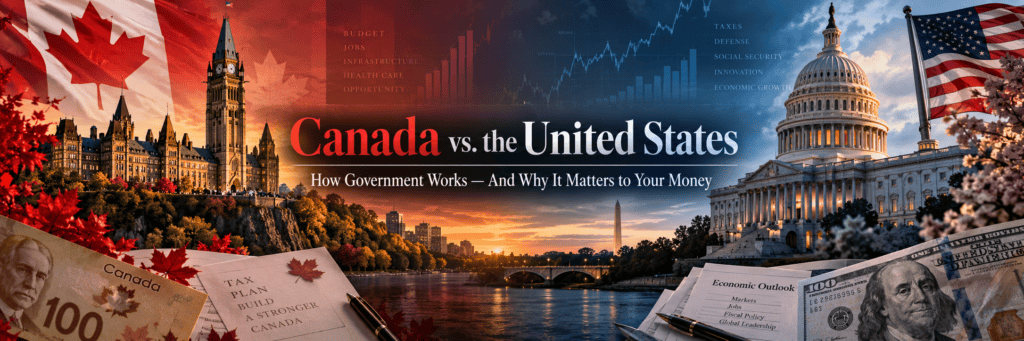
But there is another complication. Canada and the United States are neighbours with deeply connected economies, yet their political systems work very differently. Canada inherited a Westminster-style parliamentary system with a prime minister, House of Commons, appointed Senate and constitutional monarchy. The United States deliberately created a different model built around a separately elected president, Congress and a strong constitutional separation of powers.
That difference explains some things that otherwise seem bizarre. Canadians do not actually vote directly for the prime minister. An American president can remain in office even after the opposition takes control of Congress. A Canadian government can potentially fall after losing the confidence of the House of Commons. And every two years, Americans hold congressional elections — including the famous midterms — even though presidential elections happen only every four years.
Understanding the machinery makes political news dramatically easier to understand. More importantly for anyone interested in finance, it makes it easier to separate a politician announcing something from a government actually having the legal and political power to make it happen.
The two legislative chambers even look different because they grew out of different political traditions. Canada’s House of Commons follows the Westminster tradition of government and opposition facing one another, while the U.S. House of Representatives belongs to a system in which Congress and the president are institutionally separate.

Canada’s House of Commons and the U.S. House of Representatives are both elected legislative chambers, but their relationship with the executive branch is fundamentally different.
First: What Do “Government,” “Parliament” and “Congress” Actually Mean?
One reason politics seems unnecessarily confusing is that words such as government, Parliament and Congress are often thrown around as though they mean roughly the same thing. They do not.
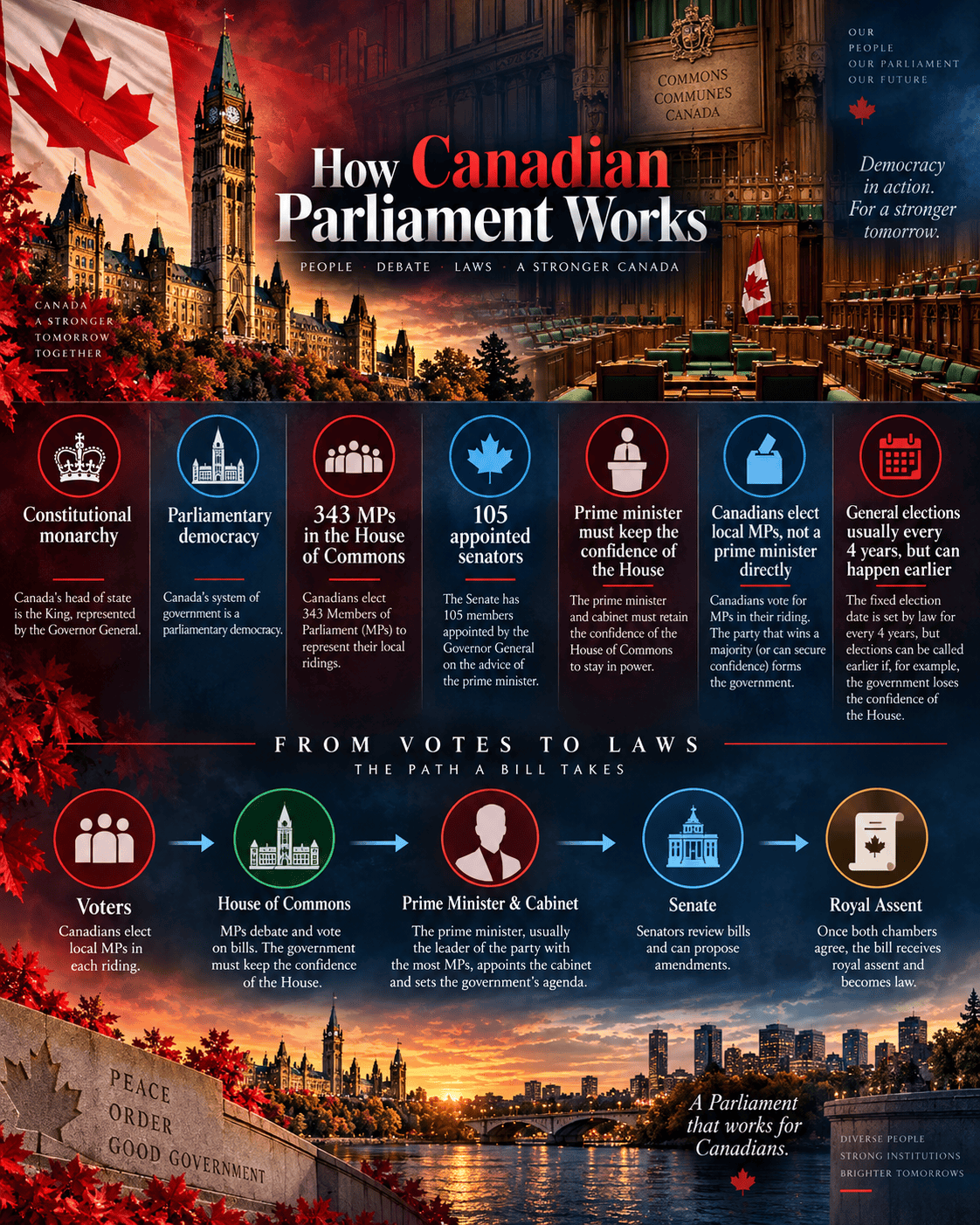
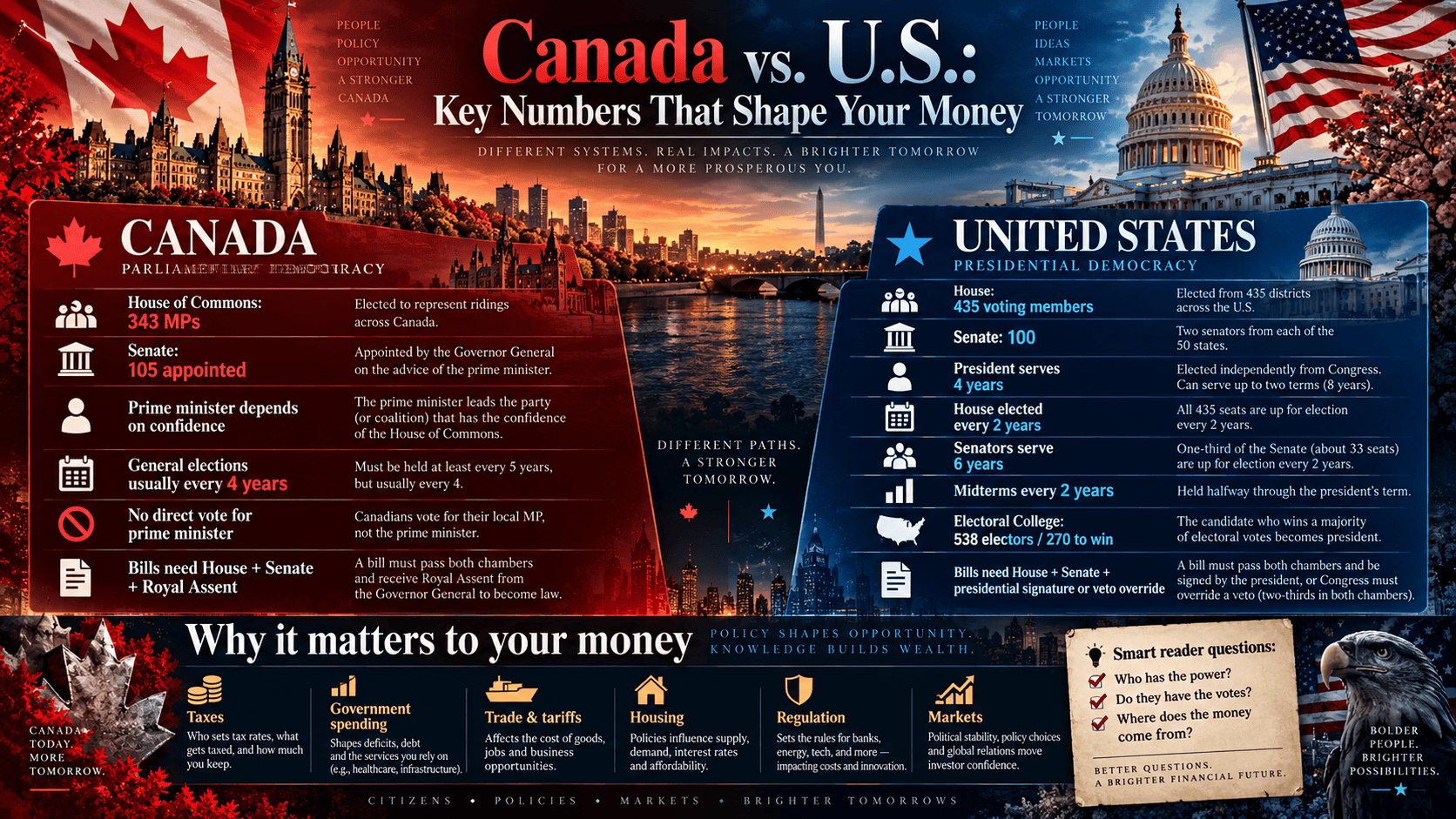
In Canada, Parliament consists of the Crown, the Senate and the House of Commons. The elected House of Commons currently contains 343 MPs, one for each federal riding, while the Senate has 105 appointed seats. The government, however, generally refers to the executive led by the prime minister and Cabinet.
In the United States, Congress is the federal legislature. It consists of the House of Representatives and the Senate. The president is not a member of Congress; the president heads a separate executive branch. The U.S. Constitution divides federal authority among the legislative, executive and judicial branches, with each possessing powers that can check the others.
That one distinction — Canada largely linking its executive government to Parliament while America separates its executive from Congress — explains a huge amount of the difference between the two countries.
How the Canadian Government Actually Works
Canada describes itself constitutionally as a federal state, parliamentary democracy and constitutional monarchy. Its parliamentary traditions grew largely out of the British Westminster model, which is why Canadian politics contains institutions and terminology that can sound strangely British: the Crown, Royal Assent, the House of Commons, a Speech from the Throne and government and opposition MPs facing one another across the chamber.
That does not mean Britain governs Canada. Canada is an independent country with its own Constitution, courts, federal division of powers and Canadian Crown. King Charles III is King of Canada and the Canadian head of state in his own constitutional capacity, while the prime minister is the head of government.
The easiest way to understand the Canadian system is to start with something many Canadians themselves occasionally overlook.
Canadians Do Not Directly Elect the Prime Minister
When Canadians vote in a federal election, the ballot lists candidates running in their local electoral district, or riding. Canada currently has 343 ridings, and each riding elects one MP to the House of Commons. The candidate receiving more votes than the other candidates wins the seat under the first-past-the-post system.
You are therefore voting directly for your local MP, not directly for the prime minister and technically not directly for a political party either. Elections Canada explicitly notes that federal electors cast ballots for local candidates rather than directly for the prime minister.
After the election, the question becomes: Who can command the confidence of the House of Commons?
Usually, the leader of the party winning the largest number of seats forms the government and becomes prime minister. But the deeper constitutional principle is confidence. If no party holds a clear majority, the governor general looks to the person most likely to enjoy the confidence of the House.
This is why simply saying Canadians “elect a prime minister” is convenient conversational shorthand but not quite accurate.
What Is a Majority Government?
A majority government exists when the governing party controls more than half of the seats in the House of Commons.
With 343 seats, a party would generally need at least 172 to hold a bare majority if all seats were filled. Because party voting in Canada can be relatively disciplined, a government with a stable Commons majority is normally in a strong position to survive votes and move much of its legislative program through the elected chamber.
That does not mean the prime minister can simply declare laws into existence. Bills still face parliamentary procedure, committee study, votes in both chambers and constitutional limits. Courts can review laws, and the Senate can scrutinize and amend legislation.
But the political arithmetic matters enormously. A prime minister backed by a dependable House majority operates in a very different environment from one who must find votes from opposition parties every time the government faces an important division.
What Is a Minority Government?
A minority government exists when the governing party does not control more than half of the Commons seats.
Now things become more interesting. The government needs sufficient support from MPs outside its own caucus — or enough abstentions — to survive important votes. Smaller parties can suddenly become highly influential because their MPs may possess enough votes to keep the government alive or help defeat it.
This is why Canadians sometimes see cooperation agreements, negotiations or compromises between parties that are otherwise political opponents. It is not necessarily friendship. It is parliamentary mathematics.
And it brings us to one of the most important differences between Canada and the United States.
What Is a Confidence Vote — and How Can a Canadian Government “Fall”?
Canada has a system of responsible government, meaning the prime minister and Cabinet must maintain the confidence of the elected House of Commons. The Privy Council Office describes executive authority as being exercised by ministers who are responsible to the House, and the House itself is where confidence in the government is tested.
If a government clearly loses the confidence of the House, it cannot simply ignore the result and continue governing indefinitely as though nothing happened. Depending on the circumstances, the prime minister may resign or seek dissolution of Parliament, potentially leading to another election. The governor general also retains constitutional responsibilities in determining who is capable of forming a government that can command confidence.
Budgets and other major financial matters are especially important because the ability to obtain money from Parliament is fundamental to governing. Historically, parliamentary control of taxation and spending is one of the foundations of responsible government itself.
This explains headlines that otherwise sound dramatic: “Government could fall over budget vote.”
In Canada, under the right circumstances, that is a genuine constitutional possibility.
If Canada Has Elections Every Four Years, How Can There Be an Early Election?
Canadian federal law provides a fixed election date generally falling in the fourth calendar year following the previous general election. But unlike an American presidential term, that date does not guarantee that Parliament must survive intact until then. Elections Canada specifically notes that the Canada Elections Act does not prevent a general election from being called earlier.
This is why Canadians sometimes hear the term snap election.
The crucial point is that the Canadian executive depends on Parliament. If the political situation makes continued government impossible, Canadians do not wait for an American-style midterm while the same Parliament carries on. The parliamentary relationship itself can be reset through a general election.
What Does the King Actually Do in Canada?
Canada is a constitutional monarchy, so the Crown remains part of the constitutional structure. King Charles III is Canada’s head of state, but the monarch does not personally manage everyday Canadian government. The governor general performs most federal constitutional functions on behalf of the Crown.
The governor general formally appoints the prime minister, swears in ministers, summons and dissolves Parliament and gives Royal Assent to legislation. In almost all normal circumstances, these functions are exercised according to constitutional convention and on ministerial advice rather than through personal political decision-making.
The office becomes particularly important when parliamentary circumstances are unclear. If no party has a majority or a government loses confidence, somebody must ensure that Canada continues to have a lawful government capable of facing Parliament.
That is one reason the Crown still matters even though the monarch is not sitting in Ottawa deciding Canadian tax rates.
What Does the Canadian Senate Do?
Canada’s Parliament has two legislative chambers. The House of Commons is the elected lower chamber, while the Senate is the upper chamber and has 105 appointed senators.
The Senate studies bills, conducts committee work, proposes amendments and reviews legislation passed by the House. Because senators are not elected in the same way as MPs, the Senate has a different political role and democratic mandate from the Commons.
The appointed Senate has been the subject of political debate for generations. Supporters of its structure have emphasized legislative review, regional representation and a chamber somewhat insulated from immediate election cycles, while critics have questioned the democratic legitimacy of an unelected upper house. Whatever one’s view, it is important to understand that the Senate is not merely decorative: most federal legislation must pass both chambers in identical form before receiving Royal Assent.
Bills involving taxation or the spending of public money must originate in the House of Commons, reinforcing the elected chamber’s central role in financial matters.
How Does a Bill Become Law in Canada?
A politician announcing an idea and Parliament passing a law are two very different things.
A typical federal bill goes through introduction and first reading, second reading, detailed committee consideration, report stage and third reading. It must then pass through the other chamber, and the House and Senate ultimately have to agree on the same text. Finally, the bill receives Royal Assent and becomes an Act of Parliament.
That process is worth remembering when reading financial news.
A government may announce a tax credit, housing program or spending commitment. A party may promise something during an election. A minister may unveil legislation. None of those events by themselves necessarily means that the legal change has taken effect.
The useful question is always: Where is this proposal in the actual legislative process?
Canada Is Also a Federation — and That Matters to Your Wallet
Ottawa does not control everything in Canada.
Canada divides governmental authority between the federal and provincial levels. Federal responsibilities include areas such as defence, foreign affairs, criminal law, currency and certain forms of trade, while provinces possess major responsibilities involving areas such as health, education, property and civil rights and natural resources. Municipalities receive their authority through provincial systems.
That distinction matters financially because Canadians sometimes blame or credit the federal government for something heavily influenced by provincial or municipal policy — and vice versa.
Housing is a perfect example. Federal tax policy, immigration and financing programs can matter. Provinces regulate important aspects of construction and property law. Municipalities control zoning, permitting and local development decisions. If housing supply is constrained, there may be several governments affecting the outcome simultaneously.
Understanding which government actually possesses the relevant power is one of the best ways to make sense of economic policy.
Now Cross the Border: The United States Works Very Differently
The American system begins with a much harder separation between institutions.
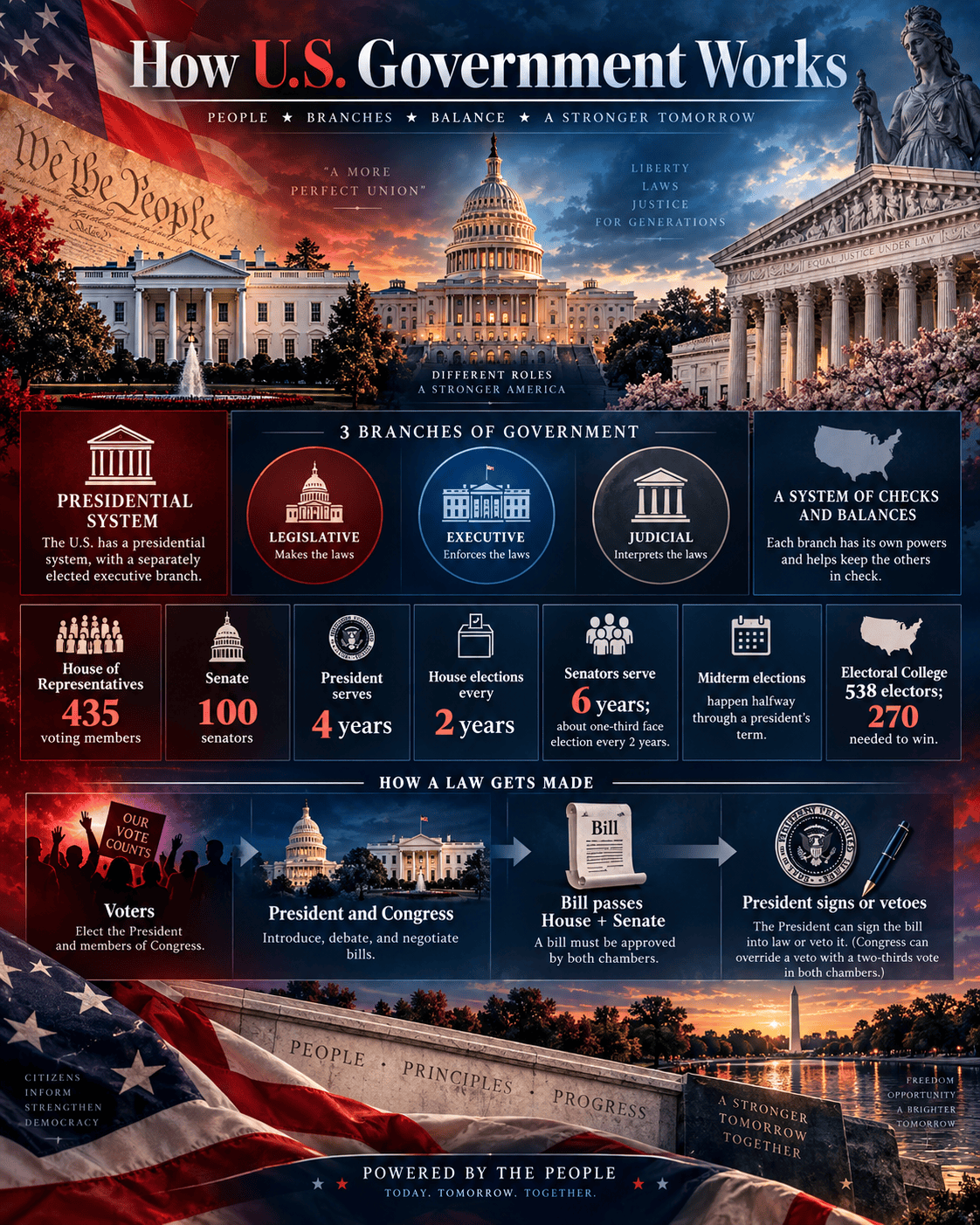
The U.S. Constitution divides the federal government into three branches: Congress in the legislative branch, the president and executive agencies in the executive branch, and the federal courts in the judicial branch. The branches have different constitutional powers and mechanisms for checking one another.
The president does not need to remain politically acceptable to a majority of Congress in the same way that a Canadian government needs the confidence of the House of Commons.
Congress can oppose the president. It can refuse legislation the president wants. One or both chambers can be controlled by the opposing party. Political deadlock can continue for years.
Yet the president remains president unless the term expires, the president resigns, dies, becomes unable to serve, or is removed through a separate constitutional process.
That is a radically different arrangement from Canadian parliamentary confidence.
What Does the U.S. President Actually Control?
The president is both the American head of state and head of government and heads the executive branch. The executive is responsible for implementing and enforcing federal laws, and the president appoints Cabinet secretaries and numerous other officials, with many important appointments requiring Senate confirmation.
The president can sign or veto legislation passed by Congress and can issue executive orders directing executive-branch operations within the authority provided by the Constitution and existing laws.
But here is the part that political headlines sometimes blur: the president is not Congress.
A president can propose a major tax bill, health-care reform or spending program, but if congressional legislation is legally required, the president cannot simply substitute a speech or executive order for an Act of Congress.
That is why control of Congress can matter so much.
How Americans Elect a President: The Electoral College
Americans vote for presidential candidates, but constitutionally the president and vice president are chosen through the Electoral College process.
There are currently 538 electors, with each state receiving a number equal to its total representation in the House and Senate, plus three electors for Washington, D.C. A candidate needs at least 270 electoral votes to win. Most states award all their electoral votes to the statewide winner, with Maine and Nebraska using different allocation systems.
This creates the unusual possibility that a candidate can win more votes nationwide but still lose the presidential election because the Electoral College determines the outcome. That has happened multiple times in U.S. history.
Again, compare that with Canada.
There is no national Canadian ballot on which every voter chooses between candidates for prime minister. Canada elects 343 individual MPs. The parliamentary result then determines who can form a government.
Congress: The House of Representatives
The U.S. House of Representatives has 435 voting members, with seats distributed among states primarily according to population. Representatives serve just two-year terms.
That short term is enormously important because it means the entire House faces voters every two years.
Not a quarter of the House.
Not half.
All 435 seats.
That gives American voters an opportunity to substantially change the political composition of one chamber of Congress halfway through a presidential term.
The U.S. Senate
The U.S. Senate contains 100 senators, with every state receiving exactly two regardless of population. California, with tens of millions of residents, has two senators. Wyoming, with a tiny fraction of California’s population, also has two.
Senators serve six-year terms, but their elections are staggered. Roughly one-third of Senate seats come up for election every two years.
This gives the Senate considerably more continuity than the House. An election can replace every member of the House in theory, while roughly two-thirds of sitting senators are not facing election during that particular cycle.
And now the mysterious American word midterm suddenly makes sense.
What Is a Midterm Election?
A midterm election is a congressional election held halfway through a president’s four-year term.
Every two years, Americans elect all 435 members of the House and roughly one-third of the Senate. When that election happens during the middle of a presidential term rather than alongside a presidential election, it is called a midterm.
The president is not being re-elected during a midterm.
But the president’s political environment can change dramatically.
Imagine a president enters office with the president’s party controlling the House and Senate. Major legislation may have a relatively clear path if members of that party agree with it. Two years later, the opposition wins the House in the midterms. The same president remains in the White House, but legislation now has to pass through a chamber controlled by political opponents.
That is divided government, and it is perfectly possible under the American system.
Why Canada Does Not Have Midterms
This difference is worth drilling into because it reveals the basic architecture of the two systems.
A Canadian prime minister governs because the government can command the confidence of the House of Commons. If that relationship fundamentally breaks down, the system may produce a new government or an election.
An American president receives an independent four-year mandate through the presidential election process. Congress receives its own separate electoral mandates. The president and Congress can therefore disagree intensely without triggering an automatic presidential election.
Canada links executive survival to the legislature.
America separates them.
Once you understand that, Canadian confidence votes and American midterms stop seeming like strange political traditions and start looking like logical consequences of the two systems.
How Does a Bill Become Law in the United States?
Congress also has two chambers, so legislation generally needs approval from both the House and Senate in identical form.
Once both chambers pass a bill, it goes to the president. The president can sign it into law or veto it. Congress can override a presidential veto, but doing so requires a two-thirds vote in both chambers.
That creates another important difference from Canada.
In Canada, the prime minister and governing Cabinet normally operate with parliamentary support because their government depends on maintaining confidence. In the United States, a president can receive legislation from a Congress controlled by political opponents and veto it — or watch Congress refuse to pass presidential priorities in the first place.
Neither structure automatically produces cooperation.
They simply organize political conflict differently.
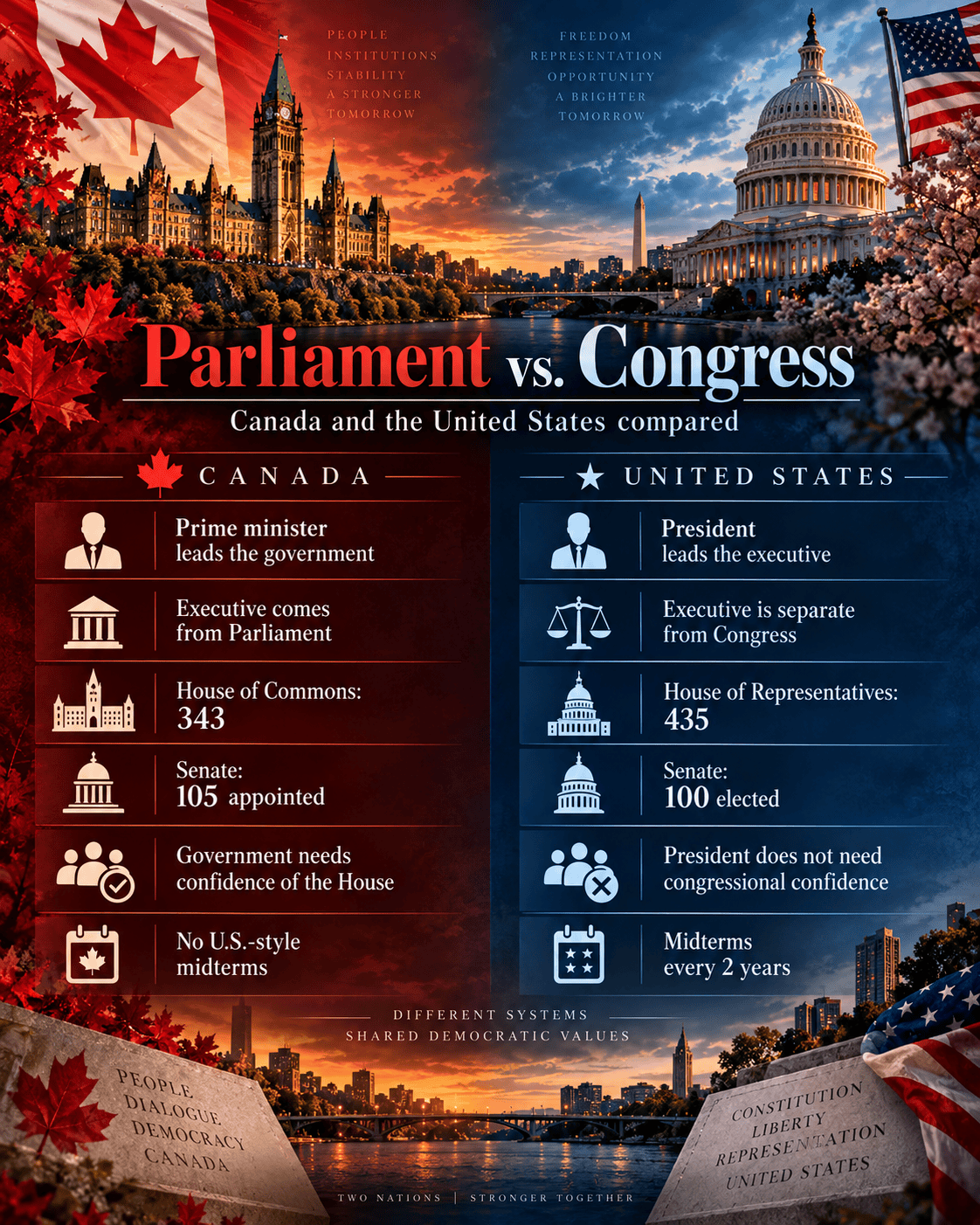
Canada vs. the United States at a Glance
The contrast becomes easier to remember when reduced to a few core differences:
- Canada is a parliamentary democracy and constitutional monarchy; the United States is a presidential republic with constitutionally separated branches.
- Canadians elect local MPs rather than directly electing a prime minister; Americans vote in a presidential election ultimately decided through the Electoral College.
- Canada’s House of Commons has 343 elected seats; the U.S. House has 435 voting representatives.
- Canada’s Senate has 105 appointed seats; the U.S. Senate has 100 elected senators.
- A Canadian government must retain the confidence of the House of Commons; a U.S. president does not require congressional confidence to remain president.
- Canada can hold a federal election earlier than its statutory fixed date; U.S. presidential elections follow a fixed four-year constitutional cycle.
- America elects the entire House and roughly one-third of the Senate every two years, creating presidential-year and midterm congressional elections.
Neither description tells you which political system is “better.” That depends heavily on what characteristics someone values. What it does tell you is why the two countries behave so differently even when confronting similar economic problems.
Now Follow the Money: Why Government Structure Matters Financially
This is where civics becomes finance.
Governments determine fiscal policy, meaning decisions involving taxation, government spending and borrowing. Those decisions influence household income, corporate profitability, employment, public investment, government debt and demand throughout the economy.
A tax cut can leave some households or companies with additional money. A new benefit can increase income for eligible recipients. Infrastructure spending can create contracts and employment. A tariff can make imported goods more expensive while potentially helping some domestic producers. New banking, energy or environmental regulations can change costs throughout an industry.
But there is a critical question behind every announcement:
Can the government actually implement it?
That depends on the political system you just learned.
The Budget Is Not a Giant Government Chequebook
Take Canada.
A federal budget describes the government’s fiscal plan, but simply announcing spending in a budget does not automatically authorize every dollar to leave the treasury. Treasury Board notes that government expenditures require parliamentary authority through appropriation legislation or other statutes, and even the federal budget itself does not automatically provide that spending authority.
That is a hugely important distinction.
Suppose Ottawa announces a $5 billion housing initiative. A useful financial reader should immediately ask where the money comes from, what legislation is required, whether parliamentary approval is needed, when the spending begins and which companies, industries or households actually qualify.
Only then can you intelligently think about investment consequences.
The same principle exists in the United States, although the institutional pathway differs. The president proposes priorities and a budget, but Congress possesses the constitutional power of the purse and passes appropriations legislation. The fact that the president wants money spent does not itself mean Congress will provide it.
Taxes: The Political Decision That Reaches Almost Everyone
Tax policy is one of the most obvious connections between elections and personal finance.
Governments can change personal income-tax brackets, corporate taxes, capital-gains rules, deductions, credits, retirement incentives and consumption taxes. They can subsidize certain investments or remove incentives that previously made them attractive.
Businesses respond too. If an industry receives an investment tax credit, projects that were previously marginal may become economically viable. If a tax rises, companies may adjust investment, pricing or compensation. Investors may change how they value future profits.
But again, the headline is not enough.
A politician proposing a tax is different from Parliament or Congress enacting one.
That distinction can save investors from reacting to policies that never actually become law.
Regulation Can Matter as Much as Taxation
A government does not need to hand a company money to dramatically affect its finances.
Consider banking regulations, environmental rules, drug approvals, telecom policy, cryptocurrency rules, pipeline permitting, mining approvals, antitrust enforcement or automobile standards. A regulatory change can alter the economics of an entire industry without producing a giant line item in the federal budget.
That is why markets sometimes react violently to political news.
Investors are not necessarily expressing support for a politician. They are recalculating future cash flows.
If a proposed regulation could cost an industry billions of dollars, company valuations may decline. If rules become less costly, expected profits may rise. If tariffs change supply chains, one group of companies may benefit while another faces higher input costs.
Politics enters a financial model surprisingly quickly.
The Prime Minister and President Do Not Personally Set Interest Rates
Here is another misconception worth clearing up.
When interest rates rise and mortgage payments become painful, political leaders often receive much of the public anger. Governments can absolutely affect economic conditions through spending, taxation, borrowing and regulation — but the prime minister of Canada does not simply press a button and set the Bank of Canada’s policy rate.
The Bank of Canada is a Crown corporation owned by the federal government, but it describes itself as separate from the political process. Its Governing Council conducts day-to-day monetary policy independently within the monetary-policy framework agreed with the federal government.
The U.S. Federal Reserve has a similar degree of monetary-policy independence. Congress established the Fed’s statutory objectives, but elected members of the administration do not sit on the Federal Reserve Board directing interest-rate decisions.
Government policy can still influence the conditions central banks react to. Large fiscal deficits, tax changes, trade policy or major spending programs may influence economic demand and inflation. But fiscal policy and monetary policy are not the same thing.
That distinction matters to anyone trying to understand mortgages, bonds or interest-sensitive investments.
Why Investors Care About Who Controls Parliament or Congress
When markets look at politics, the most financially useful question is often not simply “Who won?”
It is “What can they actually pass?”
Suppose an American president proposes a sweeping corporate tax change. If the president’s party controls both chambers of Congress and its members broadly support the proposal, the policy may have one probability of becoming law. If the opposing party controls the House, the probability could be very different.
Now move the same idea to Canada.
A Canadian government with a secure Commons majority may have a clearer path for much of its fiscal agenda than a minority government negotiating bill by bill with opposition parties. That does not mean every proposal succeeds, but the legislative arithmetic is different.
Investors who understand the political structure are therefore evaluating something deeper than ideology.
They are evaluating policy probability.
A Better Way to Think About Elections and the Stock Market
There is a tempting story that gets repeated every election cycle:
Candidate X wins, therefore stocks will rise.
Or:
Party Y wins, therefore the economy will suffer.
Real economies are not that simple.
Stock markets respond to interest rates, inflation, productivity, technological innovation, commodity prices, wars, consumer behaviour, corporate earnings, demographics, currencies and events that have nothing to do with domestic elections. Political policies are one important variable among many.
Even when a government introduces a policy that clearly helps a particular industry, share prices may already reflect that expectation before the policy arrives. Investors trade expectations, not just events.
A better question is:
What specific policy became more or less likely, and which businesses or households actually have financial exposure to it?
That is far more useful than trying to turn an election into a simple buy-or-sell signal.
Donald Trump: When Political Power and Private Wealth Intersect
Donald Trump offers an unusually dramatic modern example of the intersection between politics, business ownership and personal wealth.
Forbes estimated Trump’s real-time net worth at approximately US$6.9 billion on September 15, 2026, with its 2026 Forbes 400 valuation rounding the figure to about $7 billion. By comparison, Forbes estimated his fortune at roughly $2.3 billion shortly before Trump Media began publicly trading in March 2024, after which the value of his Trump Media stake pushed Forbes’ estimate to about $6.4 billion almost immediately.
So yes, Trump is substantially wealthier by current Forbes estimates than he was under some earlier estimates. But it would be inaccurate to say simply, “He became president and therefore gained several billion dollars.” A large part of the initial jump came from the public-market valuation of Trump Media before he returned to the presidency, and estimated wealth tied to publicly traded assets can rise or fall dramatically without that amount of cash ever entering someone’s bank account.
His business finances have also changed considerably during his second presidency. Reuters reported that Trump’s 2025 financial disclosure showed more than $1.4 billion in income primarily associated with cryptocurrency ventures, including World Liberty Financial and the Trump meme coin. Reuters also reported criticism from ethics specialists concerned about conflicts between private financial interests and public authority, while the White House has rejected conflict-of-interest allegations and said Trump’s businesses are managed by his children.
That makes Trump a useful financial case study regardless of anyone’s political opinion.
It illustrates the difference between net worth and income, the enormous effect market valuations can have on billionaire wealth and the ethical questions that arise when a powerful elected official maintains major private business interests.
There is also a broader lesson: when somebody tells you that a politician “made billions,” ask how the number was calculated. Was it salary? Business revenue? Investment gains? Cryptocurrency proceeds? Stock appreciation? Real estate revaluation? A billionaire’s estimated fortune can change by hundreds of millions of dollars in a day because a stock price moved.
Numbers require context.
Who Deserves Credit — or Blame — for the Economy?
This may be the most useful skeptical question in the entire article.
Presidents and prime ministers have real economic power, but they do not control an economy like somebody steering a car.
A government can change taxes and spending. Legislatures can regulate industries. Trade policy can alter prices. Governments can run deficits or surpluses. Those are meaningful decisions.
But governments cannot dictate oil prices, prevent every recession, manufacture productivity growth on command or control how every company invests. Central banks operate with significant monetary-policy independence. Provincial and state governments possess their own powers. Global wars, pandemics, technological breakthroughs and financial crises can overwhelm domestic policies.
This means claims such as “President X created every job” or “Prime Minister Y personally caused every increase in grocery prices” should generally make a financially literate reader suspicious.
Economic outcomes usually have multiple causes.
The Same Skepticism Should Apply to Government Announcements
Imagine this headline:
PRIME MINISTER ANNOUNCES $10 BILLION PLAN TO TRANSFORM HOUSING
Before deciding the policy will revolutionize Canadian real estate, ask:
Who needs to approve the money? Is new legislation required? Is any of the $10 billion money that was already budgeted? Is it spending, loans, loan guarantees or tax credits? Over how many years will it be deployed? Is the federal government dependent on provinces or municipalities to actually produce new homes?
Now imagine:
PRESIDENT ANNOUNCES MASSIVE NEW ECONOMIC PROGRAM
Ask the same questions.
Does the president possess statutory authority to implement it directly? Does Congress need to pass legislation? Which chamber controls the relevant votes? Does the program need annual appropriations? Could courts review the policy?
Those questions turn political news into financial analysis.
Why the Structure of Government Can Matter More Than the Personality at the Top
Modern politics focuses intensely on personalities. Presidents and prime ministers dominate television screens, campaign advertising and social media, which can create the impression that national governments are essentially one person.
They are not.
A Canadian prime minister with a majority government faces a different political reality from one heading a fragile minority. An American president with cooperative majorities in the House and Senate faces a very different legislative environment from one confronting an opposition Congress.
Judges matter. Senators matter. MPs matter. Representatives matter. Parliamentary committees matter. Regulators matter. Provinces and states matter.
Institutions may be less entertaining than political personalities, but they often tell you more about what is actually going to happen.
Five Questions to Ask Whenever Politics Meets Your Money
The next time a major political or economic announcement appears in your news feed, run it through five questions:
- Who actually has the legal authority to do this?
- Does Parliament or Congress have to approve it?
- Are the votes realistically there to pass it?
- Where does the money come from — taxes, borrowing, spending cuts or something else?
- Which households, businesses or investments are actually affected if it becomes law?
Those questions will not tell you whether a policy is morally right or politically popular.
They will tell you something more useful for financial analysis: whether it is real, how it can happen and where the money flows.
Final Takeaway: Canada and America Speak Different Political Languages
Canada and the United States are close allies and trading partners, and both are federal democracies with elected legislatures and independent courts. But beneath those similarities are two very different ways of organizing political power.
Canada’s system grew out of the Westminster parliamentary tradition. Canadians elect local MPs to the House of Commons, the government must retain the confidence of that House, the prime minister heads the executive government, the appointed Senate reviews legislation and the Crown remains part of Parliament’s constitutional architecture.
The United States separates the presidency from Congress. Americans elect a president through the Electoral College process while separately electing members of the House and Senate. All 435 House seats face election every two years, while Senate terms are staggered, producing the midterm elections that can completely alter a president’s legislative environment without removing the president from office.
And that is where politics meets money.
Governments determine tax systems, public spending, borrowing, trade rules, regulations and enormous financial incentives. But a political promise does not automatically become policy, and a political leader does not single-handedly control the economy.
Understanding the structure underneath the headlines gives you a much better way to judge what matters.
When somebody announces a trillion-dollar program, do not just ask whether you like the politician.
Ask who has the votes, who has the authority, where the money comes from and where it ultimately goes.
That is when understanding government becomes part of understanding finance.
For a deeper look at the Canadian system, see the Government of Canada’s explanation of Democracy in Canada. For the American system, see USAGov’s guide to the branches of the U.S. government.