
SpaceX’s public-market debut is being treated as something larger than a space-company story. According to a cluster of SignalDraft source cards from Markets Digest, American Market Insiders, Finance Studio Advisors, and Finance Wrapped between Aug. 1 and Aug. 8, 2026, investors were not simply asking whether rockets and satellite services could keep growing. They were asking whether one of the market’s most celebrated private companies could justify the scale of its artificial-intelligence spending once public shareholders had daily liquidity and a visible price.
That is the useful signal for ordinary investors. The reported facts are striking: strong revenue growth, very large capital spending, a reported AI spend of $15.8 billion in one quarter, an exclusive commitment to Nvidia, lockup windows that could make hundreds of millions of shares sellable, and public trading that reportedly put pressure on earlier private-market valuation marks. None of those items, taken alone, proves that AI spending is a bubble or that SpaceX is a poor business. Together, they show how quickly the market’s question can shift from “How exciting is the story?” to “Who pays for the buildout, and when?”
This article is educational analysis, not individualized financial, tax, investment, legal, or trading advice. Figures, prices, lockup amounts, company filings, and market reactions in this draft are based on the supplied newsletter evidence and should be verified against primary filings and current market data before publication or any personal decision.
The most important tension in the supplied evidence is simple: SpaceX reportedly showed strong revenue growth, but the market focused on spending and liquidity. American Market Insiders wrote on Aug. 5, 2026 that SpaceX booked $7.81 billion of revenue in the prior quarter, up 92% from a year earlier, while also spending $18.37 billion on capital projects during the same period. Markets Digest separately described Q2 capital expenditures as about $18.4 billion, with the bulk going to AI.
For a public investor, that difference matters. Revenue growth tells you demand may be rising. Capital expenditure tells you how much money management believes must be spent today to support tomorrow’s opportunity. A business can be growing quickly and still create concern if the growth requires unusually heavy, recurring investment or if investors cannot yet see the payback window.
The lockup issue added pressure. A lockup is a temporary selling restriction that often applies to insiders, employees, and early investors after a company goes public. It can support the stock in the first weeks or months after an offering because only a limited portion of shares can trade. Once the lockup expires, the market gets a more realistic test: how many previously restricted holders want liquidity at the current price?
In the supplied cards, American Market Insiders reported on Aug. 3 that approximately 911.5 million shares could become eligible to trade on Thursday, Aug. 6, worth roughly $104 billion at the then-current price. Markets Digest described the first lockup stage as freeing about $101 billion of stock. Finance Studio Advisors framed the potential unlock as $116 billion. These are not identical numbers, which is common when reports use different reference prices, eligibility assumptions, or timing. The shared point is what matters: the possible supply was large enough to make the lockup itself a market event.
| Signal from the supplied sources | Why it matters | Review note |
|---|---|---|
| Revenue reportedly rose 92% year over year | Suggests strong top-line growth | Verify against the cited quarterly filing before publishing |
| Capital projects reportedly totaled about $18.37B to $18.4B | Shows how expensive the growth plan may be | Confirm exact figure, definition, and period |
| AI spending reportedly reached $15.8B in one quarter | Turns the story into an AI infrastructure test | Confirm whether this was company-disclosed, estimated, or interpreted |
| Roughly 911M shares reportedly became eligible to trade | Creates a liquidity test after a thin initial float | Verify lockup terms and actual sellable shares |
Large capital spending is not automatically bad. In infrastructure-heavy businesses, management sometimes has to spend heavily before revenue arrives. Satellites, launch systems, data centers, chips, power, and networks can all require upfront investment. If the investment creates durable advantages, future cash flows may justify the near-term burden.
The harder question is whether AI capital expenditure is building a moat or simply raising the amount of capital required to stay in the race. In plain English, a moat is a durable advantage that competitors have difficulty copying. A company may argue, directly or indirectly, that buying scarce chips, building compute capacity, and integrating AI into operations creates that advantage. Investors may accept that argument while money is abundant and the shares are illiquid.
Public markets tend to ask more frequently for proof. If AI capex leads to better margins, faster product cycles, lower operating costs, stronger pricing power, or defensible new revenue streams, the spending can be seen as productive. If it mainly produces higher depreciation, supplier concentration, financing needs, or uncertain future benefits, shareholders may treat it as risk moving from private backers to public owners.
That is why the SpaceX case is useful even for readers who never plan to own the stock. It offers a live example of a broader market dilemma. Over the last several years, many AI-linked valuations have depended on the belief that large buildouts will later become economic advantages. The SpaceX trading story asks what happens when the buildout becomes visible, the lockup expires, and the market can mark the optimism every day.

Markets Digest reported on Aug. 5 and Aug. 8 that SpaceX spent $15.8 billion on AI in a single quarter and committed exclusively to Nvidia. The same source card said AMD fell after the Nvidia commitment. This should be read carefully: the supplied evidence supports the claim that newsletters framed the event this way, but the exact wording, contractual details, and durability of any exclusivity should be checked against primary company materials before publication.
Still, the investment lesson is clear. Supplier concentration can be both a strength and a weakness. Nvidia has been the central beneficiary of the AI infrastructure cycle because its chips, software ecosystem, and supply position are widely viewed as critical to advanced AI workloads. If a company aligns itself with the leading supplier, it may gain access to better performance, a deeper developer ecosystem, and a clearer technical roadmap.
But concentration also narrows the margin for error. If a company is dependent on one supplier for a key part of its AI buildout, investors may ask whether costs can be controlled, whether supply is guaranteed, whether bargaining power shifts to the supplier, and whether technical flexibility is reduced. In a market already concerned about AI capital intensity, a single-vendor commitment can make the spending story feel less diversified.
For households and beginning investors, the practical takeaway is not to guess which chipmaker wins. It is to recognize how dependency shows up in public-company analysis. A growth story can look attractive while the company controls the narrative in private markets. Once it trades publicly, investors can reprice that story quickly if they believe too much future value depends on one supplier, one assumption, or one very expensive buildout path.
One of the quieter but important points in the SignalDraft package is the link between SpaceX’s public trading and private-market marks. Markets Digest reported on Aug. 3 that Alphabet’s SpaceX mark had lost about a third of its value from the day it was struck. Another Markets Digest source card from Aug. 1 said Alphabet and Amazon had built much of an earnings beat on unrealized gains from private AI stakes. These claims need verification in current filings before being treated as final, but they point to a real market mechanism.
Private valuations can be influential without being continuously tested. A late-stage private company may raise money at a high valuation, and investors may carry that position on their books based on marks that depend on financing rounds, internal models, or limited transactions. Public trading changes the evidence. A visible market price does not always equal intrinsic value, but it becomes a hard reference point that analysts, auditors, investors, and boards can no longer ignore.
This is why an IPO can be uncomfortable for the broader ecosystem around a private-market winner. Early employees, venture funds, crossover investors, mutual funds, and public companies with private stakes may all have different cost bases and reporting needs. If the public price trades below recent private marks or below the IPO price, the pressure is not limited to the company’s new shareholders. It can ripple into reported gains, portfolio valuations, and investor confidence in similar late-stage private names.
The supplied cards also suggest that retail investors reportedly sold SpaceX for the first time and that one note framed the quarter as $7.81 billion of revenue versus $18.37 billion of spending. That comparison is not a full cash-flow analysis, and it should not be treated as one. But it does capture why liquidity can change the tone. When shares can be sold, investors do not have to wait patiently for the story to mature; they can reduce exposure if the numbers make them uneasy.
The broader market backdrop in the source package is mixed. Some hyperscalers were reportedly rewarded for AI-related spending or private AI exposure, while certain chipmakers or AI-linked names were punished. That is not contradictory. Markets often reward AI spending when it appears to strengthen a dominant platform and punish it when the cost, dependency, or payback period looks less certain.
SpaceX is a clean lens because it combines several stress points at once. It has a powerful brand, a high-growth story, a public ticker, a large reported AI spend, a supplier-concentration issue, and a lockup event that could reveal how earlier holders behave when they are allowed to sell. That makes it less useful as a narrow referendum on space and more useful as a referendum on late-stage AI optimism.
There are at least three reasonable interpretations of the same evidence. The bullish interpretation is that the market is underestimating a company willing to spend aggressively on infrastructure that could widen its advantage. The skeptical interpretation is that private-market enthusiasm allowed a capital-hungry AI strategy to be priced too generously before public investors had full liquidity. The middle interpretation is that both can be true: SpaceX may be an exceptional company, and its stock may still face valuation discipline if public investors decide the expected payoff is too far away or too uncertain.
That distinction is important for everyday readers. A good company is not automatically a good investment at every price. A promising technology is not automatically a profitable deployment. And a large capital budget is not automatically proof of either strength or weakness. The investor’s job is to ask what assumptions must be true for the spending to pay off, who bears the downside if those assumptions fail, and whether the current price already assumes success.
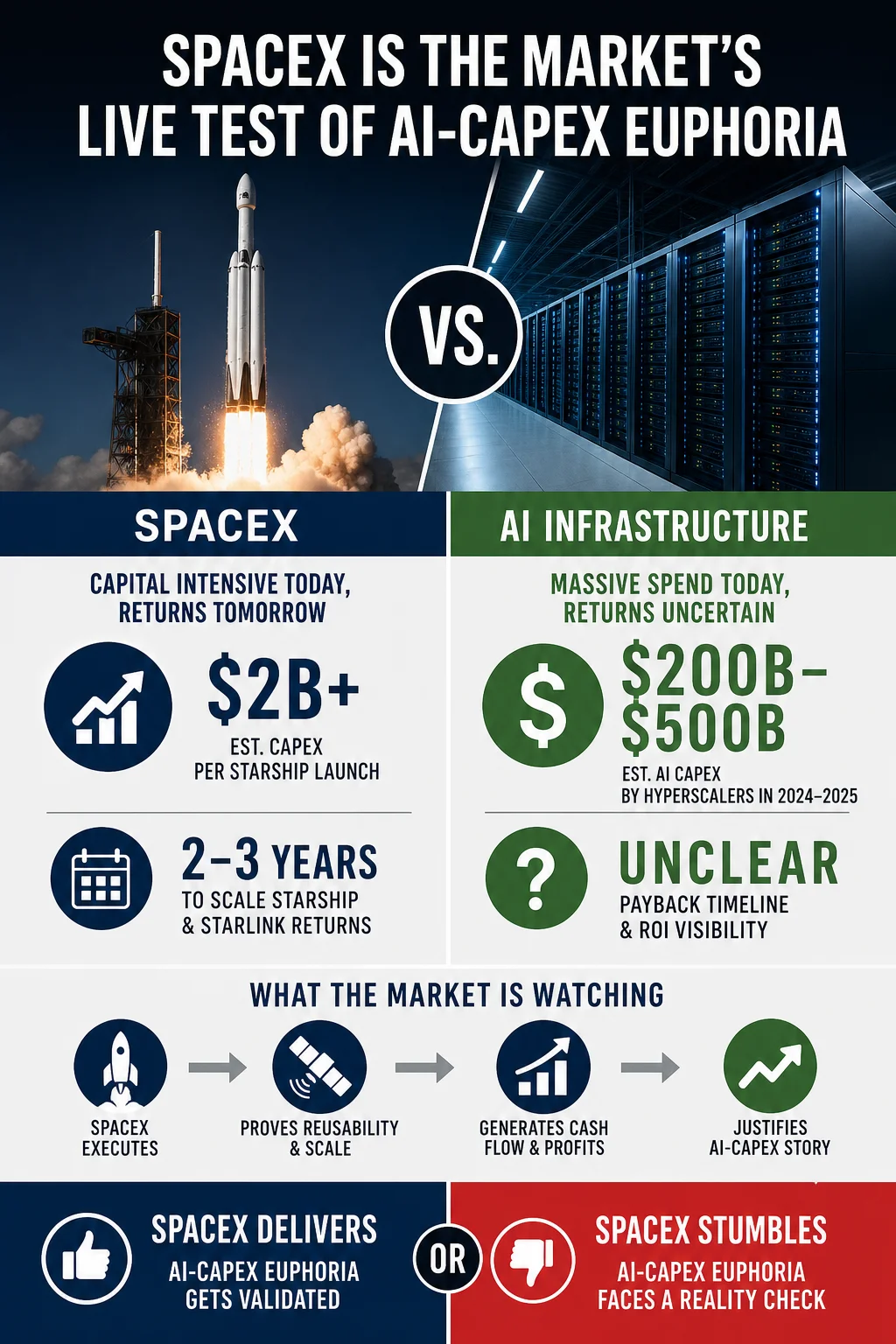
Most households do not need to analyze SpaceX’s lockup table line by line. But AI-capex stories are likely to keep appearing in public markets, retirement funds, index holdings, and employer stock plans. A simple checklist can help separate useful evidence from excitement.
- Start with the source of the number. Is the capex figure from a company filing, management commentary, analyst estimate, or newsletter interpretation?
- Separate revenue growth from cash demands. Fast growth can still require heavy spending, borrowing, dilution, or long payback periods.
- Ask whether capex is recurring or temporary. One-time buildout costs are different from a permanent rise in the cost of staying competitive.
- Look for concentration. If a company depends heavily on one supplier, customer, platform, or financing source, the valuation should reflect that risk.
- Watch lockups and float. A thin float can make early trading less representative. More supply can reveal whether insiders and early investors are eager to sell.
- Be careful with paper gains. Unrealized marks can improve reported results, but public trading may later test those values.
- Avoid turning a theme into a personal mandate. AI may be economically important without every AI-linked stock being attractively priced.
For personal portfolios, the conservative lesson is boring but useful: understand your risk tolerance, keep single-stock exposure in context, and do not let a popular technology theme override diversification, emergency savings, debt plans, or time horizon. If a decision has meaningful consequences for your finances, bring it to a qualified financial, tax, or legal professional who can review your specific circumstances.
The next useful evidence would not be another dramatic headline. It would be slower, more concrete information: updated filings, actual share-sale data after lockup windows, management’s explanation of AI spending, supplier-contract details, margins, depreciation, financing needs, and whether the reported AI investment begins to show up in measurable business results.
Readers should also watch whether public-market discipline spreads to other AI-linked private valuations. If SpaceX’s public trading pressures marks held by large technology companies or investment funds, the effect could reach beyond one ticker. The same logic applies to other companies that raised money at high private valuations based on AI infrastructure, data, compute, or platform narratives.
The takeaway is not that AI capex is automatically foolish. It is that liquidity changes the burden of proof. In private markets, optimism can survive for long periods with limited trading and selective valuation marks. In public markets, the story has to meet a daily price, a broader shareholder base, and a steadier demand for evidence. SpaceX has become a visible test of that transition.
Time-sensitive claim review note: Before publication, verify all stock prices, trading dates, lockup terms, sellable-share counts, capex figures, AI spending figures, supplier commitments, reported valuation marks, and related market reactions against current primary filings and market data. The newest supplied newsletter source is dated Aug. 8, 2026, and the SignalDraft package notes that the newest source was 23 days old at drafting time.