
What’s the Point of CMHC? Where Canada’s Housing Billions Actually Go
If you follow Canadian politics for long enough, you start hearing the same defence whenever a major problem gets worse: the government points to how much money it spent. Housing is one of the clearest examples. Billions of dollars are announced, billions more are committed, a new fund gets a catchy name, politicians hold press conferences in front of construction sites, and yet Canadians still look at rents, mortgage payments and home prices and reasonably ask what all that money actually accomplished. At some point, “we invested billions” stops being an answer and starts sounding like a way of avoiding the question.
That question becomes especially interesting when you get to the Canada Mortgage and Housing Corporation, better known as CMHC. To many Canadians, CMHC is vaguely associated with mortgage insurance, government housing programs and a steady stream of billion-dollar announcements, but most people would probably struggle to explain exactly what it does. It can easily look like one more enormous federal organization sitting between taxpayers and a housing market that somehow keeps becoming less affordable. Once you dig into the numbers, though, CMHC turns out to be much more complicated — and considerably more important — than that description suggests.
CMHC is simultaneously a mortgage insurer, a financial-market backstop, a housing research organization and an administrator of federal housing programs. Some parts of the organization receive public money, while other parts generate substantial revenue. Some of its programs have clear and measurable outputs, while others rely on forecasts, permits and long-term policy changes that may take years to produce actual homes. The useful question, therefore, is not simply whether CMHC spends a lot of money, but what each part of the organization is supposed to accomplish and whether Canadians are actually receiving reasonable value in return.
What Is CMHC, Anyway?
CMHC is a federal Crown corporation that was created in 1946, originally in response to Canada’s enormous postwar housing needs. Over the decades, its role expanded far beyond helping returning soldiers and their families find places to live. Today, CMHC sits close to the centre of Canada’s housing system, connecting federal policy with banks, mortgage lenders, developers, municipalities, non-profit housing providers and individual homebuyers. It is not merely a government department handing out housing grants, even though that is sometimes how it appears from the outside.
At a basic level, CMHC has four major jobs. It provides mortgage default insurance, supports Canada’s mortgage-securitization system, administers a large collection of federal housing programs and produces housing-market research and data. Those functions are very different from one another, which is one reason arguments about whether CMHC is “worth it” can become muddled. Someone criticizing a municipal housing subsidy may be attacking a completely different part of CMHC than someone talking about mortgage insurance or the stability of Canada’s banking system.
The financial numbers show just how different those sides of the organization can be. In 2025, CMHC reported roughly $4.9 billion in government funding for housing programs and approximately $4.6 billion in housing-program expenses. At the same time, its mortgage-insurance business generated roughly $1.4 billion in income before tax, while its securitization activities generated approximately another $1.1 billion. CMHC as a whole reported about $1.8 billion in net income for the year, which does not mean taxpayers received $1.8 billion in free money, but it does demonstrate that the organization is not simply a giant spending department.
CMHC takes financial risk, maintains capital and ultimately operates with federal backing, so its commercial activities should not be confused with a normal private company. Still, the distinction matters. When people hear that CMHC administers billions of dollars in housing programs, it can sound as though the entire corporation exists to spend tax revenue. In reality, a significant portion of CMHC operates more like a large financial institution sitting underneath the Canadian housing market.
The CMHC Service Most Homebuyers Actually Know
For ordinary Canadians, CMHC is probably best known for mortgage default insurance. If someone purchases a home with a down payment of less than 20%, mortgage insurance is generally required, and CMHC is one of the organizations that provides it. One detail is frequently misunderstood: the insurance primarily protects the lender, not the homeowner, if the borrower defaults on the mortgage. The buyer pays the insurance premium because that insurance allows the lender to take on a loan that would otherwise be considered riskier.
There is a fairly straightforward economic argument for this system. Without mortgage insurance, many lenders would either refuse high-ratio mortgages or charge substantially more to compensate for the additional risk. Insurance makes that lending more predictable and allows qualified buyers to purchase homes without first saving a full 20% down payment, which can take many years in expensive Canadian housing markets. The trade-off, of course, is that easier access to credit can also increase purchasing power in a market where the supply of homes is already constrained.
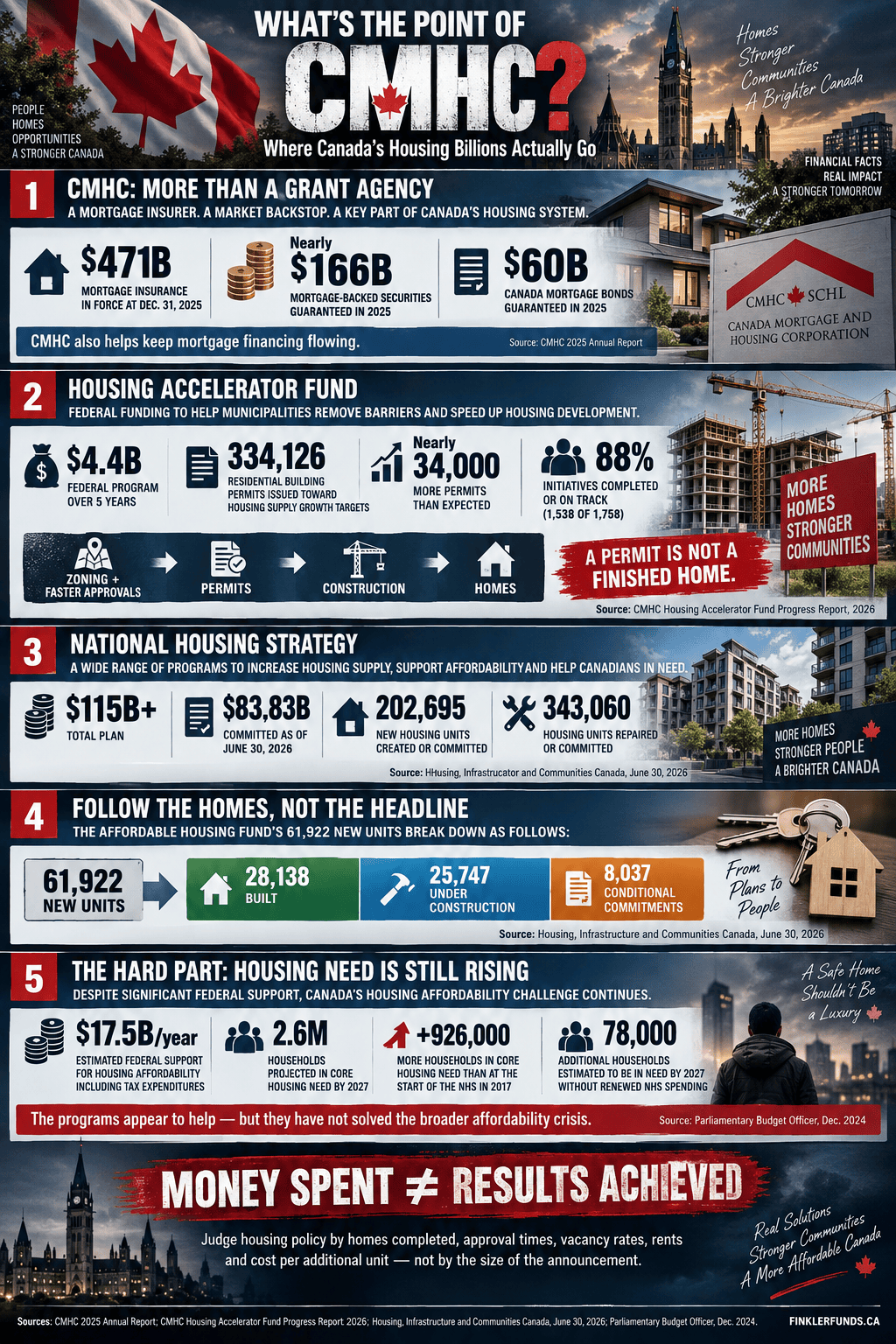
The scale of CMHC’s insurance operation is enormous. By the end of 2025, CMHC had approximately $471 billion of mortgage insurance in force, covering homeowner mortgages, lender portfolio insurance and multi-unit residential properties. That figure alone should make it clear that CMHC is not a fringe government agency operating a few obscure grant programs. It is deeply woven into the financial structure supporting Canadian housing.

The Part Almost Nobody Talks About: Keeping Mortgage Money Flowing
CMHC also plays a major role in something most Canadians never think about: helping lenders obtain the money they need to issue mortgages in the first place. Through programs such as National Housing Act Mortgage-Backed Securities and Canada Mortgage Bonds, qualifying mortgages can be pooled into securities that investors purchase. This lets lenders recover capital rather than keeping every mortgage locked on their balance sheets for decades, and that capital can then be used to issue additional mortgages. It is essentially part of the plumbing underneath the mortgage market.
The scale here is even larger than most people realize. In 2025, CMHC guaranteed approximately $165.7 billion in new NHA mortgage-backed securities and around $60 billion in Canada Mortgage Bonds. By the end of that year, total guarantees outstanding through the system were roughly $573 billion. That does not mean taxpayers spent $573 billion, because a government guarantee is financially different from government expenditure, but it shows how much mortgage financing depends on a system in which CMHC plays a central role.
This side of the organization rarely makes headlines because it is boring when it works properly. Nobody holds a press conference to announce that mortgage-market liquidity continued functioning normally this month, and most homeowners have no reason to think about how their lender funded their mortgage. During a serious credit crisis, however, reduced access to mortgage funding could mean higher borrowing costs, tighter lending standards and fewer mortgages being issued. One of the points of CMHC, therefore, is not to build homes at all but to help keep the financial machinery supporting Canadian mortgages operating.
Why Does CMHC Attract So Much Criticism?
The criticism becomes easier to understand once we move away from CMHC’s financial operations and into federal housing programs. Canadian governments increasingly respond to housing problems by announcing very large dollar amounts, and the size of the announcement itself is often presented as evidence that meaningful action has occurred. A $500-million program sounds serious, a $4-billion program sounds enormous, and a national housing strategy worth more than $100 billion sounds almost impossible to criticize. The problem is that money spent is an input, not an outcome.
Spending $1 billion on housing does not automatically mean Canadians received $1 billion worth of additional housing. In some cases, the money has not even been spent yet because a headline figure may represent funding announced over several years, loans expected to be repaid or money committed to projects that are still in planning. This is where political messaging becomes slippery without necessarily being factually false. The number may be real, but the impression created by that number can be very different from what has actually happened on the ground.
Housing announcements regularly use words such as announced, committed, supported, accelerated, permitted, started and built as though they describe roughly the same thing. They do not. A housing project can pass through all of those stages over several years, and a politician can potentially use the largest number available at any stage when defending the government’s record. Anyone trying to judge housing spending should therefore follow the project from announcement all the way to occupancy rather than stopping at the press release.
A useful way to think about the process is this:
- Announced: The government says funding will be available.
- Committed: Money has been assigned to a project, organization or municipality.
- Spent: The funding has actually gone out the door.
- Permitted: Local government has approved the housing development.
- Started: Physical construction has begun.
- Completed: The homes actually exist.
- Occupied and affordable: People are living in them at prices they can reasonably afford.
Those distinctions sound obvious when written down, but they make an enormous difference when evaluating government performance. A city receiving funding for 10,000 potential units is not the same thing as 10,000 families moving into new homes. Likewise, issuing permits is an important step, but it does not guarantee construction will actually happen. Once you start separating those stages, the housing debate becomes considerably easier to understand.
Enter the Housing Accelerator Fund
The Housing Accelerator Fund, commonly called HAF, is one of the best examples of how modern federal housing policy works. The name makes it sound as though Ottawa created a giant construction fund that simply pays municipalities to build houses, but that is not really the model. Instead, the federal government offers money to municipalities in exchange for reforms that are supposed to make housing easier and faster to approve. Municipalities submit action plans, agree to housing targets and implement changes before later portions of the funding are released.
Those reforms can include allowing more homes on existing residential lots, increasing density around transit, simplifying zoning, reducing parking requirements, speeding up permit approvals, digitizing planning systems and opening municipal land for housing. Some municipalities have also used the program to make secondary suites or small multi-unit buildings easier to construct. The underlying logic is fairly simple: Ottawa cannot directly rewrite every municipal zoning bylaw in Canada, so it uses federal money to encourage municipal governments to change those rules themselves. Whether that sounds like clever federal leverage or a bizarre situation in which one level of government has to pay another level of government to allow homes to be built depends largely on your perspective.
By mid-2026, there were roughly 238 active local-government Housing Accelerator Fund agreements representing approximately $4.37 billion in commitments. Those agreements were intended to help fast-track permits for more than 120,000 net new homes, and CMHC reported that around 88% of the municipal initiatives it was tracking were either completed or on schedule. Participating municipalities had also issued hundreds of thousands of residential permits, with permit activity exceeding earlier forecasts in many cases. On the surface, those are encouraging numbers.
The program’s first-year numbers were also notable. Participating municipalities reportedly issued more than 160,000 residential permits, approximately 22,000 more than expected at that stage. That suggests the program may genuinely be affecting local planning and approval systems rather than merely distributing money. However, this is where one of the most important caveats in the entire article comes into play: a permit is not a house.
A developer can receive approval for a project and still decide not to build it. Interest rates may be too high, construction financing may disappear, labour shortages can delay projects, material prices may rise, development charges can destroy the economics of a project and demand for a certain type of housing may weaken. Governments can make housing legal without making housing economically viable. For that reason, HAF cannot ultimately be judged only by the number of permits municipalities issue.

Is the Housing Accelerator Fund Actually Working?
The fairest answer at this stage is that there are signs it is working, but the final verdict is still years away. Municipalities have changed zoning rules, rewritten planning processes and implemented reforms directly connected to their HAF agreements. Those changes may continue producing housing long after the federal funding ends, which could turn out to be one of the program’s most valuable effects. A permanent change allowing four homes on a property where only one had been permitted before can influence development for decades.
There is also evidence that CMHC is willing to enforce at least some of the agreements rather than simply distributing every promised dollar regardless of performance. Funding has been reduced in some municipalities and certain agreements have been cancelled when governments failed to meet their commitments. Toronto, for example, had part of its funding reduced, while other municipalities have faced cuts or cancellations when agreed reforms or targets were not delivered. That is important because one of the most common weaknesses of government programs is the reluctance to admit failure once money has already been announced.
The skeptical argument remains strong, however, because measuring what would have happened without the program is extremely difficult. Imagine a city that was already going to approve 8,000 homes but receives federal money and ultimately approves 9,000. How many of those additional units were genuinely caused by HAF, how many projects would have happened anyway, and what did taxpayers effectively pay for each truly additional home? Those questions are much harder to answer than simply counting permits and announcing the total.
Ottawa Provides a Fascinating Example
Ottawa received approximately $176 million through the Housing Accelerator Fund, making the program especially relevant to people living in the National Capital Region. The city has directed a large portion of that money toward affordable-housing development while also using HAF to support planning reform, transit-oriented development, office conversions, municipal land initiatives and broader zoning changes. Ottawa has also pursued a wider Housing Acceleration Plan designed to simplify regulations and make new residential development easier. On paper, there is a logical connection between those reforms and increased housing supply.
But $176 million is a very large amount of public money, and residents are justified in asking what they will actually receive for it. How many homes will exist because Ottawa received this funding that otherwise would not have existed? How much faster are permits being processed, how many approved projects are actually under construction and what happens to rents and vacancy rates after the reforms have been in place for several years? Those are much more useful questions than whether the federal government can say it “invested $176 million in Ottawa housing.”
At certain points during the program, Ottawa had been significantly behind some of its annual permit targets. That does not automatically mean HAF failed, because construction markets fluctuate and major zoning reforms can take years to translate into finished buildings. It does, however, illustrate why funding announcements cannot themselves be considered accomplishments. The real accomplishment has to be what happens after the money is committed.
Then There Is the Much Bigger National Housing Strategy
The Housing Accelerator Fund is only one piece of a much larger federal housing system. Canada’s National Housing Strategy launched in 2017 and has since grown into a collection of programs worth more than $115 billion. By June 2026, the federal government reported approximately $83.8 billion in commitments through the strategy. That is enough money that taxpayers should expect detailed reporting on what has been accomplished, not simply broad claims that housing has been “supported.”
The National Housing Strategy includes programs dealing with new affordable housing, repairs to existing housing, rental construction, homelessness, community housing, Indigenous housing and several other forms of assistance. Federal reporting has associated the strategy with more than 200,000 new housing units created or committed, alongside repairs to hundreds of thousands of existing units and assistance for many households. Those are substantial numbers, but once again the wording deserves attention. Some of those homes are complete, others are under construction and others remain commitments that may take years to become occupied housing.
One federal affordable-housing program provides a particularly useful example. At one point in 2026, the Affordable Housing Fund was associated with roughly 62,000 new units, which sounds at first like approximately 62,000 homes had been created. Looking deeper, roughly 28,000 had actually been built, about 26,000 were under construction and around 8,000 remained conditional commitments. Nothing about the larger total is necessarily dishonest, but “62,000 units supported” creates a very different impression from “28,000 completed, 26,000 being built and 8,000 still conditional.”
That distinction is one of the most important lessons in evaluating government statistics. Numbers can be completely accurate while still being presented in a way that makes progress look more impressive than it really is. The right question is not simply whether a number is true but what exactly that number is measuring. Before celebrating 60,000 homes, taxpayers should know whether those homes have roofs yet.

The Statistic That Should Make Every Taxpayer Pay Attention
One of the most useful sources for examining federal spending is the Parliamentary Budget Officer, because its job includes evaluating government finances independently of whichever political party is in power. Its analysis of housing affordability produced a striking conclusion. Federal housing spending increased substantially during the National Housing Strategy period, with the PBO estimating average housing-affordability spending of roughly $6.1 billion per year over the strategy’s ten-year period. When housing-related tax expenditures and other measures are included, overall federal support becomes considerably larger.
Despite that dramatic increase in spending, Canada’s overall housing-affordability problem continued to deteriorate. The PBO estimated that roughly 2.4 million Canadian households were already in core housing need, with that number potentially increasing to around 2.6 million by 2027. That would represent roughly 926,000 more households in core housing need than when the National Housing Strategy began in 2017. At first glance, those figures look like a devastating indictment of the entire strategy.
The story becomes more complicated when you look at the PBO’s counterfactual estimate. It also concluded that without the National Housing Strategy programs, approximately 78,000 additional households could be in core housing need. In other words, the programs appear to be helping some Canadians, but not nearly enough to overcome larger forces such as population growth, limited housing construction, higher interest rates, rising land values, construction costs and years of restrictive planning decisions. Both sides of the argument therefore have a piece of the truth.
Canada’s housing programs can be producing real benefits while the overall housing crisis simultaneously becomes worse. Critics are wrong if they claim that every dollar has accomplished nothing, but governments are equally wrong if they point to dollars spent or households assisted as proof that the broader problem is being solved. Reality sits somewhere in between, which is precisely why the numbers need to be examined carefully.
Spending Billions Is Not the Same as Solving the Problem
This brings us back to one of the most frustrating habits in political debate. A minister is asked why housing remains unaffordable, and the response is often some variation of, “Our government has invested billions of dollars in housing.” That may be true, but it answers a different question. The question was whether housing became more affordable, not whether the government successfully spent money.
Imagine hiring a contractor to repair your leaking roof. Six months later the roof is still leaking, and when you ask what happened, the contractor proudly tells you that he spent $30,000 on the project. You would probably want to know what he purchased, what was repaired, why the leak remains and whether the work actually accomplished what you hired him to do. Government programs deserve exactly the same standard.
There is nothing inherently impressive about spending a large amount of money. In fact, if two programs produce the same result and one costs half as much, the cheaper program is arguably the greater achievement. The size of a government announcement should therefore be the beginning of the investigation, not the conclusion.
Is CMHC Actually a Waste of Taxpayer Money?
Calling CMHC itself a waste of money does not hold up particularly well once you understand the organization’s full role. Its mortgage-insurance operations generate significant revenue, its securitization programs form an important piece of Canadian mortgage-market infrastructure and its housing data is used throughout the economy. It also administers programs created by elected governments, meaning that criticism of a particular federal housing policy is not always the same thing as criticism of CMHC itself. If Parliament creates a questionable housing program and tells CMHC to administer it, the policy decision ultimately belongs to the government.
If CMHC disappeared tomorrow, many of its functions would still have to exist somewhere. Canada would still require systems for mortgage insurance and mortgage-market funding, governments would still create housing initiatives and someone would still have to collect national housing data. Private companies could potentially take over some of those functions, but that would involve its own costs, risks and policy choices. Simply abolishing CMHC would therefore not make the housing crisis disappear.
The much stronger debate is whether every program operating under the CMHC umbrella produces enough benefit to justify its cost. A program that spends billions while mostly subsidizing projects that would have happened anyway deserves criticism, even if the policy objective was well intentioned. On the other hand, a program that permanently removes local barriers to housing construction could produce benefits long after the original federal money is gone.

Could Housing Assistance Actually Make Housing More Expensive?
There is another uncomfortable issue that rarely fits neatly into political messaging. Government programs intended to help people afford housing can sometimes contribute to higher prices if they increase demand without increasing supply. Imagine 100 homes are available but 200 families want to buy them, and government suddenly gives each buyer more purchasing power. There are still only 100 homes, which means buyers can simply bid more aggressively against one another.
This is why economists often distinguish between demand-side and supply-side housing policy. Mortgage assistance, buyer incentives and certain tax credits can strengthen the financial position of individual households, but if housing supply remains fixed, some of that assistance may eventually show up in higher prices. That does not mean every buyer program is bad, but it means governments need to consider how the market responds rather than assuming assistance automatically improves affordability.
Programs such as the Housing Accelerator Fund attempt to attack the other side of the equation by increasing supply. Instead of helping households spend more money on existing homes, HAF tries to remove regulatory barriers so more homes can eventually be built. Economically, that is a defensible approach. The challenge is making sure the zoning changes and permits ultimately become physical homes rather than impressive-looking spreadsheets.
There Is a Bigger Lesson Here About Government Organizations
CMHC is hardly the only Canadian institution that generates a “What exactly do these people do?” reaction. Canada also has organizations such as the Canada Infrastructure Bank, Business Development Bank of Canada, Export Development Canada and several regional economic-development agencies. They can issue loans, guarantee financing, make investments, distribute grants and partner with private companies. When those transactions are reduced to a political headline, they can sound dramatically different from what is actually happening.
For example, “Government gives company $500 million” sounds outrageous, but a $500-million repayable loan is financially different from a $500-million grant. A $5-billion loan guarantee does not mean taxpayers wrote a $5-billion cheque, and a government investment that later earns a return is different from a subsidy that never comes back. None of that means those transactions are automatically wise. It simply means they should be judged using the correct financial category.
The useful questions are always the same: Who received the money, was it a grant, loan, guarantee or investment, what was the government supposed to receive in return and did the promised result actually occur? Those questions work whether the government involved is Liberal, Conservative or anything else. Taxpayers should not reward politicians merely for spending money, but they should not automatically condemn every large dollar figure either.
The Numbers Canadians Should Demand
If governments genuinely want taxpayers to believe that housing programs are working, reporting needs to focus much more heavily on results ordinary people can understand. Canadians should know how many homes existed before a program began, how many additional homes were actually completed afterward and how long municipal approvals took before and after reforms. We should also know whether newly created units are rental apartments, condos, subsidized housing or expensive market-rate properties, because those categories solve different problems.
Most importantly, governments should make a serious effort to estimate the cost of each genuinely additional housing unit. If a program spends $1 billion and creates 20,000 homes that would not otherwise have existed, that tells us something meaningful. If it spends the same amount while mostly funding projects already planned, the economic value is much harder to defend. Perfect measurements will never be possible, but that is not an excuse for avoiding the question altogether.
Useful measurements should include:
- Number of housing units actually completed rather than merely permitted
- Construction starts compared with pre-program levels
- Average municipal approval times before and after reforms
- Vacancy rates before and after major housing initiatives
- Average rents relative to comparable communities
- Number of affordable units that remain affordable over the long term
- Estimated taxpayer cost per additional completed unit
- Percentage of projects likely to have proceeded without the subsidy
- Amount of funding issued as grants versus repayable financing
- Number of recipients that missed program targets
- Money withheld, cancelled or recovered when commitments were not met
Those figures would tell Canadians far more than another press conference announcing another billion-dollar fund. They would also make it easier to identify programs that genuinely work, which should be just as important as identifying waste. Good government should not be afraid of measurement.
What Would Happen If Canada Simply Abolished CMHC?
Thinking about what would happen if CMHC disappeared is useful because it reveals how many different jobs have been bundled into one organization. Mortgage insurance would still be required for many high-ratio borrowers, although private insurers could potentially take a larger role. Canada’s mortgage-securitization system would also have to be replaced or restructured, and changing that system could affect how cheaply banks and other lenders obtain mortgage funding. Federal guarantees would not disappear from the economic conversation simply because the CMHC logo did.
Federal housing programs would not automatically vanish either. Unless Parliament eliminated those programs themselves, another department or agency would need to administer them. Housing research and national market data would also have to move somewhere else if governments, banks, builders and researchers still wanted reliable information about rents, vacancy rates, mortgage markets and housing construction. Abolishing CMHC might change the structure of government involvement in housing, but it would not eliminate the underlying functions.
Most importantly, getting rid of CMHC would not solve Canada’s fundamental housing shortage. The problem is ultimately physical: there are not enough suitable homes in many of the places Canadians want and need to live. Financial restructuring can affect who gets credit and how cheaply, but it cannot substitute for building housing.
The Housing Crisis Ultimately Comes Down to Supply
Governments can create mortgage programs, tax credits, grants, financing tools, zoning incentives and affordability programs, but none of them can permanently escape basic arithmetic. If the number of households grows faster than the number of homes, competition for housing increases. When competition increases, prices and rents tend to rise unless something else changes dramatically. Government can redistribute who receives housing or subsidize certain households, but a shortage does not disappear merely because public money changes hands.
That is why zoning reform matters, construction financing matters, infrastructure matters and the availability of skilled trades matters. Population growth matters too, because the rate at which housing demand increases has to be compared with the rate at which housing is actually completed. Even very generous assistance programs can struggle if new households are forming much faster than the housing stock expands. Canada cannot permanently spend its way around a shortage unless that spending ultimately creates more usable housing.
This is also why Housing Accelerator Fund reforms may prove more important than the immediate number of units attributed to them. A subsidy can disappear after a few years, while a zoning rule allowing more homes on thousands of properties can continue influencing construction long afterward. The question is whether those theoretical opportunities become projects that builders can actually finance and people can actually live in.
Final Verdict: CMHC Has a Point — But Spending Is Not the Point
So, what is the point of CMHC? A surprisingly large part of the answer has very little to do with politicians handing out housing money. CMHC insures mortgages, supports the financial system that keeps mortgage funding flowing, provides housing-market information and helps maintain parts of Canada’s financial infrastructure that most people only notice when something goes wrong. Those functions have genuine economic value, and simply dismissing the entire corporation as useless does not fit the evidence.
The more controversial question concerns the billions of dollars in housing programs administered through CMHC. The Housing Accelerator Fund has produced real zoning changes, municipal reforms and increases in permits, and CMHC has shown some willingness to reduce or cancel funding when municipalities fail to deliver. Those are meaningful positives, but permits and policy changes are still intermediate outcomes. Canadians ultimately need finished homes, reasonable rents and functioning communities.
The National Housing Strategy tells a similar story on a much larger scale. Tens of billions of dollars have been committed, hundreds of thousands of homes or households have received some form of support and independent analysis suggests the programs have prevented some Canadians from falling into housing need. At the same time, the overall affordability crisis has become considerably worse. Those two facts can coexist, and pretending otherwise produces bad policy regardless of which political party is making the argument.
Perhaps that is the most important lesson in the entire CMHC debate. Governments like measuring effort in dollars because dollars are easy to announce and easy to control. They can decide tomorrow morning to spend another billion dollars and immediately claim they have taken action. Outcomes are much harder because homes have to be financed, approved, built, completed and occupied before Canadians experience any real benefit.
CMHC clearly has a purpose, and several of its most important functions would still need to exist in some form even if the corporation disappeared. Taxpayers are nevertheless completely justified in questioning the value of individual programs and demanding much better evidence when governments claim success. A funding announcement should never be the end of the conversation. The proper response to “What did Canadians get for all that money?” should not be, “Look how much we spent.” It should be, “Here is what actually changed.”