
When people look at lists of the world’s richest individuals, the numbers can feel unreal. Hundreds of billions. Tens of billions. Even “only” a few hundred million feels unreachable to most people.
But here’s the truth most finance blogs don’t tell you:
These fortunes weren’t built by luck, genius alone, or overnight success.
They were built by owning leverage, compounding advantage, and playing long games most people never enter.
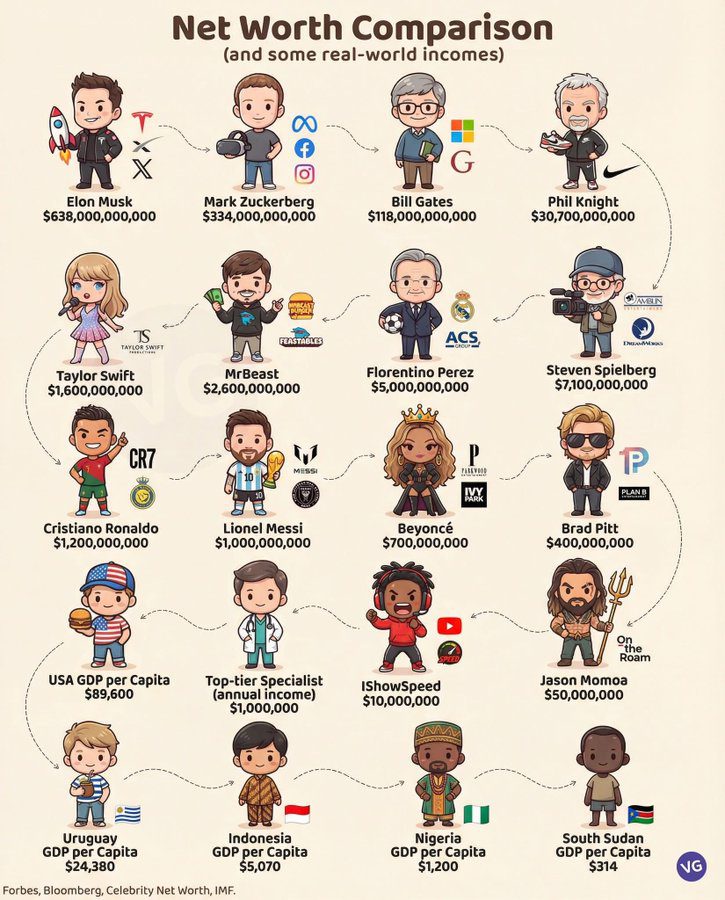
This article breaks down the real stories behind the people featured in the infographic—how they made their money, what patterns show up repeatedly, and what ordinary people can actually learn from them to build a stable, comfortable, and financially resilient life.
This isn’t about worshipping billionaires.
It’s about extracting usable financial lessons.
Elon Musk — Turning Engineering Into Exponential Leverage
Estimated net worth: ~$638 billion (varies wildly with markets)
Elon Musk’s wealth comes primarily from ownership, not salary. Tesla and SpaceX are equity-driven machines. His strategy wasn’t to be paid well—it was to own large stakes in companies positioned at the intersection of technology, government contracts, and future infrastructure.
Key insights:
- Musk repeatedly reinvested his earnings into new ventures instead of diversifying early.
- He accepted extreme personal risk and long periods of negative cash flow.
- He leverages public markets (Tesla) and private markets (SpaceX) simultaneously.
Lesson for regular investors:
You don’t need rockets—but you do need equity. Owning a small piece of scalable systems beats being paid well forever.
Mark Zuckerberg — Platforms Create Permanent Cash Flow
Estimated net worth: ~$334 billion
Zuckerberg’s wealth came from building a platform, not a product. Facebook (now Meta) didn’t sell software—it sold attention.
Advertising-based platforms scale faster than almost any other business model because:
- Marginal cost approaches zero
- Network effects lock users in
- Data compounds in value
Lesson:
If you’re building online—blogs, apps, communities—think platform-first, not “side hustle.”
Bill Gates — Timing + Distribution Wins
Estimated net worth: ~$118 billion
Gates didn’t invent the personal computer—but Microsoft controlled the operating system layer, which became unavoidable.
What’s often overlooked:
- Gates licensed software instead of selling it outright.
- Microsoft benefited from massive enterprise lock-in.
- Later, Gates diversified aggressively into infrastructure, farmland, and health.
Lesson:
You don’t need to invent. You need to control distribution.
Phil Knight — Branding Is Financial Power
Estimated net worth: ~$30.7 billion
Nike is proof that branding itself is an asset class. Knight outsourced manufacturing and focused relentlessly on:
- Athlete endorsement
- Brand identity
- Emotional storytelling
Nike doesn’t sell shoes. It sells status and aspiration.
Lesson:
In business, perception often scales faster than engineering.
Taylor Swift — Owning Your Masters Changes Everything
Estimated net worth: ~$1.6 billion
Swift’s wealth exploded when she began reclaiming ownership of her music. Touring, merchandise, and re-recordings turned her into a vertically integrated brand.
Lesson:
Creative work becomes real wealth only when you own the rights.
MrBeast — Attention Compounds Like Capital
Estimated net worth: ~$2.6 billion
MrBeast reinvests nearly all earnings back into content, creating a feedback loop:
attention → revenue → bigger content → more attention.
He monetizes through:
- YouTube ads
- Brand deals
- Physical products (Feastables)
- Equity in ventures
Lesson:
Reinvestment beats lifestyle inflation every time.
Florentino Pérez — Infrastructure Wealth Is Quiet
Estimated net worth: ~$5 billion
Pérez made his money in construction and infrastructure, not football. Real Madrid amplified his brand—but ACS Group built his fortune.
Lesson:
Boring industries often produce the most durable wealth.
Steven Spielberg — Intellectual Property Pays Forever
Estimated net worth: ~$7.1 billion
Spielberg negotiated backend deals, earning percentages of box office and licensing long after release.
Lesson:
IP that pays repeatedly is worth more than one-time paydays.
Cristiano Ronaldo — Brand > Career
Estimated net worth: ~$1.2 billion
Ronaldo monetized himself beyond sport:
- Endorsements
- Clothing lines
- Social media reach
Lesson:
Your personal brand can outlive your job.
Lionel Messi — Global Recognition Scales Income
Estimated net worth: ~$1 billion
Messi’s earnings include salary, sponsorships, and lifetime brand deals.
Lesson:
Global markets beat local ceilings.
Beyoncé — Vertical Integration in Entertainment
Estimated net worth: ~$700 million
Beyoncé controls production, distribution, touring, and branding.
Lesson:
Middlemen drain wealth. Ownership multiplies it.
Brad Pitt — Smart Investing Matters
Estimated net worth: ~$400 million
Pitt combined acting income with real estate and production equity.
Lesson:
High income doesn’t equal wealth unless invested intelligently.
IShowSpeed — Digital Fame Is Fast but Fragile
Estimated net worth: ~$10 million
Speed’s wealth is attention-driven and volatile.
Lesson:
Fast money requires fast discipline—or it disappears.
Jason Momoa — Diversification Protects Income
Estimated net worth: ~$50 million
Momoa combines acting with business ventures.
Lesson:
Multiple income streams reduce risk.
Income vs Wealth: The Reality Check
The infographic also highlights GDP per capita figures from different countries. This contrast matters.
High income ≠ high net worth
Wealth is what remains after expenses, after time, after mistakes.
What This Means for You
You don’t need to be famous.
You don’t need billions.
To live comfortably, you need:
- Ownership
- Skills with leverage
- Patience
- Low lifestyle drag
- Smart reinvestment
Most millionaires are:
- Business owners
- Investors
- Specialists
- Quiet accumulators
Final Thought
Wealth is not about chasing the richest people on Earth.
It’s about building durable systems that work while you sleep, grow while you age, and protect you when life gets unpredictable.
That’s real financial freedom.
And it’s achievable.
Pingback: The Wealth Mindset Framework Part 3: Discipline, Faith, and Paying Yourself First
you are truly a just right webmaster. The website loading speed is
amazing. It seems that you are doing any distinctive trick.
In addition, The contents are masterpiece. you’ve performed a wonderful activity on this subject!