
Oil, Inflation, and Interest Rates: Why Tech Investors Should Pay Attention
Most tech enthusiasts love talking about artificial intelligence, chips, robotics, software, automation, and the future of computing. That makes sense. Those are the exciting parts of the market. They feel futuristic, they attract capital, and they create the sense that we are living through a once-in-a-generation transformation.
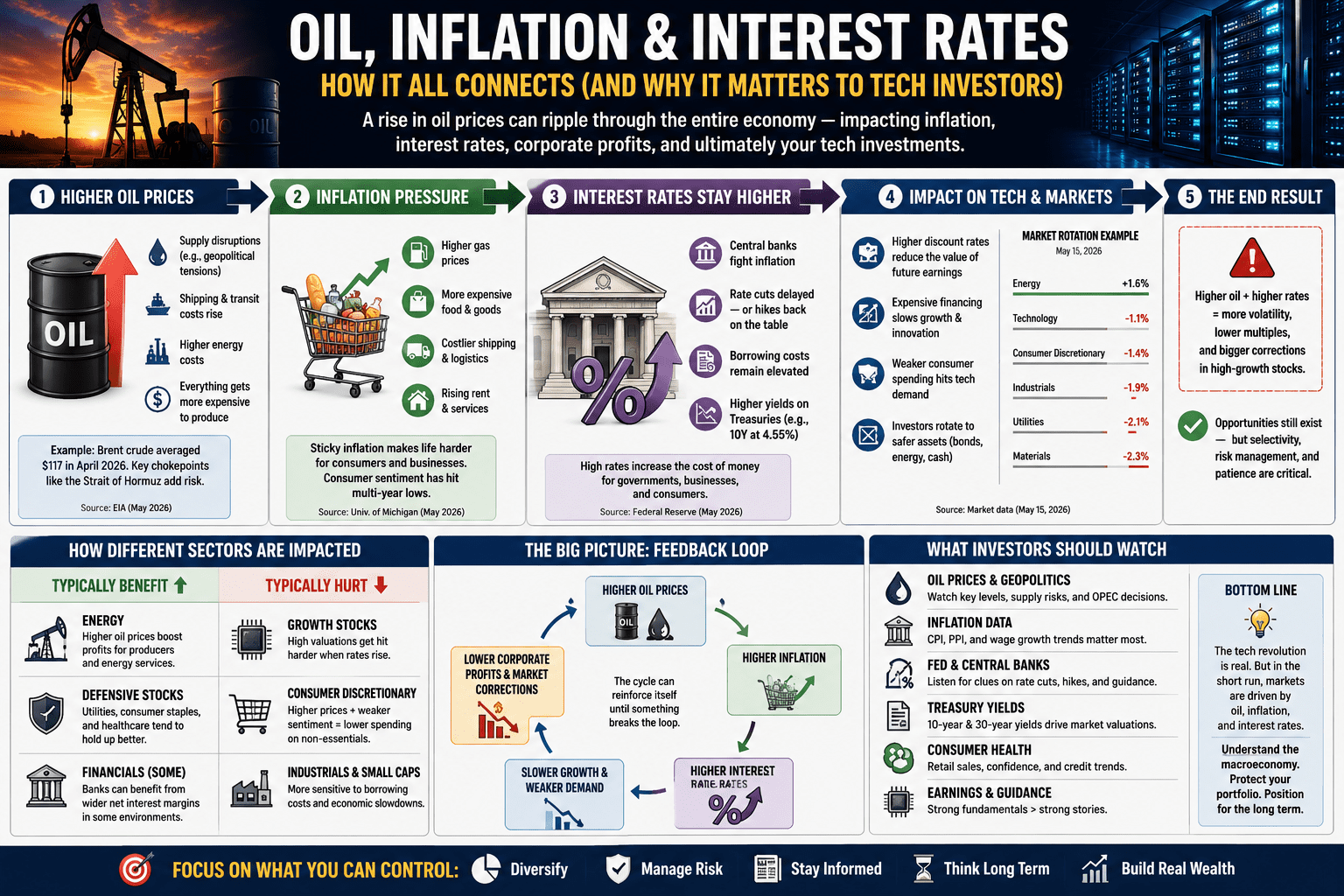
But there is a less exciting force that can crush even the most exciting tech story: the cost of money. When oil prices rise, inflation pressure can rise with them. When inflation pressure rises, central banks become more cautious. When central banks become more cautious, interest rates stay higher for longer. And when rates stay higher, high-growth technology stocks can suddenly look a lot more vulnerable.
That is the uncomfortable setup investors are dealing with now. The AI infrastructure boom may still be real, but the macro backdrop is getting harder. Oil markets are volatile, consumers are stretched, Treasury yields are elevated, and investors are being forced to ask whether the tech trade can keep climbing if inflation refuses to cool down.
This is where a lot of people make a mistake. They separate “cool tech trends” from “boring economic data,” as if Nvidia, Microsoft, data centers, and AI startups exist in a different universe from oil prices, electricity bills, mortgage rates, and household spending. They do not. Every tech boom eventually runs into the real economy.
What Is Happening Right Now?
The market is dealing with a messy combination of higher energy prices, inflation pressure, elevated interest rates, and uncertainty around future central bank policy. That combination matters because it affects both sides of the economy: households and corporations.
For households, higher gasoline, food, rent, and borrowing costs reduce disposable income. That means people have less money for restaurants, gadgets, home renovations, subscriptions, travel, and discretionary purchases. For corporations, higher rates increase financing costs, lower the present value of future profits, and make aggressive expansion harder to justify.
The U.S. Energy Information Administration recently described global oil markets as being in a period of heightened volatility and uncertainty due to the de facto closure of the Strait of Hormuz, a major oil transit chokepoint. The EIA reported that Brent crude averaged $117 per barrel in April 2026 and projected global oil inventories would fall sharply in the second quarter, keeping Brent around $106 per barrel in May and June.
That is not just an energy story. It is a market story, a consumer story, and a tech story. Oil affects transportation, shipping, plastics, agriculture, manufacturing, and consumer psychology. When energy gets expensive, it quietly raises the cost structure of almost everything.
At the same time, consumer confidence is weak. The University of Michigan’s preliminary May 2026 survey showed its Consumer Sentiment Index at 48.2, down from 49.8 in April and 52.2 a year earlier. That kind of sentiment reading tells investors something important: people may still be spending, but they do not feel good about the economy.
Why Tech Investors Should Care About Oil
At first glance, oil and tech seem like separate worlds. One is pipelines, tankers, refineries, diesel, gas stations, and geopolitical chokepoints. The other is code, chips, cloud computing, AI models, and software platforms. But in the market, these worlds are connected by inflation and interest rates.
Oil is one of the most psychologically powerful inflation inputs because people see it constantly. They see it at the gas pump. They see it in delivery fees. They see it in airline tickets. They see it in grocery prices when transportation costs rise. Even if a central bank prefers to focus on “core” inflation, households do not live in a core-inflation spreadsheet.
When oil prices rise, the market starts asking whether inflation will stay hot. If inflation stays hot, the Federal Reserve may have less room to cut interest rates, or in a more extreme scenario, may have to consider tightening again. The April 2026 FOMC minutes are relevant here because investors are watching how policymakers discuss inflation risks, growth risks, and the balance between patience and action.
This matters for tech because growth stocks are especially sensitive to interest rates. A company whose profits are expected far in the future becomes less valuable when the discount rate rises. That is finance-speak, but the idea is simple: if investors can earn more from safer assets, they become less willing to overpay for distant future growth.
That does not mean tech stocks automatically crash when oil rises. It means the margin for error shrinks. Expensive AI stocks, semiconductor stocks, cloud stocks, and speculative growth names need stronger earnings, stronger guidance, and clearer profitability to justify premium valuations.
The AI Trade Is Not Immune to the Macro Cycle
The AI infrastructure boom is still one of the most important investment stories in the world. Data centers, GPUs, storage, networking, cloud platforms, power systems, and AI software are attracting enormous capital. That part is real. But even real booms can correct when the macro environment turns hostile.
The newsletter material you provided made this point clearly: when oil and rates rose, technology and semiconductor names came under pressure, while energy was one of the few stronger areas. The same material argued that the market was pricing a world where oil stays high, rates move higher, and the AI trade alone may not be enough to carry everything.
That is the key insight. AI can be transformative and still be vulnerable to valuation resets. A company can be strategically important and still become overbought. A sector can have real long-term demand and still fall 20%, 30%, or more if investors were pricing in perfection.
This is why tech investors need to watch the bond market. The bond market often spots inflation and rate pressure before equity investors fully accept it. If long-term yields keep rising, it becomes harder for high-multiple tech stocks to keep expanding their valuations.
For AI infrastructure specifically, higher rates can create a second problem: financing. Data centers, power projects, semiconductor fabs, and grid upgrades are capital-intensive. When borrowing costs rise, the economics of new projects get tougher. That does not stop the strongest players, but it can hurt weaker companies, speculative suppliers, and projects built on optimistic assumptions.
The Strait of Hormuz Problem
The Strait of Hormuz matters because it is one of the most important energy chokepoints in the world. When oil and gas flows through that region are disrupted, the impact can ripple across global markets. The EIA has described the Strait of Hormuz as a major transit chokepoint through which nearly 20% of global oil supply flowed before the current disruption.
That is why investors pay attention when the region becomes unstable. It is not only about headlines or geopolitics. It is about physical supply. If tankers cannot move normally, oil supply tightens. If supply tightens, prices can rise. If prices rise, inflation pressure can spread. If inflation pressure spreads, central banks get boxed in.
Reuters reported on May 21, 2026, that ADNOC CEO Sultan Al Jaber said full oil flows through the Strait of Hormuz may not resume until the first or second quarter of 2027, even if the current Middle East conflict ends immediately. That is a major statement because it suggests the market may be dealing with a long repair and normalization period, not just a short-term headline scare.
The International Energy Agency has also warned that oil markets are approaching a critical “red zone” as reserves decline and Middle East exports remain limited. The risk is not just that oil spikes for a few days. The risk is that elevated energy costs linger long enough to shape inflation expectations, household behavior, business margins, and central bank policy.
For tech investors, that means one thing: do not treat energy risk as somebody else’s problem. The AI economy may run on chips, but those chips run inside data centers, and those data centers run on electricity. Energy is part of the tech stack now.
How Higher Interest Rates Hit Tech Stocks
Interest rates affect technology stocks in several ways. The first is valuation. High-growth companies are often valued based on earnings expected many years in the future. When rates rise, those future earnings are discounted more heavily, which can reduce the stock’s fair value even if the business is still growing.
The second is capital cost. Many technology companies, especially smaller ones, rely on external financing to fund growth. Higher rates make debt more expensive and equity financing less attractive. That can slow expansion, reduce hiring, and push companies to focus on profitability sooner than planned.
The third is customer spending. If businesses face higher borrowing costs, they may delay software purchases, cloud migrations, hardware upgrades, and AI projects. The strongest AI investments may continue, but marginal projects can get cut or delayed.
The fourth is investor psychology. In a low-rate world, investors tolerate big dreams and long timelines. In a high-rate world, they demand cash flow, margins, and proof. That is why the same company can be loved in one rate environment and punished in another.
This is especially important for small caps. Small-cap stocks often have less access to cheap capital, weaker balance sheets, and more sensitivity to economic slowdowns. If you are targeting “small caps” as an SEO keyword, this is a useful angle: small caps can offer explosive upside, but they are also more exposed when rates stay high and investors become defensive.
The Consumer Squeeze Is Showing Up
The consumer is the bridge between macro pressure and corporate earnings. If households feel squeezed, companies eventually feel it too. That is why investors are watching retailers, restaurants, home improvement stores, and discount chains closely.
Home Depot is a useful signal because its core customer is often a homeowner with at least some financial stability. Home Depot reported first-quarter fiscal 2026 sales of $41.8 billion, up 4.8% from the prior year, while comparable sales increased just 0.6% and U.S. comparable sales rose 0.4%.
That is not a disaster, but it is not a boom either. For investors, the important question is whether homeowners are delaying bigger renovation projects because of mortgage rates, inflation, and uncertainty. If the financially stronger consumer is becoming more cautious, that raises questions about everyone below them.
The newsletter content made the same point bluntly: Home Depot’s customer is one of the more protected consumer cohorts, and even that customer appears to be putting off big renovation projects. It framed Home Depot as “the ceiling,” meaning Target and Walmart would help show whether pressure was spreading further down the income ladder.
That matters for tech because consumer weakness can hit hardware, subscriptions, e-commerce, advertising, travel, restaurants, and discretionary software. It can also affect companies that depend on small businesses, because small businesses often feel consumer pressure quickly.
Why This Matters for Everyday Investors
For everyday investors, this environment is frustrating because the signals conflict. On one hand, AI, cloud computing, automation, and defense technology look like powerful long-term trends. On the other hand, oil, inflation, rates, and consumer stress are making the short-term setup more dangerous.
This is where discipline matters. The goal is not to predict every market move perfectly. The goal is to avoid putting yourself in a position where one bad macro turn wrecks your entire plan.
A practical investor should ask a few questions before chasing any tech or AI stock right now:
- Does this company produce real free cash flow, or does it constantly need new financing?
- Is the valuation already assuming perfect growth?
- Would higher rates hurt this company’s customers?
- Is the company exposed to energy, data center, or supply-chain costs?
- Does the stock still make sense if the market stops rewarding hype?
Those questions are not meant to scare people away from investing. They are meant to keep people from gambling. There is a big difference between investing in a long-term trend and buying into a hot story at any price.
What Tech Enthusiasts Should Watch Next
Tech enthusiasts should watch energy prices, Treasury yields, Fed commentary, and consumer earnings with the same seriousness they watch product launches and chip benchmarks. That may sound boring, but it is how the market actually works.
The first thing to watch is oil. If oil stays elevated, inflation pressure becomes harder to dismiss. If oil falls because supply normalizes, pressure may ease. But if oil falls because demand is collapsing, that tells a different story: the economy may be slowing.
The second thing to watch is the 10-year Treasury yield. Rising yields can pressure growth stocks, mortgage rates, business borrowing, and valuation multiples. If yields stabilize, tech stocks may regain breathing room. If yields keep rising, investors may become more selective.
The third thing to watch is earnings guidance from major tech companies. Revenue growth is important, but guidance matters more. If companies keep spending heavily on AI infrastructure while customers keep signing contracts, the bull case strengthens. If management teams start talking about delays, margin pressure, or slower enterprise demand, investors should pay attention.
The fourth thing to watch is consumer behavior. Retailers, restaurants, payment companies, credit card delinquencies, and discount chains can tell you whether inflation is becoming a true demand problem. Weak consumers eventually affect many tech companies, especially those tied to advertising, e-commerce, devices, and subscriptions.
The fifth thing to watch is small caps. If rates stabilize and investors regain risk appetite, small caps can bounce hard. But if rates stay high and credit tightens, small caps can stay under pressure even while mega-cap tech holds up.
The Canadian Angle
For Canadian readers, this story matters too. Canada may not set U.S. interest rate policy, but Canadian markets, mortgages, energy prices, job conditions, and tech valuations are deeply influenced by global rates and commodity prices.
Higher oil prices can help parts of Canada’s energy sector, but they can also raise costs for households and businesses. Higher U.S. yields can pressure Canadian rates, the Canadian dollar, and investor appetite for risk. A weaker consumer environment in the U.S. can also affect Canadian exporters, retailers, and cross-border business activity.
The Canadian job market angle is especially important. If businesses face higher rates and weaker demand, hiring can slow. At the same time, AI and automation are changing the type of workers companies want. The safest long-term path may be to build hybrid skills: technical literacy, practical problem-solving, AI tool usage, cybersecurity awareness, data skills, and industry-specific knowledge.
That is why this topic belongs on a finance site. It is not just about whether oil goes up or down. It is about how regular people protect their income, invest smarter, avoid panic, and position themselves for a changing economy.
The Skeptical View
The skeptical view is that markets may be overreacting. Oil prices can spike and then normalize. Inflation can rise temporarily and then fade. Consumers can complain in surveys but keep spending in real life. Tech companies can absorb higher rates if their earnings growth is strong enough.
That is all fair. Markets often price fear too aggressively in the short term. If oil flows improve, inflation expectations cool, and the Fed stays patient, tech stocks could recover quickly. In that scenario, the pullback in AI and semiconductor names may look like another buying opportunity.
But investors should be careful with the word “temporary.” Many inflation shocks start as temporary. The problem is what happens if they last long enough to change behavior. If workers demand higher wages, businesses raise prices, consumers trade down, and central banks become more hawkish, a temporary shock can become a longer cycle.
The correct position is not blind optimism or constant fear. It is conditional thinking. If oil eases and rates stabilize, risk assets may regain momentum. If oil stays high and yields keep rising, investors should expect more pressure on expensive growth stocks.
Final Verdict: The Macro Still Matters
The biggest mistake tech investors can make right now is believing that innovation cancels out the macro cycle. It does not. AI may change the world, but it still has to survive electricity costs, interest rates, financing conditions, customer budgets, and investor expectations.
Oil, inflation, and interest rates matter because they determine the environment in which innovation gets funded. When money is cheap and inflation is calm, investors fund big dreams. When money is expensive and inflation is sticky, investors demand proof.
That does not mean the tech boom is over. It means the easy part may be over. The next phase may reward companies with real demand, real margins, strong balance sheets, and essential infrastructure. It may punish companies that only have a story.
For readers trying to build net worth, the lesson is simple: stay exposed to the future, but do not ignore the present. AI, automation, and data centers may define the next decade, but oil prices, rates, and consumer pressure can decide what happens to your portfolio this year.
The smartest investors do not panic every time the market shakes. They also do not pretend risk does not exist. They watch the signals, size their bets, keep cash available, avoid overconcentration, and remember that wealth is built by surviving long enough for compounding to work.
Relevant External Links
U.S. Energy Information Administration — Short-Term Energy Outlook: Global Oil Markets
Federal Reserve — April 28–29, 2026 FOMC Minutes