
Your first sale is the hardest one you’ll ever make.
Not because your product is bad, but because everything is unproven. You don’t know if your offer works, if people care, or if your marketing is even reaching the right audience. That uncertainty creates hesitation, and hesitation kills momentum.
But here’s the truth most people miss: your first sale isn’t about scaling—it’s about validation. Once you prove that one person is willing to pay, everything changes. Confidence goes up, clarity improves, and your next steps become obvious.
1. Stop Thinking Like a Business—Start Thinking Like a Customer
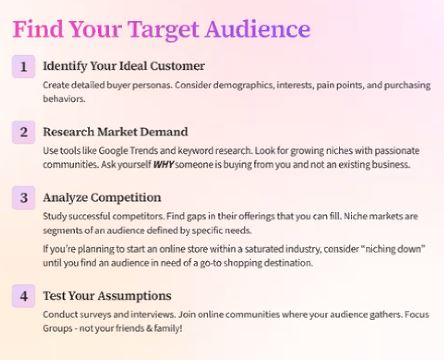
Most beginners approach their first sale from the wrong angle. They think about their product, their logo, their website, and how everything looks. But customers don’t care about any of that initially—they care about themselves.
Your job is to understand what someone wants badly enough to pay for. Not what you think is cool, not what you think should work—what already has demand. This shift alone will save you months of wasted effort.
A strong starting point is to anchor your idea in a real-world desire or frustration. That could be saving time, making money, improving health, or solving a daily inconvenience. If your offer connects directly to one of those, you’re on the right track.
- Focus on the customer’s outcome, not your product
- Identify a specific group, not “everyone”
- Look for existing demand, not hypothetical interest
If you get this wrong, nothing else matters. If you get it right, everything becomes easier.
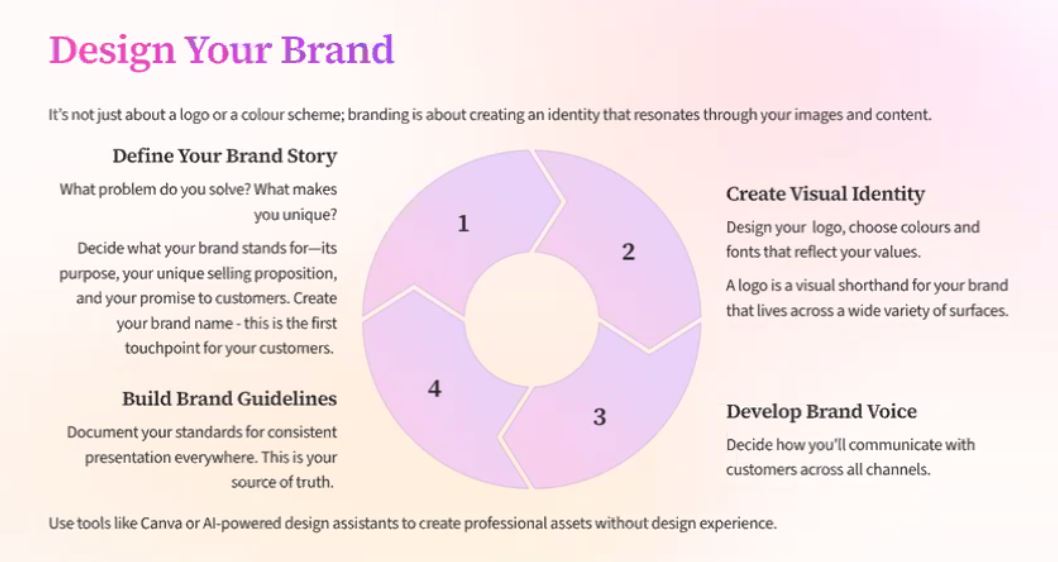
2. Define Your Brand Story (Even at the Beginning)
A lot of people skip branding because they think it’s just logos and colors. That’s a mistake. Branding is about meaning—why your product exists and why someone should trust it.
Even at the early stage, your brand should answer one simple question:
“Why should I buy from you instead of anyone else?”
You don’t need a polished identity, but you do need a clear message. People buy from brands they understand and relate to. If your messaging is vague, your conversion rate will suffer.
Your brand story doesn’t have to be dramatic. It just has to be clear and consistent.
- What problem do you solve?
- Who do you help?
- What makes your approach different?
When your branding aligns with your audience, your marketing becomes much more effective.
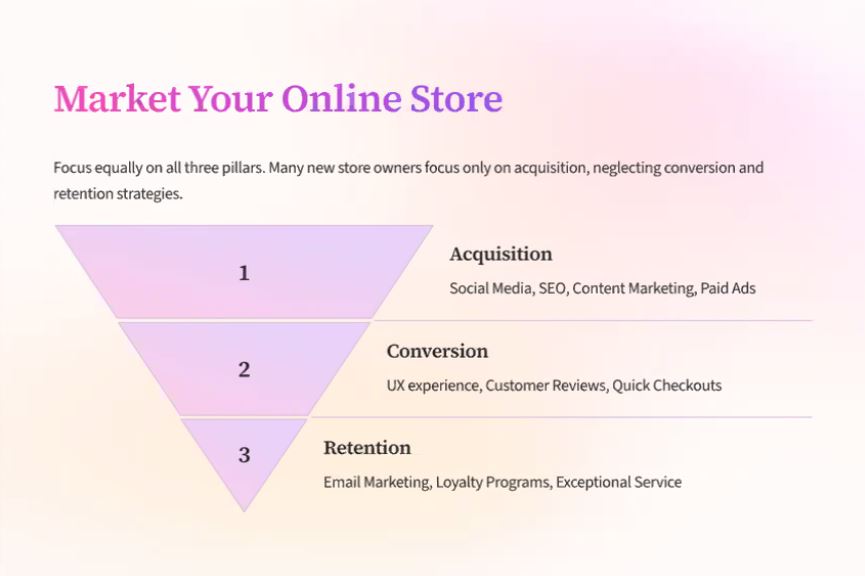
3. Focus on the Three Pillars: Traffic, Trust, Conversion
Your slides hinted at something critical:
Most people focus only on getting attention—and ignore everything else.
That’s why they struggle to make sales.
To get your first sale, you need to balance three things at once. If even one is missing, the system breaks.
- Traffic → People need to see your offer
- Trust → People need to believe in it
- Conversion → People need a reason to act
Think of it like a chain. If one link is weak, nothing moves forward.
Where Beginners Go Wrong
They usually do one of these:
- Get traffic but no sales (no trust or weak offer)
- Build a product but no traffic (nobody sees it)
- Have interest but no conversion (no urgency or clarity)
Your job is to keep all three aligned—even at a basic level.
4. Market Your Offer Where People Already Are
You don’t need to build an audience from scratch to get your first sale. That’s slow and inefficient. Instead, go where your audience already exists.
This is one of the fastest ways to validate your idea. Instead of waiting for people to find you, you put your offer directly in front of them.
Think platforms, not isolation. Communities, not empty websites.
- Reddit communities related to your niche
- YouTube comments and tutorials
- Facebook groups
- Niche forums
The goal is simple: show your offer to people who already care about the problem you’re solving.
Key Insight
Your first sale often comes from direct interaction, not passive discovery.
That means you may need to:
- Answer questions
- Start conversations
- Offer value first
This isn’t scalable—but it works.
5. Make Your Offer Easy to Say Yes To
At the beginning, your biggest obstacle is friction. If someone hesitates for even a second, you lose them.
Your offer needs to feel simple, clear, and low-risk.
You don’t need a perfect product—you need a compelling reason to try it.
- Clear benefit (what they get)
- Clear price (no confusion)
- Clear action (what to do next)
If your offer requires explanation, it’s too complicated.
Simple Wins for First Sales
- Offer a discounted “early user” price
- Provide a simple guarantee
- Keep the product focused on one result
Your goal is not perfection—it’s conversion.
6. Remove Doubt Before It Appears
People don’t buy because of doubt, not because of price.
Your job is to remove that doubt before it even forms.
Think about what someone might hesitate about:
- “Will this work?”
- “Is this legit?”
- “Is this worth it?”
Then answer those questions proactively.
- Show examples or results
- Keep messaging clear and honest
- Avoid exaggeration
Trust is built through clarity, not hype.
7. Take Action Before You Feel Ready
This is the part most people struggle with.
They wait.
They tweak.
They optimize.
And they never actually put their offer in front of real people.
Your first sale doesn’t come from perfect preparation. It comes from action.
- Publish the offer
- Share it where your audience is
- Learn from the response
Speed matters more than perfection at this stage.
8. Your First Sale Changes Everything
Once you get that first sale, something shifts.
You now have proof.
Proof that someone is willing to pay. Proof that your idea works. Proof that you’re on the right track.
From there, your job becomes refinement, not guessing.
- Improve the offer
- Improve the messaging
- Improve the distribution
But it all starts with that first conversion.
Final Thought
Your first sale is not about building a perfect business.
It’s about proving that your idea has real-world value.
Focus on clarity, action, and direct engagement, and you’ll get there faster than most people who are stuck overthinking.
Once that first sale happens, everything else becomes easier.