
Why More People Are Building Income Ecosystems Instead
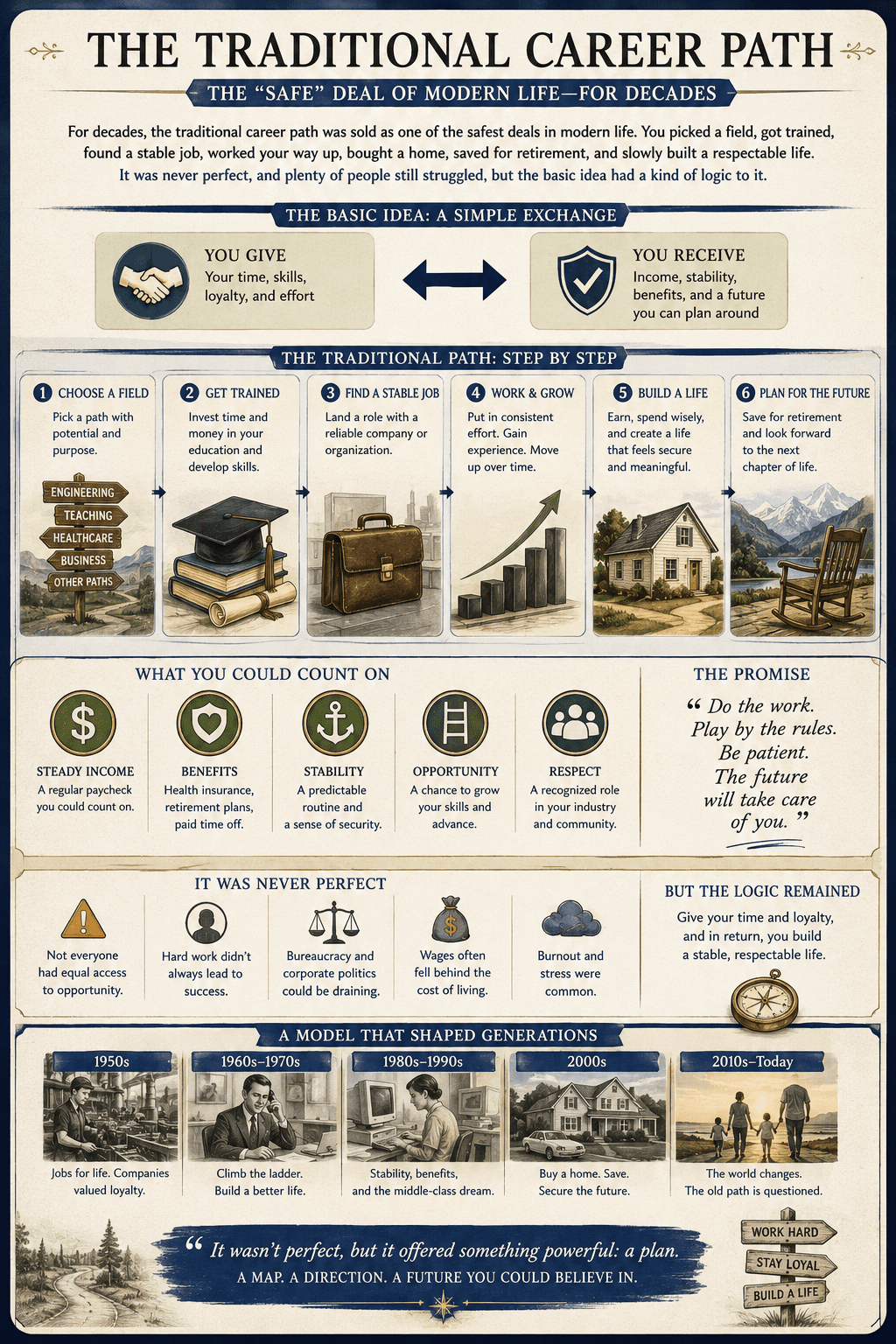
For decades, the traditional career path was sold as one of the safest deals in modern life. You picked a field, got trained, found a stable job, worked your way up, bought a home, saved for retirement, and slowly built a respectable life. It was never perfect, and plenty of people still struggled, but the basic idea had a kind of logic to it. Give your time and loyalty to a company or profession, and in return, you would receive income, stability, benefits, and a future you could plan around.
That deal feels weaker now.
Today, many people are looking at the old career model and quietly asking whether it still deserves their trust. Layoffs happen with little warning. AI tools are starting to automate tasks that once required trained office workers. Housing and food costs have made ordinary life more expensive. Meanwhile, social media shows endless examples of people building online businesses, selling digital products, running Etsy shops, creating YouTube channels, writing newsletters, freelancing, investing, and using AI to do things that once required a full team.
This is where the idea of an income ecosystem becomes important. Instead of relying on one job, one boss, one company, one industry, or one fragile paycheque, more people are trying to build several connected sources of income. Some are tiny at first. Some may never become huge. But together, they create something traditional employment often no longer provides: optionality.
An income ecosystem is not just “having a side hustle.” It is a broader way of thinking about financial survival and financial growth. It means building skills, assets, content, products, relationships, tools, and income streams that support each other over time. A person might have a job, a small Etsy shop, a niche website, a YouTube channel, digital PDFs, freelance work, investments, local services, and AI-assisted tools all feeding into the same long-term system.
That may sound scattered at first, but for many people, it is starting to look more realistic than depending completely on one employer forever.


The Old Career Model Is Losing Its Psychological Power
The traditional career model depended on one extremely important belief: if you worked hard and stayed loyal, the system would eventually reward you. That belief has been weakened by decades of restructuring, outsourcing, inflation, technological disruption, and corporate behaviour that increasingly treats workers as flexible costs rather than long-term partners. People still need jobs, of course, but many no longer see employment as a true guarantee of security.
That loss of trust matters. Once people believe a company can replace them at any time, they naturally start thinking differently. They ask why they should devote all their energy to building someone else’s system while owning nothing themselves. They begin to wonder what would happen if their role was automated, their department was cut, their industry declined, or their health made full-time work harder.
The finance newsletters you provided captured this uncertainty well. One section noted that AI-related data center construction is creating jobs right now, but questioned how many of those jobs remain once the servers are built and running. It described the current boom as less of a broad manufacturing comeback and more of a data center construction wave tied to AI spending.
That is a perfect example of the modern economy. Jobs appear in new places, but they may not look like the stable long-term careers people once expected. A construction boom can be real and still temporary. An AI company can grow rapidly while employing fewer people than an older industrial giant. A platform can create opportunity while also concentrating power.
This is why people are not simply being paranoid when they talk about career insecurity. The ground is genuinely moving.
AI Is Making Independent Building More Realistic
Artificial intelligence is one of the biggest reasons income ecosystems suddenly feel more possible. Ten or fifteen years ago, if you wanted to build an app, design a product, create a website, write marketing copy, make graphics, edit videos, automate tasks, or launch a polished online business, you often needed money, technical skill, or a small team. Today, one determined person with AI tools can attempt projects that would have been unrealistic before.
That does not mean everything is easy. This is where online hype gets dangerous. AI can help someone move faster, but it does not magically replace judgment, taste, persistence, business sense, or consistency. A person can use AI to build an app, but they still need to understand the problem, test the product, serve users, market it, fix bugs, and keep going when the first version fails.
Still, the shift is enormous. The barrier between “I have an idea” and “I can try building this” has collapsed. A non-coder can now use plain English to explore software ideas. A small creator can make visuals, outlines, landing pages, scripts, and product descriptions. A solo entrepreneur can research markets, draft business plans, create content, and build simple automations without hiring specialists for every step.
McKinsey estimated that generative AI could add trillions of dollars in annual value across the global economy, with particularly large effects in customer operations, marketing and sales, software engineering, and research and development. It also noted that workers will need support as work activities shift and some people change occupations.
That is the contradiction of AI. It creates opportunity for individuals while also creating pressure on traditional employment. It gives workers new tools while forcing them to keep adapting. It makes entrepreneurship more accessible while making the job market feel less predictable.
The “Too Much Free Time” Conversation Feels Detached From Real Life
One of the strangest parts of the AI debate is hearing extremely wealthy people worry about what ordinary people will do if AI creates too much free time. The concern is usually framed as philosophical: if machines do more work, where will people find purpose? What will humans do all day? How will society function if traditional work becomes less necessary?
There is a real economic question underneath that, but the way it is often discussed feels completely detached from ordinary life.
Most working people are not terrified of having free time. Many are exhausted. They are commuting, paying bills, raising families, managing debt, dealing with stress, and trying to keep up with an economy that keeps demanding more. The average person is not sitting around worried that a life with less forced labour would be too meaningful. Many would love more time to rest, learn, build, exercise, repair their homes, raise their kids, start businesses, create art, garden, travel, volunteer, or simply breathe.
The real issue is not whether people can find purpose without a boss. People can absolutely find purpose without a boss. The issue is whether the economic gains from AI will be distributed in a way that allows ordinary people to live with dignity if traditional labour becomes less central.
That is the unsolved mystery. AI may create incredible productivity. But if that productivity mainly flows to shareholders, executives, platform owners, and companies with massive capital advantages, then ordinary workers may not experience “freedom.” They may experience displacement, wage pressure, and a desperate race to adapt.
That is why building an income ecosystem is not just trendy. It is a rational response to uncertainty.
Small Business Is Not Dead, But It Is Changing
It is tempting to say small business is dead because big companies dominate so much of the modern economy. Amazon dominates online shopping. Google dominates search. Meta dominates social advertising. Microsoft dominates workplace software. Apple controls an enormous mobile ecosystem. NVIDIA became central to AI infrastructure. Shopify powers countless online stores. The modern entrepreneur often operates inside platforms owned by giants.
But small business is not dead. It is being reshaped.
The Canadian government’s 2025 small business statistics show that small businesses employed 5.8 million people in Canada in 2024, representing 46.6% of the private labour force. That is not a dead sector; that is nearly half of private employment.
The real change is that small businesses increasingly need to be smarter, leaner, more digital, and more adaptive. A local woodworking business can also be a YouTube channel. A niche blog can support Etsy products. A finance website can become a newsletter, video channel, and digital download store. A hobby can become a content library. A service business can use AI for admin, quotes, marketing, customer communication, and documentation.
This is where the income ecosystem model becomes powerful. The modern small operator does not have to think in one lane. A single project can become an article, a short video, a PDF, a product listing, a Pinterest pin, a newsletter, and eventually a paid guide.
The winners may not be the people who chase every shiny object. The winners may be the people who connect their efforts so each piece strengthens the next.
Why Multiple Jobholding and Side Income Keep Growing
The rise of income ecosystems is not just an online fantasy. The labour market already shows signs that people are piecing together work in more complex ways. Statistics Canada data shows total employed multiple jobholders increased from about 966,400 in 2021 to about 1,178,600 in 2025.
That does not mean everyone with multiple jobs is building a dream business. Some people are simply trying to survive. That distinction matters. Multiple income streams can be empowering when they create choice, but exhausting when they are forced by necessity.
This is why readers need a realistic approach. The goal is not to glorify burnout. The goal is to gradually move from fragile extra work toward durable extra assets. Delivering food after work can bring in cash, but it usually stops paying when you stop driving. A digital product, content library, niche website, or small tool can potentially keep working after the first effort is complete.
That is the difference between extra labour and an income ecosystem. Extra labour gives you more money now. Assets give you more leverage later.
A smart modern strategy may include both, but people should know which one they are building.
The Income Ecosystem Model
An income ecosystem works best when the pieces are connected instead of random. Random side hustles can become exhausting because they pull your energy in different directions. A connected ecosystem compounds because one effort feeds another.
For example, a person building a practical DIY brand might write articles, film projects, sell PDF plans, post Pinterest pins, make YouTube videos, offer templates, and eventually sell physical products or courses. Each piece supports the others. The article brings search traffic. The video builds trust. The PDF creates revenue. The email list keeps the audience connected. The product gives people something useful to buy.
A finance creator might do the same thing with market explainers, budgeting templates, AI economy reports, side hustle guides, newsletters, short videos, and digital downloads. The point is not to become a giant company overnight. The point is to create a small system where attention, trust, and products work together.
A healthy income ecosystem usually has three layers. The first layer is active income, such as a job, contract work, freelancing, or local services. The second layer is semi-active income, such as content, Etsy products, digital guides, affiliate-style resources, or paid newsletters. The third layer is asset income, such as investments, owned websites, email lists, evergreen products, software tools, or businesses that can operate with systems.
Most people start with active income because they need cash flow. That is normal. The mistake is staying forever in pure active income without slowly building anything that can compound.
AI Makes the Solo Builder More Dangerous
AI gives solo builders leverage, but it does not remove the need for discipline. This is important because a lot of people will use AI to create noise. They will generate generic articles, generic products, generic videos, and generic advice. That may work briefly, but over time people still respond to usefulness, personality, taste, and trust.
The real advantage comes when someone combines AI with lived experience. A person who actually builds raised beds, studies finance, fixes websites, creates PDFs, experiments with Etsy, learns AI, and documents the process has something more valuable than generic content. They have proof of work.
That is where a GoFinkle-style ecosystem has potential. Multiple niche websites can look scattered if they are treated as random disconnected projects. But if they become a long-term library of real projects, lessons, guides, visuals, tools, and digital products, they become a media-and-product ecosystem. That is much stronger than chasing one low-commission affiliate link at a time.
The key is patience. These systems often take years, not weeks. That is frustrating, but it is also why most people quit before the compounding starts.
The Danger: Hustle Culture Can Eat Your Life
There is a trap here, and it needs to be said clearly. Building an income ecosystem can become unhealthy if every hobby, thought, skill, and spare hour gets turned into a monetization project.
The internet is full of people telling you to wake up at 4 a.m., build five businesses, post on every platform, optimize every minute, and never relax. That can sound motivating for about three days. Then reality hits. People have families, jobs, health issues, messy houses, financial stress, and limited energy.
The goal is not to become a machine. The goal is to build a more resilient life.
A strong income ecosystem should eventually reduce fragility, not increase it. It should give you more options, not make you feel guilty for resting. It should help you gain control of your time, not turn every waking moment into a productivity contest.
This is why readers should start small. One extra income stream built properly is better than ten half-built ideas that create anxiety. One useful PDF, one strong website category, one consistent newsletter, one service offer, one practical YouTube series, or one well-made product can become the seed of something larger.
What Readers Can Actually Do This Month
The most useful step is to stop thinking in vague dreams and start thinking in assets. An asset is something that can keep creating value after the first effort. That might be a product, a website, a skill, an audience, a template, a guide, a tool, a process, or a relationship.
A practical first month might look like this: choose one topic where you have real interest or experience, create one genuinely useful piece of content, turn part of that content into one simple downloadable resource, and share it on one or two platforms where the audience already exists. Do not build a giant empire first. Build a working loop.
For example, a person interested in personal finance could write one article about reducing monthly expenses, create a printable budget sheet, post short clips discussing the topic, and collect emails from readers who want the template. A DIY creator could build one project, photograph the steps, write a guide, make a PDF plan, and post a short video. A tech learner could document one AI workflow and turn it into a checklist or tutorial.
The point is not perfection. The point is creating a repeatable system.
Once one loop works, repeat it. Article to product. Product to video. Video to traffic. Traffic to email list. Email list to future product. That is how an income ecosystem begins.
The Investor Angle: Follow the System, Not the Hype
This article is not investment advice, but readers should understand the investment lesson hiding inside this trend. The market is increasingly rewarding systems, platforms, infrastructure, and scalable assets. That is true for giant AI companies, but it is also true at the personal level.
The newsletters you uploaded repeatedly point to structural shifts underneath the headlines: AI infrastructure spending, data center construction, energy bottlenecks, private credit stress, consumer pressure, and market concentration. One section described five private credit confirmations in seven days and warned that financial sector weakness was pricing stress the broader market had not fully absorbed. Another noted that AI inflation may run on chip, memory, and server costs rather than just oil or geopolitical disruption.
The takeaway for ordinary readers is not to panic or chase every stock tip. It is to understand that the economy is becoming more system-driven. The people and companies with durable systems, strong balance sheets, adaptable skills, and diversified income are generally better positioned than those relying on one fragile source of cash flow.
That applies to a household just as much as a corporation.
Counterargument: Not Everyone Should Become an Entrepreneur
There is a fair skeptical view here. Not everyone wants to run a business. Not everyone has the energy, risk tolerance, or time to build digital products or content. Some people prefer stable employment, and there is nothing wrong with that. Society still needs nurses, teachers, tradespeople, engineers, drivers, accountants, public servants, technicians, and countless other traditional roles.
The point is not that everyone must become a full-time entrepreneur. The point is that more people may benefit from thinking entrepreneurially even if they keep their jobs.
That could mean learning AI tools to become more valuable at work. It could mean building a small emergency income stream. It could mean investing steadily. It could mean documenting your skills online. It could mean selling one useful product per year. It could mean having a backup plan before you need one.
The income ecosystem mindset is not about rejecting jobs entirely. It is about refusing to let one job be your entire financial identity.
Final Verdict
The traditional career is not disappearing overnight, but its role is changing. The old promise of one employer, one ladder, one pension, and one secure path no longer feels reliable enough for many people. AI, inflation, layoffs, platform economics, rising costs, and rapid technological change are pushing workers to think differently about money and security.
That is why income ecosystems matter.
They give people a way to build optionality in an uncertain economy. They turn skills into assets. They turn projects into products. They turn content into trust. They turn AI from a threat into a tool. Most importantly, they help ordinary people stop depending entirely on systems they do not control.
This does not happen instantly. It may take years. It may feel painfully slow at first. But that is how real compounding usually works. The first website, first PDF, first video, first sale, first email subscriber, or first freelance client may not change your life immediately. But each one can become part of a larger system.
The future may belong less to people searching for the perfect career and more to people building flexible, connected, resilient income systems around themselves.
And in an economy this unpredictable, that may be one of the smartest financial moves a person can make.
Relevant External Links
World Economic Forum — Future of Jobs work and skills research.
McKinsey — The economic potential of generative AI
The key to this side income dream is consistency and relentless determination. You need to have faith through the times when no income from your endeavors is coming in. Fail fast,fail often and adapt accordingly.