
How to Buy Canadian During the U.S. Tariff Fight: Where Your Money Really Goes
A Canadian shopper walks into Costco and fills a cart with milk, meat, vegetables, toilet paper and household supplies. The warehouse employs Canadians, buys from Canadian suppliers and collects Canadian sales taxes—but Costco itself is an American corporation headquartered in Washington State. So is that shopper supporting Canada, supporting the United States or somehow doing both at once?
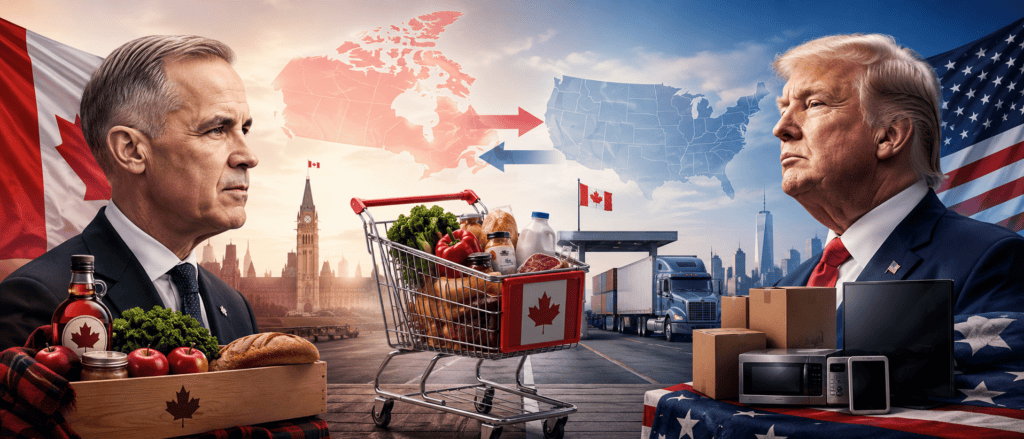
That question has become much more important as Canada and the United States move through another tense period of tariffs, counter-tariffs and political threats. Canadians are being encouraged to “buy Canadian,” but the advice is often reduced to flags, slogans and viral lists that do not explain where products were made, who owns the retailer or how much Canadian economic activity a purchase actually creates.
The reality is more complicated—and more useful—than a boycott list. Buying Canadian can mean shopping at a Canadian-owned company, purchasing something manufactured in Canada, choosing food grown by a Canadian farmer, hiring a local service provider or ordering directly from a Canadian small business. Those choices overlap, but they are not identical.
The strongest approach is not to swear off every American-owned store overnight. It is to understand where your money goes and redirect a realistic portion of your recurring spending toward Canadian workers, producers, manufacturers and businesses.
What Is Happening With Canada-U.S. Tariffs?
A tariff is essentially a tax placed on an imported product. Contrary to a common political talking point, the foreign government does not normally write the tariff cheque. The company or individual importing the product pays the tariff to its own government, after which some of that additional cost may be passed to customers through higher prices.
The Bank of Canada explains that importers, foreign suppliers and retailers may each absorb part of the cost, depending on competition and demand. However, tariffs can still leave consumers paying more, businesses earning lower margins and companies having less money available for investment. Tariffs on raw materials and components can also raise the price of products that appear to have nothing to do with international trade.
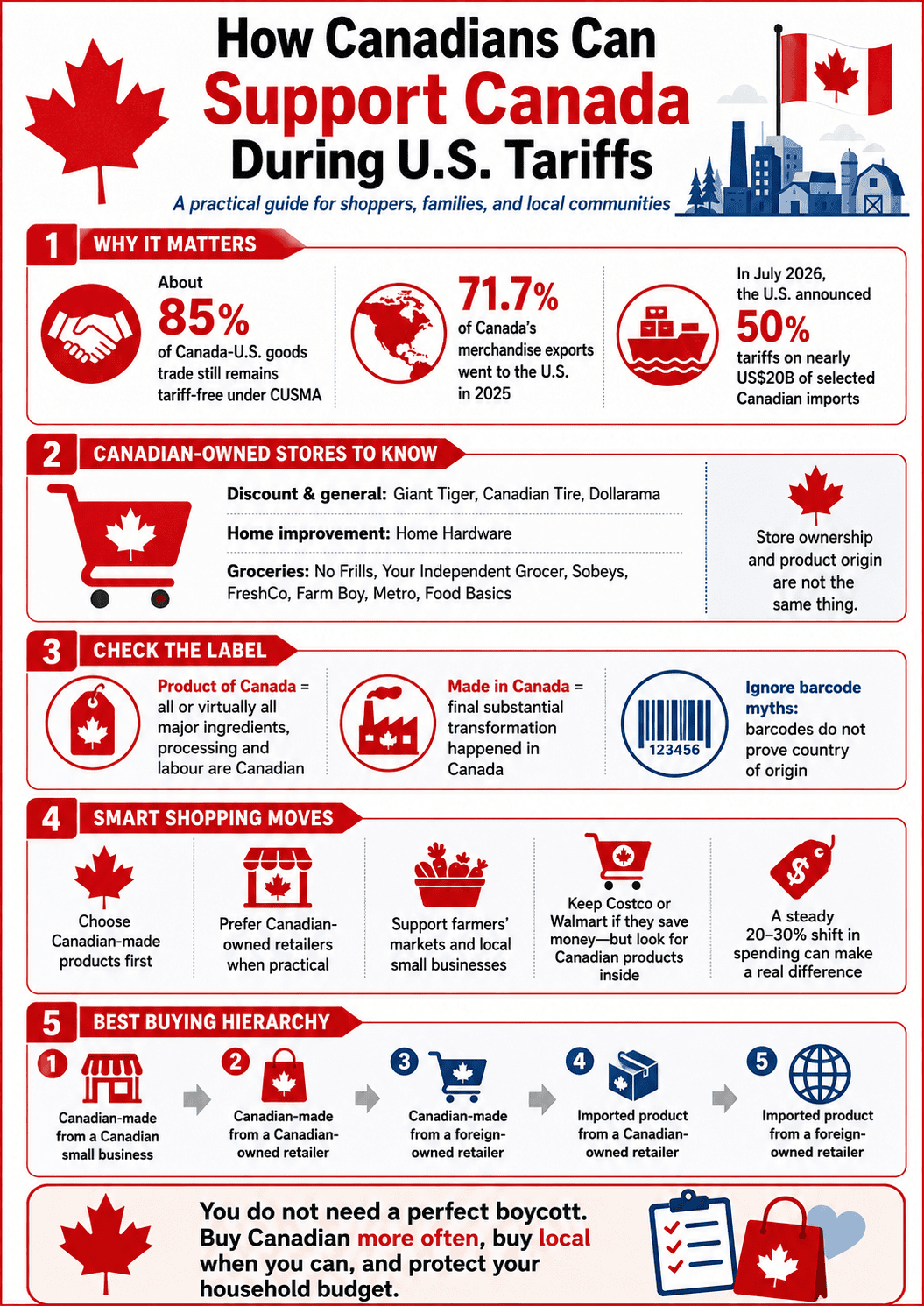
As of July 31, 2026, most trade between Canada and the United States remains tariff-free under the Canada-United States-Mexico Agreement, known in Canada as CUSMA and in the United States as USMCA. The Canadian government estimates that approximately 85% of Canadian goods trade continues to cross the border without tariffs, although industries including steel, aluminum, automobiles and lumber have been hit much harder.
Canada removed many of the broad counter-tariffs introduced in early 2025, but Canadian counter-tariffs on selected American steel, aluminum and automobiles remain. The federal government says those measures have been maintained because the United States continues to apply sector-specific tariffs without a full CUSMA exemption in those industries.
The dispute intensified again on July 20, 2026, when the United States announced additional 50% tariffs on nearly US$20 billion of Canadian imports. The U.S. administration linked those measures to disagreements involving automobiles, alcoholic beverages and dairy, with the new tariffs scheduled to take effect 30 days after the announcement. Canada has said it is considering its response while negotiations continue.
A separate American tariff action announced on July 23 targeted numerous economies over forced-labour policies. Canada faces a 10% rate under that measure, but qualifying CUSMA-compliant goods are exempt. That exemption is important because dramatic tariff headlines do not necessarily mean every Canadian product entering the United States suddenly faces the same tax.
Why Canadians Believe Their Shopping Choices Matter
The “buy Canadian” movement is partly economic and partly emotional. When a much larger neighbour threatens Canadian industries, it is natural for people to look for something they can personally control. Most Canadians cannot negotiate a trade agreement, change an industrial supply chain or impose a counter-tariff, but they can choose one brand of ketchup over another.
Supporters argue that shifting consumer demand helps protect Canadian employment, encourages retailers to carry more domestic products and signals that Canadian businesses have a reliable home market. Even a relatively small change can become meaningful when repeated across millions of households.
The attraction is also psychological. Choosing a Canadian product gives shoppers a way to respond without waiting for politicians or corporations to act. It transforms an abstract trade conflict into a visible decision at the grocery shelf.
That does not mean every purchase becomes an economic weapon. One household changing cereal brands will not reverse a tariff, and Canadian companies are not automatically more ethical, affordable or locally productive than foreign competitors. The useful question is not whether a purchase is perfectly Canadian—it is whether it keeps more production, employment, ownership and economic activity inside Canada than the available alternatives.
Canadian-Owned and Canadian-Made Are Not the Same
A product can be sold by a Canadian-owned retailer while being manufactured entirely overseas. Dollarama is a Canadian company founded in Quebec, for example, but many products on its shelves are imported. Buying there supports a Canadian corporation and Canadian retail employment, but it does not necessarily support Canadian manufacturing.
The opposite can also be true. An American-owned retailer may sell vegetables grown in Ontario, dairy processed in Quebec or packaged foods manufactured in Alberta. Buying those products can support Canadian farmers, factories, truck drivers and processors even though the retailer’s ultimate parent company is foreign-owned.
Costco is a good example of this middle ground. Costco Wholesale Corporation is American, and its consolidated profits ultimately belong to the American parent company and its shareholders. However, Costco’s Canadian operations employ Canadians, operate warehouses and distribution networks in Canada, purchase from Canadian suppliers and sell many Canadian products.
Walmart presents a similar situation. Walmart Canada openly identifies itself as part of Walmart Inc., but it also reports employing more than 100,000 people and working with close to 2,000 Canadian suppliers. Calling every dollar spent at Walmart “money sent to America” is therefore an oversimplification. Calling Walmart Canadian would also be inaccurate.
The most valuable purchases frequently combine several layers of Canadian economic activity:
- A product grown, manufactured or substantially transformed in Canada
- Purchased from a Canadian-owned retailer or independent business
- Using Canadian ingredients, materials and labour
- With profits reinvested in Canadian facilities, employees or communities
You will not be able to verify every layer while standing in a checkout line. Fortunately, you do not need to. Recognizing the difference between ownership and production already makes you a much more informed shopper.
Which Stores Are Actually Canadian-Owned?
Some of the most familiar Canadian retail names genuinely remain under Canadian ownership or control. Others have Canadian histories and Canadian headquarters but are owned by foreign parent companies. That distinction is rarely obvious from a storefront.
Giant Tiger
Giant Tiger is one of the clearest practical choices for shoppers who want a Canadian alternative to American discount chains. Its first store opened in Ottawa in 1961, and the company remains privately held and Canadian-owned. It sells groceries, clothing, cleaning supplies, seasonal products and basic household goods, making it one of the easier places to redirect everyday spending.
Giant Tiger is particularly relevant for Ottawa-area shoppers because the company began in the ByWard Market. Shopping there does not guarantee that every product was made in Canada, but it does support a Canadian retail operation with deep roots in the national capital region.
Home Hardware and Home Building Centre
Home Hardware is an especially strong choice for tools, lumber, paint, building materials and home-improvement products. Founded in St. Jacobs, Ontario, in 1964, it describes itself as Canada’s largest dealer-owned home-improvement retailer. Its network includes Home Hardware, Home Building Centre and Home Hardware Building Centre locations.
Many locations are operated by local dealers, which can keep more ownership and decision-making within the community. Once again, shoppers should still check where individual tools and building materials were manufactured, but the retail ownership model is distinctly Canadian.
Canadian Tire and Its Related Stores
Canadian Tire Corporation is a Canadian public company with a national retail network. Its major banners include Canadian Tire, Mark’s, Sport Chek, Atmosphere and PartSource. These stores cover automotive supplies, tools, work clothing, sporting goods, outdoor equipment and household products.
The name “Canadian Tire” does not mean every item in the store is Canadian-made. Much of the retail inventory is imported, just as it is at most large chains. The Canadian connection here is primarily corporate ownership, domestic operations and the dealer network—not universal Canadian product origin.
Simons
Simons is a Canadian family-owned retailer whose history reaches back to Quebec City in 1840. It remains one of the clearest Canadian alternatives for clothing, fashion and home products, although much of its merchandise is sourced internationally.
For Ottawa shoppers, the Simons location at the Rideau Centre offers a Canadian-owned alternative to several foreign-owned department and fashion chains. Its ownership matters, but individual product labels still matter too.
Dollarama
Dollarama was founded by Canadian entrepreneur Larry Rossy in Matane, Quebec, in 1992. It is a Canadian public company and a major national value retailer.
Dollarama can be useful for keeping corporate spending within a Canadian-based chain, especially when household budgets are tight. However, consumers should not confuse Canadian ownership with Canadian manufacturing, because a substantial portion of discount-store merchandise is produced abroad.
Which Grocery Chains Are Canadian?
Canadian grocery ownership is heavily concentrated among several large corporate groups. These companies are Canadian, although public-company shares can be held by both Canadian and international investors.
Loblaw Companies began in Canada in 1919. Its banners and brands include Loblaws, No Frills, Real Canadian Superstore, Your Independent Grocer, Zehrs, Maxi, Provigo, T&T Supermarket, Shoppers Drug Mart, President’s Choice and No Name.
Empire Company is headquartered in Stellarton, Nova Scotia, and owns Sobeys. Its grocery network includes Sobeys, FreshCo, Foodland, Safeway, IGA, Farm Boy and other regional banners. Farm Boy remains a Canadian business, but it is no longer an independent Ottawa-owned chain; Empire completed its purchase through Sobeys.
Metro is another Canadian public company, operating primarily in Ontario and Quebec. Its network includes Metro, Food Basics, Super C, Adonis and Première Moisson, along with pharmacies operating under Jean Coutu, Brunet, Metro Pharmacy and Food Basics Pharmacy.
For an Ottawa household, a realistic Canadian-owned grocery rotation could include Giant Tiger, Food Basics, Metro, No Frills, Your Independent Grocer, Farm Boy, FreshCo and Sobeys. That gives families options at different price levels rather than implying that supporting Canada requires shopping exclusively at premium stores.
Stores Canadians Commonly Mistake for Canadian
Brand familiarity is not the same as Canadian ownership. Several retailers have operated in Canada for so long that shoppers understandably assume they are domestic companies.
Walmart is American and remains part of Walmart Inc. Costco is also American, with its parent corporation headquartered in the United States. Their Canadian divisions make substantial contributions through employment, taxes, facilities and suppliers, but their ultimate corporate ownership is American.
Winners, HomeSense and Marshalls are operated by TJX Companies, an American corporation. Winners began as a Canadian company but was acquired by TJX decades ago. Today, TJX organizes Winners, HomeSense and Marshalls as its Canadian retail division.
RONA is more complicated. It has a long Canadian history, is headquartered in Boucherville, Quebec, and employs thousands of Canadians. However, it is owned by Sycamore Partners, a private-equity firm based in New York. Shoppers specifically prioritizing Canadian corporate ownership may therefore prefer Home Hardware, while recognizing that RONA’s Canadian stores and affiliated dealers still create Canadian jobs and economic activity.
This is why simplistic blacklists are unsatisfying. A foreign-owned company can have a large Canadian workforce, while a Canadian-owned retailer can fill its shelves with imported merchandise. Store ownership should guide a decision, not end the investigation.
How to Recognize Products That Are Really Canadian
Canadian flags and maple leaves can be helpful, but they are not proof that every ingredient or component originated in Canada. The Canadian Food Inspection Agency notes that a maple leaf may indicate Canadian ingredients, processing, labour, corporate ownership or compliance with a Canadian standard. The symbol’s exact meaning depends on the accompanying wording.
For food, some of the most useful claims include:
- 100% Canadian: The ingredients, processing and labour used to make the food are Canadian.
- Product of Canada: All or virtually all major ingredients, processing and labour are Canadian. Very small amounts of ingredients that are not normally available in Canada may be permitted.
- Made in Canada from domestic and imported ingredients: The product was substantially transformed in Canada using a combination of Canadian and imported ingredients.
- Made in Canada from imported ingredients: Canadian processing and labour were involved, but the ingredients came from other countries.
- Prepared for a Canadian retailer: This does not necessarily mean the product was prepared or manufactured in Canada.
For non-food consumer goods, the Competition Bureau applies different guidance. A “Product of Canada” claim generally requires at least 98% of the direct production or manufacturing costs to have been incurred in Canada, along with the last substantial transformation occurring here. A qualified “Made in Canada” claim generally requires at least 51% of direct production or manufacturing costs to have been incurred in Canada, with the final substantial transformation occurring in Canada.
Country-of-origin information is especially useful on fresh produce. Imported prepackaged fruits and vegetables are generally required to identify where they were grown. When comparing tomatoes, apples, berries or greenhouse vegetables, the actual origin declaration is more reliable than the branding on the front of the package.
Do not rely on social-media posts claiming that the first digits of a barcode reveal where a product was manufactured. GS1, the international organization behind barcode standards, states that companies can manufacture products anywhere and that GS1 prefixes do not identify a product’s country of origin. A barcode identifies the product and its registered brand owner; it is not a manufacturing passport.
The Smartest Way to Redirect Your Spending
A perfect Canadian shopping cart is difficult to build. Canada does not manufacture every electronic component, grow tropical fruit in February or produce every affordable household product its population needs. Demanding purity can turn a sensible economic habit into an expensive and frustrating performance.
A more realistic hierarchy is:
- Buy a Canadian-made product directly from a Canadian small business.
- Buy a Canadian-made product from a Canadian-owned retailer.
- Buy a Canadian-made product from a foreign-owned retailer.
- Buy an imported product from a Canadian-owned retailer.
- Buy an imported product from a foreign-owned retailer when it is still the most reasonable option.
This framework also shows why buying Ontario-grown vegetables at Costco may support more Canadian production than buying imported vegetables from a Canadian-owned supermarket. Ideally, you combine Canadian production with Canadian retail ownership, but product origin often has the more direct effect on farmers and manufacturers.
Start with purchases you make repeatedly. Milk, eggs, meat, bread, produce, cleaning products, pet supplies, work clothing and building materials add up because they are bought month after month. Changing one weekly purchase can matter more over a year than making one dramatic patriotic purchase and returning to old habits the following week.
Local services deserve attention too. Hiring a Canadian mechanic, carpenter, web designer, repair technician, landscaper, fitness coach or independent contractor can keep a large share of the transaction within your community. Service purchases often contain less imported material than retail goods and can therefore circulate more money through local wages and business spending.
Should Canadians Stop Shopping at Costco and Walmart?
Not necessarily. That might feel like the boldest response, but it is not always the most effective or financially responsible one.
A family that saves hundreds of dollars through bulk purchases at Costco should not create financial hardship merely to make a political statement. The same applies to a household relying on Walmart because it offers the lowest price for diapers, school supplies or groceries. Supporting Canada should strengthen Canadian households, not make already-expensive necessities unaffordable.
A smarter strategy is to use foreign-owned retailers selectively. Keep the membership or store that genuinely saves money, but look for Canadian meat, dairy, produce and manufactured products while you are there. At the same time, redirect easy purchases toward Giant Tiger, Home Hardware, Canadian Tire, Canadian grocery groups, farmers’ markets and local independent businesses.
A consistent 20% or 30% shift in spending is likely to be more sustainable than attempting a total boycott for two weeks. The goal is not moral perfection. It is creating durable demand for Canadian economic activity.
What Leverage Does Canada Have Against the United States?
Canada is much smaller than the United States, and there is no value in pretending the relationship is equal. In 2025, 71.7% of Canadian merchandise exports still went to the United States, down from 75.9% in 2024. Canadian exports to the United States declined 5.8% during the year, showing both the depth of the relationship and the damage caused when trade weakens.
Canada nevertheless possesses important leverage. American industries depend on Canadian energy, aluminum, steel, potash, lumber, minerals, agricultural goods and automobile components. Canadian and American manufacturing systems are so integrated that a product may cross the border multiple times before it reaches a customer.
Tariffs can therefore hurt businesses on both sides. An American manufacturer may pay more for Canadian aluminum, while a Canadian factory loses orders from American customers. Retaliation can pressure politically sensitive American industries, but it can also raise costs for Canadian importers and consumers.
Canada’s strongest long-term strategy is not simply buying fewer American products. It is building more Canadian production, reducing barriers to trade between provinces, improving transportation and energy infrastructure, and expanding exports to Europe, Asia and other markets. Statistics Canada reported that Canadian exports to non-U.S. destinations rose considerably in 2025, although replacing the scale and convenience of the American market remains a major challenge.
The Bank of Canada’s July 2026 outlook described the Canadian economy as weak but showing signs of improvement. It expects growth to pick up while warning that the future of the Canada-U.S. trade relationship remains one of the most important risks facing inflation and the economy.
The Skeptical View: Does Buying Canadian Really Work?
Critics correctly point out that consumer choices alone cannot repair structural economic problems. A shopper choosing Canadian jam does not build a semiconductor factory, negotiate CUSMA or remove an interprovincial trade barrier.
There is also a risk that companies will exploit patriotic sentiment by placing maple leaves on products that contain limited Canadian input. Some Canadian-owned corporations may raise prices, reduce competition or rely heavily on imported goods while benefiting from the assumption that Canadian ownership automatically makes them the virtuous choice.
Price and quality must remain part of the calculation. Canadian businesses will not become internationally competitive if they are protected from all criticism or rewarded regardless of performance. Supporting Canada should mean giving good Canadian producers a fair opportunity—not accepting poor value simply because a flag appears on the packaging.
Even with those limitations, consumer demand is not meaningless. Retailers measure what sells. When shoppers repeatedly choose Canadian products, stores devote more shelf space to them, distributors order more of them and producers gain a stronger reason to expand.
Why This Matters Beyond the Current Tariff Fight
Tariff disputes eventually change, but Canada’s economic dependence will not disappear when the headlines fade. The current conflict has exposed how closely Canadian jobs, prices and investment are tied to decisions made outside the country.
Buying Canadian is therefore most useful when treated as a long-term habit rather than an angry reaction. A stronger domestic market gives Canadian businesses a better base from which to survive downturns, invest in productivity and reach international customers.
It also gives shoppers a clearer understanding of the economy they participate in every day. Ownership, manufacturing, ingredients, labour and retail employment are separate pieces of the same system. Once consumers understand those layers, they become harder to manipulate with misleading labels and simplistic boycott campaigns.
Final Verdict: Buy Canadian, but Do It Intelligently
Canadians do not need to throw away their Costco memberships, boycott every American brand or spend beyond their means to support the country. They need to become more deliberate.
Choose Canadian-made products when the price and quality are reasonable. Prefer Canadian-owned retailers when they offer what you need. Support independent shops, farmers, tradespeople and online businesses. Check country-of-origin statements instead of trusting maple leaves or barcode myths.
Keep using foreign-owned stores when they genuinely protect your household budget, but look for Canadian products inside them. Redirect recurring purchases where doing so is easy and sustainable.
The strongest response to tariffs is not a temporary wave of anger. It is a Canadian economy with productive businesses, skilled workers, competitive manufacturers, strong local communities and customers who understand where their money goes.
You do not have to change everything you buy. Start with the next item in your cart—and make that choice count. 🇨🇦
Helpful Canadian Resources
Government of Canada: Current U.S. products subject to Canadian counter-tariffs
Canadian Food Inspection Agency: How to identify Canadian food