
Inflation risk is usually discussed as if it begins and ends with the latest CPI report, wage data, or Federal Reserve speech. The SignalDraft newsletter package points to a different problem: markets are again reacting to policy shocks before those shocks show up clearly in household prices. Tariff threats, tariff reversals, oil-route risk, strategic stockpile concerns, China supply-chain breaks, and tariff refund litigation are all appearing in the same market conversation.
That cluster matters because policy-driven inflation can move differently from ordinary demand-driven inflation. A tariff can raise input costs even when consumers are cautious. A shipping or oil shock can raise fuel and freight costs even if job growth is cooling. A court ruling or refund decision can change a company’s cash flow or the federal budget without any change in consumer demand.
This article is an educational macro brief, not individualized investment, tax, legal, or financial advice. The useful takeaway is not “buy this” or “sell that.” It is that households, side-hustle operators, and beginner investors may need a wider dashboard than CPI alone when trying to understand why prices, rates, and market sectors are moving.
Time-sensitive claim review note: the source package covers newsletters dated from July 28, 2026, through August 24, 2026. Tariff rates, court outcomes, oil prices, Treasury actions, federal budget figures, and company-specific impacts can change quickly. Verify all rates, limits, deadlines, market prices, and legal outcomes before publishing or making any financial decision.
The research package is strong in the sense that it captures repeated coverage across 21 newsletters, five unique sources, 71 story items, and 129 original links. But repeated newsletter coverage is not the same as a fully verified official record. The safest way to use the material is as a map of what market-oriented newsletters were watching in late July and August 2026, not as a substitute for primary-source verification.
The central pattern is clear: several newsletters treated policy as a direct market input. Markets Digest reported shifting U.S.-Canada tariff developments, including a threatened 50% tariff on Canadian autos, a later note that talks had collapsed and 50% tariffs had taken effect, and a separate Aug. 20 item saying a U.S.-Canada deal cut steel and aluminum tariffs to 25% and auto tariffs to 15%. Those are not minor differences. They illustrate the core issue: policy risk is not just about whether a tariff exists, but how quickly the expected rate, timing, and affected products can change.
Finance Wrapped and Markets Digest also framed copper as a live tariff-risk gauge. The point is not that copper can predict policy with certainty. It is that futures markets sometimes begin pricing the odds of policy changes before ordinary readers see the effects in invoices, shelf prices, or official inflation reports.
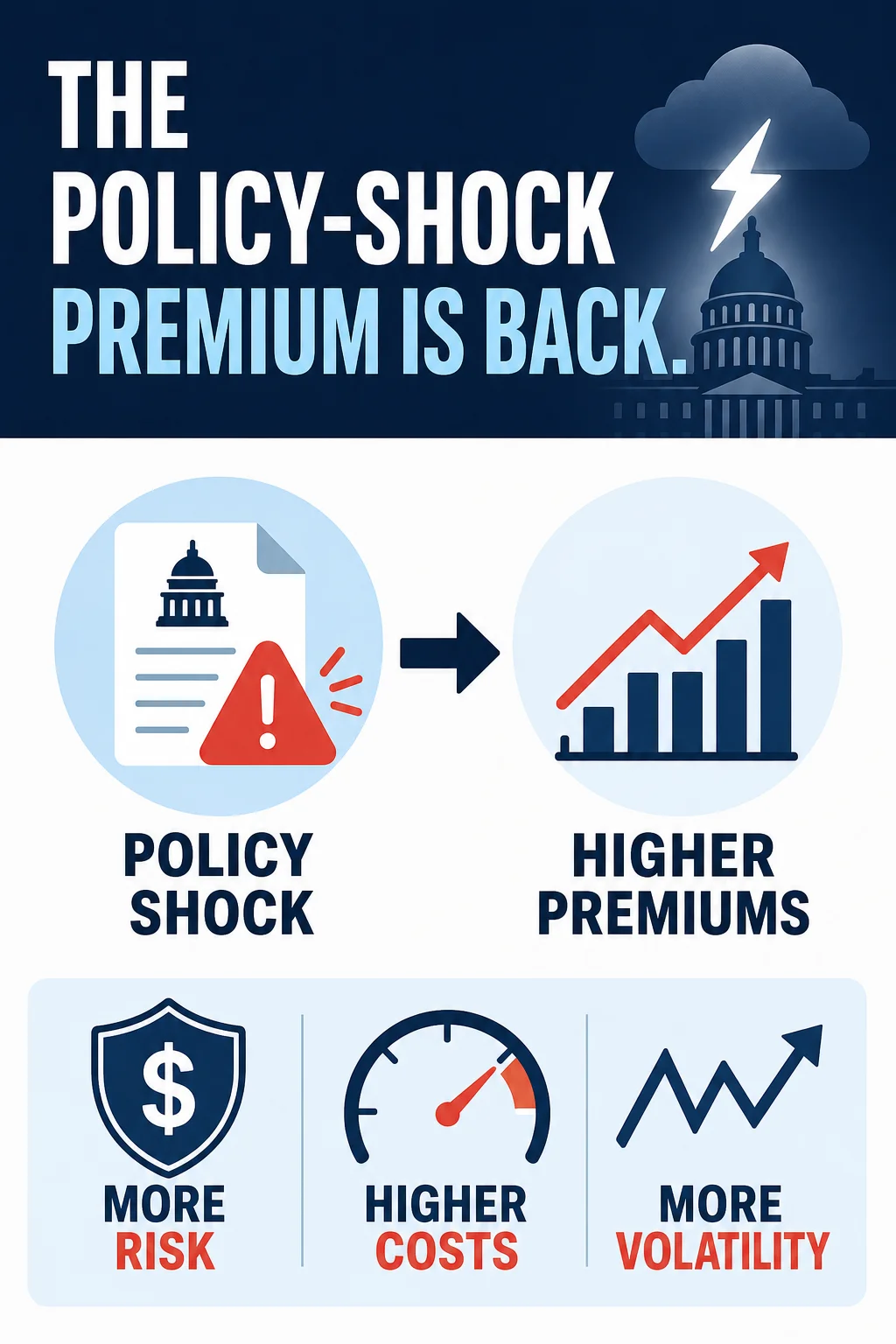
Other items broaden the same theme. Newsletters referenced crude oil moves around Iran and the Strait of Hormuz, concern over the Strategic Petroleum Reserve, China-related chip and memory supply-chain stories, tariff refund cohorts, and food or consumer channels such as beef imports and restaurant or retail pressure. Taken together, the sources suggest that the “policy-shock premium” is not one story. It is a basket of risk signals that can show up in commodities, bond yields, corporate margins, public budgets, and household expenses.
| Policy shock channel | Market or household signal to watch | Why it matters |
|---|---|---|
| Tariffs on autos, metals, or imports | Input costs, company guidance, consumer goods prices | Tariffs can act like a tax on supply chains and may be passed through unevenly. |
| Copper and industrial metals | Futures pricing, import flows, producer margins | Industrial metals can react early when traders expect tariff or supply changes. |
| Iran and Hormuz oil risk | Brent and WTI crude, gasoline, freight, yields | Energy shocks can feed into transportation, utilities, and inflation expectations. |
| Strategic reserve concerns | Emergency energy cushion, oil-security headlines | A lower cushion can make markets more sensitive to geopolitical disruptions. |
| China supply-chain pressure | Semiconductors, memory, defense deadlines, reshoring costs | Replacing supply chains can improve resilience but may raise near-term costs. |
| Tariff refunds and litigation | Federal budget effects, company cash flow, equity moves | Legal outcomes can shift money between government and companies after the fact. |
Tariffs are often covered as political news, but markets tend to translate them into cash-flow questions. Who pays more? Who can pass costs along? Which contracts already locked in prices? Which companies receive refunds later? Which households face higher prices before anyone gets relief?
The Canada-related items in the source package show why the details matter. According to Markets Digest items dated Aug. 20 and Aug. 24, the reported tariff picture shifted between a deal that cut metals and auto tariff rates and later coverage of talks collapsing, with 50% tariffs taking effect or being threatened for Canadian autos. The exact current status needs verification before publication, but the market lesson is not dependent on one final number. When policy terms move from 15% to 25% to 50% in market discussion, investors and businesses have to price a wider range of possible costs.
For ordinary readers, autos are a useful example because the sticker price is only the most visible part of the chain. Tariffs can affect parts, repair costs, dealer inventories, financing assumptions, and manufacturer margins. A side-hustle operator who depends on a vehicle may feel those effects through insurance replacement values, maintenance costs, or delayed purchase decisions rather than through a neat “tariff line item” on a bill.
Metals tariffs work in a similar way but can be less visible. Steel and aluminum show up in vehicles, appliances, construction, packaging, and machinery. A small business may not buy raw aluminum directly, yet it can still face higher equipment, packaging, or renovation costs if suppliers reprice around tariff risk.
Copper is especially important because the newsletters treated it as an early market gauge. Finance Wrapped’s Aug. 19 “Pennies on the Pulse of the Tariff Trade” framed copper as a tariff “crystal ball,” and Markets Digest’s Aug. 14 “Sales Miss | Tech Earnings Inflated | China Reroutes” said copper tariff odds were being priced by the futures market. That does not mean copper is a clean forecast. Copper prices can also move because of construction demand, energy infrastructure, electric grid investment, mining constraints, currency moves, or global manufacturing trends. But when copper futures react to tariff odds, they become one place to watch for policy premium entering real-economy materials.
For readers who want to check the source trail, the Finance Wrapped package included a supplied CNBC link on copper, Trump tariffs, metals, commodities, and trade-war pricing: CNBC’s copper and tariff coverage. Before publishing, confirm whether that article remains available and whether its details still reflect current policy.
Oil shocks are one of the clearest ways geopolitical risk can reach households. A crude spike can raise gasoline prices, freight costs, airline costs, and petrochemical input costs. If investors believe an oil shock will keep inflation higher for longer, bond yields may also react. Higher yields can flow into mortgage rates, business borrowing costs, and the discount rates used to value stocks.
The source package repeatedly referenced Iran, Hormuz, Brent, and WTI moves. Finance Wrapped’s Aug. 17 item described Iran’s economy as being squeezed and linked the story to economic warfare. Markets Digest had an Aug. 8 Iran-focused item, and the opportunity notes say additional index items covered Brent and WTI moves around Iran and shutdown bets for the Strait of Hormuz. The article should not treat any specific oil price or military scenario as settled without fresh verification. The supported editorial point is narrower: markets were watching geopolitical oil-route risk as an inflation channel.
The Strait of Hormuz matters because it is a major transit route for global oil and energy shipments. If traders fear disruption, the price response can come before a physical shortage reaches consumers. That is how a geopolitical headline can become a financial condition: oil rises, inflation expectations rise, yields respond, and household borrowing costs may become less forgiving.
The Strategic Petroleum Reserve adds a second layer. American Market Insiders’ Aug. 10 newsletter said the U.S. Strategic Petroleum Reserve had fallen below 300 million barrels, reported a further weekly drop, and discussed the possibility that the cushion could fall to roughly 243 million barrels after a release. It also noted that the Energy Department says about 70 million barrels are needed to keep the reserve operating safely. Those figures should be checked against official Energy Department data before publication, but the risk logic is straightforward. A thinner emergency cushion can make oil markets more sensitive to the next disruption.
Households do not need to trade oil futures to care about this. Energy touches regular budgets through commuting, heating and cooling, food distribution, shipping surcharges, travel, and business costs. A restaurant, delivery driver, contractor, or online seller may feel oil risk faster than a salaried worker who drives little. That is why energy belongs on a practical inflation watchlist even for readers who never buy energy stocks.

Supply-chain policy is often described as a national-security issue, and in many cases that framing is reasonable. The source package mentions China-related supply-chain stories involving domestic chipmaking tools, a memory-company IPO pressuring Micron, and critical U.S. replacement deadlines tied to the Pentagon. Those examples sit in a broader theme: governments and companies are trying to reduce dependence on fragile or politically exposed supply chains.
For markets, the key question is not whether resilience is good in theory. It is what resilience costs, how long the transition takes, and who absorbs the bill. Replacing a low-cost supplier with a more secure supplier can be sensible and still inflationary in the short run. Building domestic capacity can reduce exposure to foreign pressure and still require higher capital spending, duplication, training, inventory buffers, and slower procurement cycles.
Semiconductors make this especially visible. A chip supply-chain disruption can affect cars, phones, data centers, medical devices, defense systems, and industrial equipment. If China-related constraints push companies toward new suppliers, new tooling, or local production, the result may be more durable supply chains but less cheap flexibility. That tradeoff can matter for corporate margins and consumer prices.
The Micron-related memory story in the opportunity notes is also a reminder that policy risk and competition risk can overlap. A China memory-company IPO, if it pressures an established memory producer, is not simply a geopolitical headline. It can affect pricing expectations, margins, capital allocation, and investor views of which companies benefit or lose from supply-chain realignment. The source package does not provide enough detail to evaluate Micron or the IPO as an investment matter, so the article should avoid any company-specific recommendation.
For ordinary readers, the more practical lens is this: when supply chains are redesigned for security rather than lowest cost, some goods may become less vulnerable but not necessarily cheaper. That can show up slowly in electronics, vehicles, appliances, repair parts, and business equipment. If you run a side business, it may be worth watching not only your current supplier prices but also delivery times, backorder frequency, and replacement-part availability.
Tariff refunds are one of the less obvious channels in the source package, but they are important. Markets Digest’s Aug. 19 “Treasury Steps In | Google-Marvell Chip Deal | Refund Rally” said the tariff refund cohort had grown to seven companies. Markets Digest’s Aug. 13 newsletter also reported that tariff refunds hit the budget at $33 billion and named Apple, Nike, and FedEx among affected companies. These are time-sensitive and should be verified against current budget documents, court records, and company filings before publication.
The concept is simple. If tariffs are collected and later challenged, modified, or refunded, the economic impact does not disappear. It changes timing and distribution. Companies that paid tariffs may receive cash back or see investors revalue expected recoveries. The federal budget may lose revenue it had previously counted. Consumers may not receive a direct refund even if companies do.
That last point matters for household expectations. Finance Wrapped’s Aug. 10 tariff-refund item linked to mainstream coverage about companies receiving tariff refunds and consumers not necessarily getting checks. The owner should verify those linked articles before publication, but the mechanism is plausible: tariff refunds typically follow legal and administrative rules, not a broad consumer rebate formula.
This creates a strange inflation-policy loop. A tariff may raise prices or compress margins when it is imposed. A refund may later improve a company’s cash position or create a budget hit. But the household that paid a higher shelf price months earlier may not be made whole. For a practical finance audience, that is the important distinction: policy costs can be passed through broadly while policy refunds may be distributed narrowly.
Budget effects also deserve care. If refunds lower tariff revenue, they can add pressure to an already strained fiscal picture. Markets Digest’s Aug. 13 item paired tariff refunds with a large July deficit and year-to-date debt-service figure. Those numbers are current-event claims and need fresh verification, but the linkage is useful: tariff policy can affect not only prices and companies, but also federal receipts and debt-management debates.
Macro stories become real for households when they reach food, fuel, rent, insurance, debt payments, and wages. The source package notes food and consumer channels, including tariff-free beef imports and pressure on restaurants and retail. The supplied preview does not provide enough detail to build a precise food-price forecast, so the safest interpretation is that consumer-facing sectors are part of the policy-shock dashboard, not proof of a specific grocery-price outcome.
Food prices are especially sensitive because they combine several risk channels at once. Beef prices can be affected by trade policy, herd conditions, feed costs, labor, fuel, refrigeration, processing capacity, and retailer margins. Restaurants add wage costs, rent, utilities, delivery fees, and consumer demand. A tariff decision in one category can be offset or amplified by supply conditions somewhere else.
Retailers face a different version of the same problem. If tariffs or freight costs rise, a retailer can raise prices, accept lower margins, pressure suppliers, reduce promotions, or change product mix. Each choice has consequences. Higher prices risk losing price-sensitive shoppers. Lower margins disappoint investors. Supplier pressure can create quality or availability problems. Product changes can frustrate customers who are already trying to stretch budgets.
This is where the policy-shock premium becomes practical. A household does not need to forecast global trade law to prepare for uncertainty. It can review flexible spending, avoid overcommitting to new monthly payments, keep an emergency fund target in view, and compare unit prices carefully. A side-hustle operator can check which inputs are imported, which supplies are energy-intensive, and which customers would resist price increases.
That is not panic planning. It is ordinary budget discipline under uncertain conditions. When policy risk is high, the best household response is usually not a dramatic market bet. It is improving cash-flow resilience, reducing avoidable debt pressure, and understanding where your personal inflation exposure actually sits.
The challenge with policy-driven inflation is that it rarely announces itself in one clean number. CPI may look tolerable while copper, crude, shipping-sensitive stocks, or long-term yields are already moving. Or markets may overreact to a headline that later gets negotiated away. The goal is not to treat every market twitch as destiny. The goal is to know which signals deserve a second look.
A conservative dashboard can separate signals into three groups: direct cost signals, financial-condition signals, and policy/legal signals. Direct cost signals include oil, gasoline, copper, steel, aluminum, freight, and food categories. Financial-condition signals include long Treasury yields, mortgage rates, corporate credit spreads, and sectors with heavy input costs. Policy/legal signals include tariff announcements, court rulings, refund decisions, enforcement deadlines, and supply-chain mandates.
| Signal | What it may be warning about | How to interpret it carefully |
|---|---|---|
| Copper futures | Industrial tariff risk or supply-chain stress | Check whether moves are policy-related or driven by demand, mining, currency, or China growth news. |
| Crude oil | Geopolitical disruption, fuel inflation, freight costs | Separate short-lived risk premiums from actual supply interruptions. |
| 30-year Treasury yield | Inflation expectations, fiscal concern, term premium | Yields move for many reasons; do not assume one cause from one headline. |
| Retail and restaurant margins | Consumer pass-through pressure | Look for repeated margin commentary, not one company’s isolated result. |
| Tariff refund cohorts | Company cash-flow changes and budget risk | Verify legal status and whether refunds are final, appealed, or estimated. |
| Supply-chain replacement deadlines | Reshoring or compliance costs | Distinguish long-term resilience from near-term cost increases. |
For investors, this dashboard is a risk-awareness tool, not a trading system. A beginner should be especially careful about turning macro narratives into concentrated bets. A story can be directionally right and still be priced in already, too early, or overwhelmed by another factor. Copper can signal tariff concern and then fall because global demand weakens. Oil can spike on Hormuz fears and then retreat if supply continues moving. Long yields can rise because of inflation fear, fiscal concern, Treasury supply, or changing central-bank expectations.
For households, the better use is planning. If energy and tariff risk are rising together, it may be a good time to review transportation costs, grocery substitutions, insurance deductibles, emergency savings, and variable-rate debt exposure. If you own a small business or side hustle, check supplier contracts, shipping terms, and how much notice you need before raising prices. Those steps are boring, but they are often more useful than chasing a headline.
The most important question is whether the policy-shock premium fades as negotiations, courts, and supply chains stabilize—or whether it becomes a recurring feature of the inflation picture. The answer will not come from one report. It will come from whether several signals keep confirming each other.
Watch the tariff path first. If U.S.-Canada auto and metals rates keep changing, the uncertainty itself can become a cost. Businesses may delay orders, carry more inventory, renegotiate contracts, or price with a wider margin of safety. Even if a lower rate eventually wins out, the period of uncertainty can still influence prices and investment decisions.
Watch copper and other industrial metals, but do not overread them. Copper is useful because it sits close to construction, electrification, manufacturing, and trade policy. It is dangerous because it has many drivers. A genuine policy-shock signal is stronger when copper moves alongside tariff news, company commentary, import behavior, and related industrial inputs.
Watch oil and the Strategic Petroleum Reserve. If Iran or Hormuz risk keeps appearing in crude pricing, and if emergency reserve concerns remain unresolved, energy could stay a live inflation channel. But verify official reserve data and actual shipping conditions before treating any newsletter claim as current.
Watch tariff refund litigation and budget treatment. Refunds can affect corporate earnings, equity prices, and federal receipts. They may also create a public perception problem if large companies receive recoveries while consumers do not receive direct relief. The legal status matters: proposed, expected, awarded, appealed, and paid are not the same thing.
Finally, watch consumer pass-through. The policy-shock premium only becomes household inflation if costs move through the chain into retail prices, service prices, debt costs, or taxes. Retail sales, restaurant margins, grocery categories, vehicle prices, repair costs, and shipping fees may tell the story before a broad inflation index does.
The practical takeaway is measured, not dramatic: policy is again acting like a market input. That means inflation risk may come from tariffs, oil routes, legal refunds, and supply-chain rules—not just from wages or consumer demand. A careful reader should keep a broader watchlist, maintain budget flexibility, and bring personal investment, tax, or legal decisions to a qualified professional who can evaluate their specific situation.