
The 50/30/20 Budget Doesn’t Work for Everyone — Here’s a More Realistic Alternative
Most budgeting advice sounds wonderfully reasonable until you try to apply it to an actual household. On paper, you divide your income into a few tidy categories, automate your savings, eliminate unnecessary spending and watch your financial life gradually improve. Then the rent comes out, groceries cost more than expected, the car needs brakes, somebody has a dentist appointment, and a utility bill arrives that seems to have been calculated during a national emergency.
That tension is one reason the famous 50/30/20 budget rule is both useful and frustrating. The concept is simple: roughly 50% of your after-tax income goes toward needs, 30% toward wants, and 20% toward savings and debt repayment. Even the U.S. Consumer Financial Protection Bureau has used the 50/30/20 framework in its financial-education materials, which shows how mainstream the idea has become.
There is nothing inherently wrong with the rule. In fact, its simplicity is probably its greatest strength. The problem begins when a rough budgeting framework gets treated like a financial law and people start believing they are failing because their rent, transportation, groceries and insurance stubbornly refuse to cooperate with somebody else’s percentages.
A more useful budget may begin with a different question. Instead of asking, “How do I force my spending into 50/30/20?”, what if you asked, “What does my life actually cost, what risks do I need to prepare for, what am I building for the future, and how much can I reasonably enjoy today?”
That leads us to a different approach: the Four-Bucket Budget.
Why the 50/30/20 Budget Is So Appealing
Before throwing the 50/30/20 rule under the bus, it deserves some credit. Personal finance can become incredibly complicated, particularly for someone who is already stressed about money. One expert tells you to categorize every transaction, another wants six different savings accounts, somebody else recommends a complicated spreadsheet, and eventually managing the budget begins to feel like a second job.
The 50/30/20 rule cuts through that noise. Instead of obsessing over whether restaurant spending should be 4% or 6% of your income, it gives money three broad jobs and lets you see the bigger picture. If necessities are consuming half of your income, discretionary spending roughly another third, and a meaningful amount is consistently moving toward savings or debt reduction, you probably have a decent financial foundation.
It is also useful as a warning system. If somebody discovers that virtually nothing is being saved despite a strong income, or that discretionary purchases are swallowing half of every paycheque, percentages can expose the problem very quickly. You do not necessarily need sophisticated financial software to recognize that spending $1,800 on optional purchases while saving $75 might be worth reconsidering.
Canada’s Financial Consumer Agency takes a similarly practical approach to budgeting itself: understand what is coming in, understand what is going out, set priorities, and make savings part of the plan. Its budgeting resources emphasize creating a realistic picture of your actual finances rather than merely guessing where your money goes.
So the issue is not percentages.
The issue is expecting everybody’s percentages to look identical.
Real Life Has a Habit of Ruining Perfect Budgets
Consider someone bringing home $4,000 a month after taxes. Under a strict interpretation of the 50/30/20 rule, necessities would ideally consume around $2,000. That initially sounds reasonable until housing takes $1,500 of it, leaving only $500 for groceries, utilities, transportation, insurance, phone service and every other expense that could legitimately be considered necessary.
Maybe housing costs less. Maybe it costs considerably more. Perhaps the person works from home and has almost no transportation costs, while somebody else commutes 40 kilometres each way and cannot realistically eliminate their vehicle. A household with young children may have expenses that a single adult living with roommates simply does not face.
This is where budgeting advice can accidentally turn financial circumstances into moral judgments. One person proudly reports that necessities consume only 38% of their income, while another struggles at 62%. Without knowing their income, housing market, family size, transportation requirements or health expenses, the percentages alone tell us surprisingly little about how responsible either person is.
That does not mean a 62% necessities rate should simply be ignored. Quite the opposite. Knowing that essential expenses consume 62% of income is extremely useful information. But the productive response is to investigate why the number is 62%, determine which parts can realistically change, and measure whether it improves over time.
Pretending it should already be 50% accomplishes nothing.
A Different Approach: The Four-Bucket Budget
The Four-Bucket Budget starts with the same basic truth as almost every good budgeting system: your money needs jobs. The difference is that it separates those jobs according to what they actually do for your life rather than forcing them into predetermined ratios.
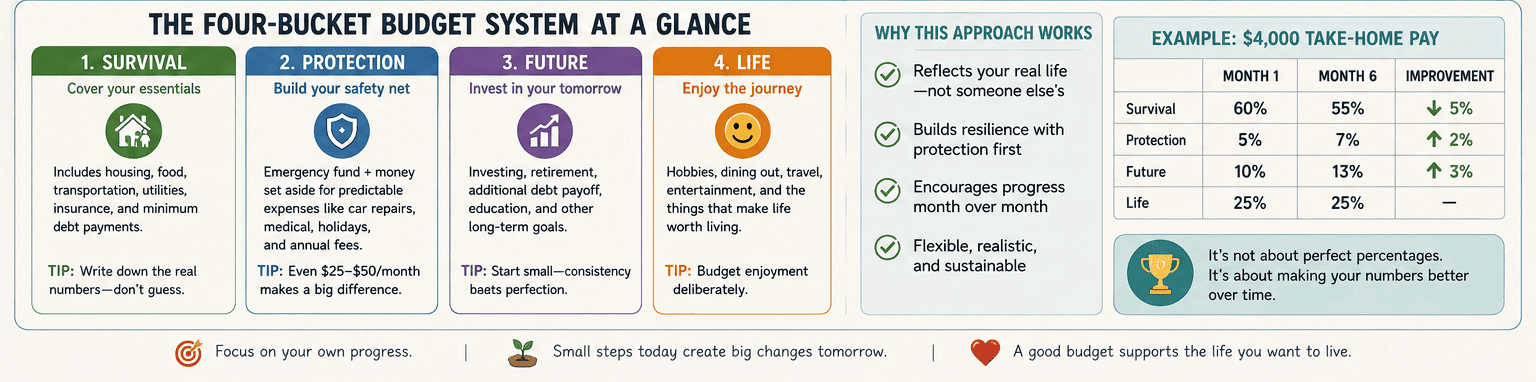
The four categories are Survival, Protection, Future and Life. Survival keeps the household running today. Protection prepares you for irregular and unexpected expenses. Future improves your long-term financial position. Life allows you to enjoy a reasonable portion of the money you are working so hard to earn.
There is intentionally no universal percentage assigned to each bucket. You still calculate the percentages, because they are incredibly useful, but they become measurements rather than commandments. Your starting point might be 60% Survival, 5% Protection, 10% Future and 25% Life. Somebody else’s numbers could look completely different.
The goal is not to win a budgeting competition. It is to make your own numbers better.

Bucket One: Survival — What Does Your Life Actually Cost?
Survival is the least glamorous category, which is precisely why it deserves to come first. This bucket contains the expenses required to keep ordinary life functioning: housing, basic groceries, necessary utilities, transportation, insurance, minimum debt obligations and other genuine necessities. Depending on the household, medication, childcare and other unavoidable costs may belong here as well.
The important word is actual. Do not begin by deciding that housing is supposed to consume a certain percentage and then manipulating the categories until your spreadsheet looks respectable. Start with what you really spend. If the result is uncomfortable, at least you now have something real to work with.
Suppose Survival consumes 64% of your take-home income. Instead of immediately declaring the budget a failure, investigate the number. Perhaps housing is responsible for most of the problem. Maybe two vehicle payments are crushing cash flow, groceries have quietly crept upward, or several small recurring expenses have accumulated over the years.
Some Survival costs may be extremely difficult to change. You cannot necessarily move to a cheaper house next Tuesday because a budgeting spreadsheet disapproves of your mortgage. Other expenses, however, may be surprisingly flexible once they are examined instead of automatically renewed every month.
This is where small improvements begin to matter. Dropping Survival from 64% to 60% does not sound spectacular, but on a $4,000 monthly take-home income that represents $160 every month that can now be assigned somewhere else. Over a year, that is $1,920 of newly available cash flow.
That is not budgeting trivia. That is meaningful money.
Bucket Two: Protection — The Category Most Budgets Underestimate
Protection deserves its own bucket because there is a major difference between building wealth and preventing financial setbacks. Someone can technically be “saving money” while remaining one car repair away from credit-card debt. An investment account may improve your future, but it does not necessarily solve the immediate problem of an unexpected $900 expense.
An emergency fund is the obvious foundation of Protection. The Financial Consumer Agency of Canada recommends building emergency savings specifically so unexpected situations such as job loss or urgent repairs do not immediately force people into debt. It also recommends incorporating emergency savings into the budget rather than treating them as an afterthought.
But Protection should also include expenses that are irregular without actually being surprising. This distinction is more important than it first appears. If you drive a vehicle every day, needing tires eventually is not an emergency. Christmas arriving in December is not an emergency either, and neither is an annual membership renewal that has occurred on roughly the same date for six consecutive years.
A Protection bucket allows you to gradually prepare for those expenses. Perhaps $60 a month accumulates for automotive maintenance, $30 goes toward holidays, and another amount builds the general emergency reserve. The numbers may seem unimpressive at first, but repeated contributions begin turning financial surprises into manageable inconveniences.
Imagine receiving a $700 vehicle repair bill while $500 is already sitting in your car-maintenance fund. You still have to spend $700, unfortunately, and no budgeting system can make that enjoyable. But instead of desperately finding $700, you only need to absorb the difference.
That feeling is financial resilience beginning to appear.
Bucket Three: Future — Where Financial Freedom Actually Starts
The Future bucket contains money that improves your position tomorrow rather than merely supporting you today. Depending on your circumstances, that could mean retirement contributions, investing, additional debt repayment, saving toward a home, funding education or building capital for another significant goal.
This is also where comparison can become particularly destructive. Online personal-finance discussions are filled with people announcing extraordinarily high savings rates, investment balances and income levels. Somebody who can currently save only 3% may look at those numbers and conclude that their contribution is so insignificant that there is almost no point.
That is exactly backward.
If 3% is what you can sustainably manage today, begin with 3%. Then examine why the number is 3%. Perhaps eliminating a debt payment eventually turns it into 6%. A raise moves it to 8%. Lower insurance costs and a paid-off vehicle push it higher again.
Financial progress does not require every improvement to happen simultaneously. It requires improvements to stick.
This is one reason the Four-Bucket approach focuses heavily on direction. A household moving Future from 4% to 9% has accomplished something significant even if an idealized budgeting formula claims it should already be 20%. The important change is that more of every dollar is gradually becoming available to build tomorrow instead of merely paying for yesterday and today.
Eventually, that widening gap between income and required spending becomes one of the most powerful numbers in your finances.
Bucket Four: Life — Because You Are Still Allowed to Enjoy Money
Extreme budgeting advice occasionally seems to assume that the highest form of financial enlightenment is never wanting anything. Restaurants are wasteful, vacations are unnecessary, hobbies are expensive, entertainment can be found for free, and somehow your reward for working hard is supposed to be watching the number in your investment account climb.
That approach can work for some people, but it is not particularly realistic for everyone. Money is both a resource and a tool. Security matters enormously, but so do experiences, hobbies, relationships and the occasional completely unnecessary thing that brings you genuine enjoyment.
The Life bucket gives those expenses boundaries without pretending they should disappear. Restaurants, entertainment, travel, hobbies, sporting equipment, video games, woodworking tools, motorcycles or whatever else makes life enjoyable can fit here. The point is not to justify irresponsible spending but to intentionally allocate some money for enjoyment.
This matters because an overly restrictive budget can create its own version of lifestyle creep. Someone follows a brutally strict plan for several weeks, feels deprived, eventually rebels against it and blows far more money than they would have spent under a reasonable discretionary allowance.
A budget you resent is difficult to maintain.
A budget that acknowledges you are a human being has a better chance.
The Most Important Comparison Is You Versus Six Months Ago
This is where the Four-Bucket Budget becomes more than another set of category names. Instead of constantly comparing your percentages with an ideal template, compare them with your own historical numbers.
Suppose your first month comes out to 60% Survival, 5% Protection, 10% Future and 25% Life. Those percentages are simply your baseline. They show what your financial life currently looks like.
Over the next six months, you finish paying a small debt, eliminate three subscriptions you barely use, shop around for insurance and receive a modest raise. When you calculate the numbers again, Survival has fallen to 55%, Protection has increased to 7%, Future has grown to 13%, and Life remains at 25%.
Nothing dramatic has happened. You did not stop enjoying yourself, triple your income or discover an obscure investment that promises 40% annual returns.
You simply became financially stronger.
That is the kind of improvement budgeting should reveal.
The Redirect Rule Can Quietly Change Everything
There is another habit worth attaching to this system: when an expense permanently disappears, do not allow all of the freed-up money to disappear with it.
Suppose a $90 monthly phone payment ends. Most households do not suddenly notice an additional $90 sitting untouched in their bank account every month. Spending has an impressive ability to quietly expand into whatever space becomes available.
Instead, make a deliberate choice before that happens. Perhaps $60 of the old payment automatically goes toward Protection or Future while you allow the remaining $30 to increase Life. You become financially stronger without feeling as though the entire benefit of paying something off has been taken away.
The same principle can apply to cancelled subscriptions, a refinanced expense or additional income. If you receive a $200 monthly raise and immediately increase monthly spending by $200, your financial situation may barely change. If lifestyle rises by $75 while the other $125 goes toward savings or debt, the raise begins doing two jobs at once.
Repeated over several years, this principle can become surprisingly powerful.
Lifestyle can improve.
But income improves faster.
The Skeptical Case Against the Four-Bucket Budget
There is an obvious criticism worth acknowledging: are we really solving anything by replacing three categories with four?
Not magically.
If someone earns $4,000 every month and consistently spends $4,600, creating beautifully labelled buckets does not change arithmetic. A serious income shortage, unmanageable debt or housing crisis may require substantially larger solutions than rearranging categories on a budget.
The Four-Bucket Budget also should not become another rigid ideology. There will be situations where expenses overlap categories, percentages fluctuate significantly from month to month, or a household temporarily has to prioritize Survival above everything else. Real finances are messy, and pretending otherwise defeats the entire purpose of creating a flexible system.
What the framework does accomplish is conceptual separation. Protection and Future are not identical goals. An emergency reserve protects you from moving backward, while investing and aggressive debt repayment help move you forward.
Both matter.
A household can be excellent at investing while having inadequate emergency savings. Another household may accumulate large amounts of cash while doing almost nothing to address long-term goals. Seeing the two separately can expose weaknesses that a single “savings” percentage might conceal.
That is the real value of the fourth bucket.
A Budget Should Help You Make Decisions, Not Judge You
The Financial Consumer Agency of Canada describes a budget simply as a plan that helps people manage money, and its current tools encourage Canadians to record real income, savings and expenses before deciding where changes should be made. That sounds obvious, yet it captures something personal-finance culture sometimes forgets.
A budget is a tool.
It is not a report card on your character.
If your Survival percentage is extremely high, that is a problem to investigate rather than a reason to feel embarrassed. If Future is almost nonexistent, the next question should be what obstacle is preventing it from growing. If Life spending is swallowing everything else, the numbers can expose that too.
Good budgeting makes trade-offs visible.
Bad budgeting merely makes people feel guilty about them.
Why This Matters More Than Finding the “Perfect” Budget
Most genuine financial improvement is surprisingly boring. A subscription disappears. A credit-card balance falls. An automatic $40 transfer begins. A raise arrives without being completely consumed by new spending. An emergency fund slowly grows large enough to cover a repair that previously would have gone onto a credit card.
None of these moments makes for spectacular social-media content.
Together, however, they can completely change the direction of someone’s finances.
That is why I am skeptical of any budgeting philosophy that focuses more on perfect percentages than on measurable improvement. Someone moving from financial chaos toward stability deserves more credit than somebody who happened to begin with inexpensive housing and a high income.
The goal should not be to make your spreadsheet look like somebody else’s.
The goal should be to make your life more financially resilient.
Final Verdict: The 50/30/20 Rule Isn’t Wrong — It’s Just a Starting Point
The 50/30/20 rule remains popular because it does something valuable: it turns personal finance into a framework almost anyone can understand. If your income and expenses naturally fit those percentages, there is little reason to abandon it simply because another budgeting method exists.
But if your numbers refuse to cooperate, do not assume you are incapable of budgeting. Use the percentages as a warning light rather than a pass-or-fail test.
Start by calculating what Survival genuinely costs. Build Protection so that irregular expenses and emergencies do not constantly knock you backward. Move something into Future, even if the initial percentage feels disappointingly small. Give yourself enough Life spending to make the system sustainable.
Then wait.
Come back in three months.
Come back again in six.
If Survival has fallen a little, Protection is stronger and more money is reaching Future, something important has happened even if you still look nothing like the textbook example.
Your budget is improving.
And perhaps that is the better target all along.
Not perfection.
Progress.
Useful Links:
For readers who want to put the idea into practice, the Government of Canada’s guide to making a budget provides practical budgeting guidance and access to the FCAC Budget Planner.
The Financial Consumer Agency of Canada also has a useful guide to setting up an emergency fund, including guidance on gradually building savings for unexpected expenses.
I really need to get a job. It should be noted that job loss AKA not getting any income whatsoever is financial suicide. Which is incredibly sad to be honest. No job = no $4,000 = RIP because who has 4 grand lying around? That’s after just one month of not working iiip