
Why a Small Service Business Can Earn More Than a Full-Time Job—In Half the Hours
One person works a nine-hour shift and earns $180 before taxes. Another spends four hours cleaning up an overgrown property and charges the homeowner $450.
At first glance, the difference seems almost absurd. Both people worked hard, but one needed nearly an entire day to earn less than half of what the other collected before lunchtime. It is easy to look at that comparison and conclude that starting a business is an automatic shortcut to earning $100 an hour.
It is not that simple. The business owner’s $450 is revenue, not personal income. Fuel, equipment, advertising, insurance, disposal costs, taxes, travel and unpaid administrative time still have to come out of that payment.
Even after those costs are considered, however, a well-run local service business can produce considerably more income per working hour than many conventional jobs. The reason is not a secret formula or motivational slogan. It is ownership.
When the same person finds the customer, agrees on the price and completes the work, fewer layers stand between the customer’s payment and the person actually delivering the result.
Why Employees Receive Only Part of the Customer’s Payment
Imagine a landscaping company charging $900 for a full day of work completed by two employees. If each worker earns $22 per hour, their combined wages may account for roughly $350 of the revenue.
That does not mean the business owner pockets the remaining $550. The company may need to cover payroll costs, insurance, fuel, trucks, equipment repairs, advertising, bookkeeping, office support and taxes. It must also survive rainy days, slow periods, cancelled appointments and estimates that never turn into paid jobs.
The employer takes responsibility for finding customers and keeping enough work on the schedule. In exchange, the business keeps whatever profit remains after the expenses are paid.
The employee receives less of the transaction, but also receives something valuable in return: a predictable wage and less personal financial risk. They normally do not have to buy the equipment, advertise the service, chase payments or worry about finding the next customer.
A solo owner-operator changes the equation. When one person handles the sales, scheduling and physical work, much of the usual overhead can be reduced. The owner does not keep every dollar, but the customer’s payment travels through a much shorter pipe.
Customers Are Paying for More Than Labour
Many new business owners make the mistake of calculating prices using only the time spent doing the visible work. They estimate that a job will take three hours, choose an hourly wage and multiply the two numbers.
That approach often leads to underpricing because the customer is not purchasing three hours of movement. They are purchasing the removal of an unwanted problem.
Consider a homeowner with an overgrown yard. They may not own the necessary equipment, know where to dispose of the waste or want to sacrifice an entire weekend doing physically demanding work. They may also be worried about damaging plants, hurting themselves or starting a project they cannot finish.
When a landscaping company completes the job properly, the homeowner is buying convenience, knowledge, equipment, risk reduction and a completed result. The value of that outcome can be much greater than the raw number of hours involved.
This is why an experienced operator may complete a $350 job in four hours without necessarily overcharging. The customer may still feel they received excellent value because the alternative involved lost time, rented equipment, frustration and an uncertain result.
Profitable service businesses eventually learn to price the complete solution rather than apologizing for every dollar they charge.
A Landscaping Business as a Simple Example
Landscaping is a useful example because it can begin with a relatively straightforward service and grow naturally over time. A person does not necessarily need a fleet of trucks, an office building or a large crew to test whether customers are willing to pay.
The first offer could be a clearly defined spring yard cleanup. It might include removing leaves and fallen branches, cutting dead growth, cleaning garden beds and preparing the property for summer.
Once customers begin booking, related services can be added gradually. The same homeowner may also need lawn cutting, hedge trimming, mulch installation, garden edging, pressure washing, gutter cleaning or a fall cleanup later in the year.
The smartest additional services usually involve the same type of customer, similar equipment and the same service area. This allows the business to earn more from each relationship without constantly starting over with a completely new audience.
A customer who initially books a $250 cleanup might also need $180 of hedge trimming and $300 of mulch installation. The operator does not need to pressure the homeowner or invent work that is not necessary. They simply need to notice a legitimate need, explain the options and let the customer decide.
In many local businesses, the next sale is already sitting on the same property as the first one.
What a $450 Job Might Actually Produce
Suppose a solo operator charges $450 for a substantial spring cleanup. The visible work takes four hours, but the total job also includes travel, preparing the estimate, communicating with the customer and disposing of the waste.
Once everything is counted, the owner may have invested five and a half hours. Disposal fees, fuel, equipment wear, consumable supplies and advertising might cost another $125.
That leaves approximately $325 before fixed overhead and income tax. Divided across the full five and a half hours, the job generated close to $59 per hour before taxes and longer-term business expenses.
That is a strong return, but it is not a guaranteed hourly wage. The owner may spend the next afternoon providing estimates that produce no work. Rain could wipe out two days of appointments, or a machine could suddenly require a costly repair.
Still, the example demonstrates why one efficiently organized service job can outperform a conventional shift. The owner is being rewarded not only for the physical labour, but also for finding the customer, organizing the work, supplying the equipment and taking responsibility for the result.
BDC recommends that businesses calculate direct expenses, overhead, break-even sales and the price customers are willing to pay. It specifically warns service businesses to account for less obvious costs such as administration, travel and equipment repairs. (bdc.ca)
Revenue may sound impressive when somebody talks about a $450 afternoon. Profit is what determines whether the business is genuinely successful.

Charging Too Little Can Be More Dangerous Than Charging Too Much
New entrepreneurs often believe low prices are the safest way to attract customers. That may produce some quick bookings, but it can also attract people who care only about finding the cheapest possible option and have little reason to remain loyal.
Underpricing creates another problem: it can make a struggling business look successful. The owner may have a full schedule, a ringing phone and constant work while still failing to generate enough profit to replace equipment or pay themselves properly.
A landscaping operator may think a four-hour job should be priced as four hours of labour. They forget the time spent travelling, quoting, answering messages, maintaining equipment and keeping records. They may also fail to account for fuel, insurance, advertising, taxes, weather delays and seasonal slowdowns.
This is how a person can remain extremely busy while slowly running out of money.
A sustainable price must cover the entire operation, create a reasonable profit and still offer fair value to the customer. Understanding what competitors charge is useful, but the goal should not be to become the cheapest person on Facebook Marketplace.
It is often more profitable to become the clearest, most dependable and easiest business to hire.
Customer Service Is Not Just Politeness
Small business owners sometimes spend hours searching for advanced marketing strategies while overlooking one of the easiest ways to stand out: answering the phone and doing what they said they would do.
Many customers have dealt with contractors who disappeared after providing an estimate, arrived hours late without notice or left a property messier than they found it. A new operator can separate themselves from much of the competition simply by communicating clearly and behaving professionally.
That means responding within a reasonable time, confirming appointments, arriving when promised and providing a price that the customer can understand. It also means protecting the property, explaining unexpected changes and cleaning up properly before leaving.
These habits may seem basic, but they create trust. Trust leads to repeat work, public reviews and referrals to neighbours, family members and friends.
A customer who hires a landscaping company for a spring cleanup may later book regular lawn maintenance and a fall cleanup. If they refer two neighbours, that single relationship could eventually generate thousands of dollars in revenue.
Excellent customer service is therefore not merely a nice gesture. It is one of the most affordable and effective forms of business development.
Repeat Customers Are Worth More Than Constantly Finding New Ones
Every new customer requires time, advertising or some form of outreach. The business may need to answer questions, visit the property, explain the service and prove that it can be trusted.
A returning customer already knows what to expect. They have seen the quality of the work, understand the pricing and know that the business will actually show up.
This makes repeat work more efficient and often more profitable. The owner spends less time selling and more time completing paid jobs.
A landscaping company can turn a spring-cleanup customer into lawn maintenance, seasonal hedge trimming and fall cleanup. A gutter-cleaning company can offer spring and autumn visits, while a pressure-washing business can contact previous customers the following year.
This does not require a complicated subscription system. A simple question at the end of the job can be enough: “Would you like me to reserve a spot for your fall cleanup before the schedule fills?”
The strongest local service businesses build a base of recurring customers and use advertising to fill the remaining openings. They do not wake up every Monday needing to rebuild the entire schedule from nothing.
BDC recommends comparing customer lifetime value with customer acquisition cost. If a customer books repeatedly and refers others, spending money to acquire that person may be worthwhile even when the first job produces only a modest profit. (bdc.ca)
Referrals and Reviews Make Future Sales Easier
A new business begins with no reputation. The owner may claim to offer excellent work, but potential customers have no reason to believe that claim.
The first group of satisfied customers helps solve this problem. Their reviews, photographs and recommendations provide evidence that the business can deliver what it promises.
After a successful job, the owner can politely ask for an honest Google review and provide a direct link. The request does not need to feel awkward or desperate. A simple message thanking the customer and explaining that reviews help a small local business is often enough.
Before-and-after photographs are particularly effective for landscaping, cleaning, repairs, restoration and other visual services. With the customer’s permission, a dramatic transformation can say more than several paragraphs of advertising.
Google says accurate Business Profile information, appropriate service areas and complete business details can improve a company’s ability to appear in relevant local searches. (support.google.com)
A company with real photographs, clear contact information and several strong reviews looks safer to hire than a company with only a name and phone number.
Advertising Without Burning Through Money
A local service business usually does not need to reach an entire city, province or country. It needs to become familiar to people living within a practical and profitable driving distance.
For a landscaping business, this may mean focusing on several nearby neighbourhoods instead of accepting jobs scattered across a huge region. A tight service area reduces travel time, fuel use and gaps between appointments.
Early advertising can be simple. A verified Google Business Profile, local Facebook posts, yard signs, door hangers, vehicle magnets and a basic website can be enough to begin generating leads.
The message matters more than fancy branding. “Professional landscaping at affordable prices” sounds like nearly every other advertisement. “Spring yard cleanup in Kanata, including leaves, branches, garden beds and waste removal” tells the customer what is being offered and where it is available.
Strong advertising also gives the customer an easy next step. Asking someone to “contact us for a consultation” feels vague and formal. Asking them to “text a photo of the yard for an estimate” is much simpler.
The easier it is to understand and request the service, the more likely someone is to respond.
Show the Value When the Service Is Difficult to Explain
Some services are easy for customers to understand. Most people immediately know what lawn cutting, moving or snow removal involves.
Other services are harder to visualize. Roof rejuvenation, deck restoration, headlight polishing and certain home-maintenance services may require more explanation before the customer understands why they should pay for them.
In those cases, a physical display or dramatic before-and-after image can do more than a long sales pitch. A roof-treatment business could show an untreated aged shingle beside a treated sample. A deck-restoration company could display a weathered board next to a restored one.
The same idea can work in landscaping. An operator can show different mulch options, demonstrate the difference between basic trimming and a fully reshaped garden edge, or use photographs of a badly overgrown property beside the completed result.
When people do not immediately understand the value, showing them is usually more effective than describing it.
Door-to-door promotion can also work for visible property services, provided it is done respectfully and legally. The operator should focus on homes that clearly need the service, keep the conversation brief and accept “no” immediately.
Pressure creates resistance. Relevance creates interest.
Prove the Customer Exists Before Building the Company
One of the most common beginner mistakes is spending too much time preparing to become a business owner.
People order uniforms, design logos, purchase expensive tools and build elaborate websites before confirming that anyone will actually pay for the service.
These activities feel productive because they are comfortable. Asking a stranger to pay is uncomfortable, but it is the only step that genuinely validates the idea.
A better approach is to begin with one clearly defined service and one type of customer. Create a simple offer, attempt to secure several paid jobs and measure the results carefully.
A person considering landscaping might begin with spring cleanups using tools they already own or can rent. After completing five paid jobs, they will understand the physical workload, disposal costs, customer questions and likely profit far better than they would after five weeks of designing a brand.
Once demand has been demonstrated, it makes sense to invest further in equipment, advertising and professional presentation.
A polished logo cannot rescue an offer nobody wants. A plain flyer can launch a real business when it solves an obvious problem.
Financial Discipline Is What Keeps the Business Alive
Seeing $10,000 in a business bank account can create the impression that the owner has earned $10,000. In reality, part of that money may already be needed for taxes, insurance, equipment, supplies or upcoming bills.
A responsible owner keeps business and personal spending separate, saves receipts and maintains clear records. They know the difference between monthly revenue, expenses, profit and cash available to withdraw.
Money should also be reserved for equipment repairs and replacement. A landscaping business that earns income using a mower, trailer or truck cannot treat every dollar as personal spending money. Eventually, those assets will need maintenance or replacement.
Canadian entrepreneurs also need to consider registration, permits, insurance and tax requirements. The federal government provides a starting-a-business guide that directs owners toward the appropriate federal, provincial and municipal resources. (canada.ca)
Businesses must also monitor the GST/HST small-supplier threshold. Registration generally becomes mandatory once taxable sales exceed $30,000 during one calendar quarter or across four consecutive calendar quarters, depending on the CRA’s timing rules. (canada.ca)
Ignoring these details can make an apparently successful business financially fragile.
Business Ownership Is Not Guaranteed Income
There is real earning potential in local service work, but it is not an automatic path to wealth or freedom.
Demand can be unpredictable. Weather can cancel a week of landscaping appointments, equipment can fail at the worst possible moment and customers can delay payments. Some advertising produces no response at all, while one pricing mistake can turn a large job into an exhausting loss.
Statistics Canada found that 83.1% of new employer businesses created in 2022 were still active one year later. Of the businesses created in 2021, 68% remained active in 2023. These figures do not perfectly represent every solo operator, but they show that survival is far from guaranteed. (www150.statcan.gc.ca)
Business owners may also work many hours that never appear on an invoice. They answer messages, provide estimates, maintain tools, plan schedules, create advertisements and keep financial records.
This is why nobody should quit a stable job because one weekend project produced an impressive hourly return. A safer approach is often to validate the service part-time, build an emergency fund and create repeat demand before relying on it as the household’s primary income.
Ownership offers greater upside because it comes with greater responsibility.
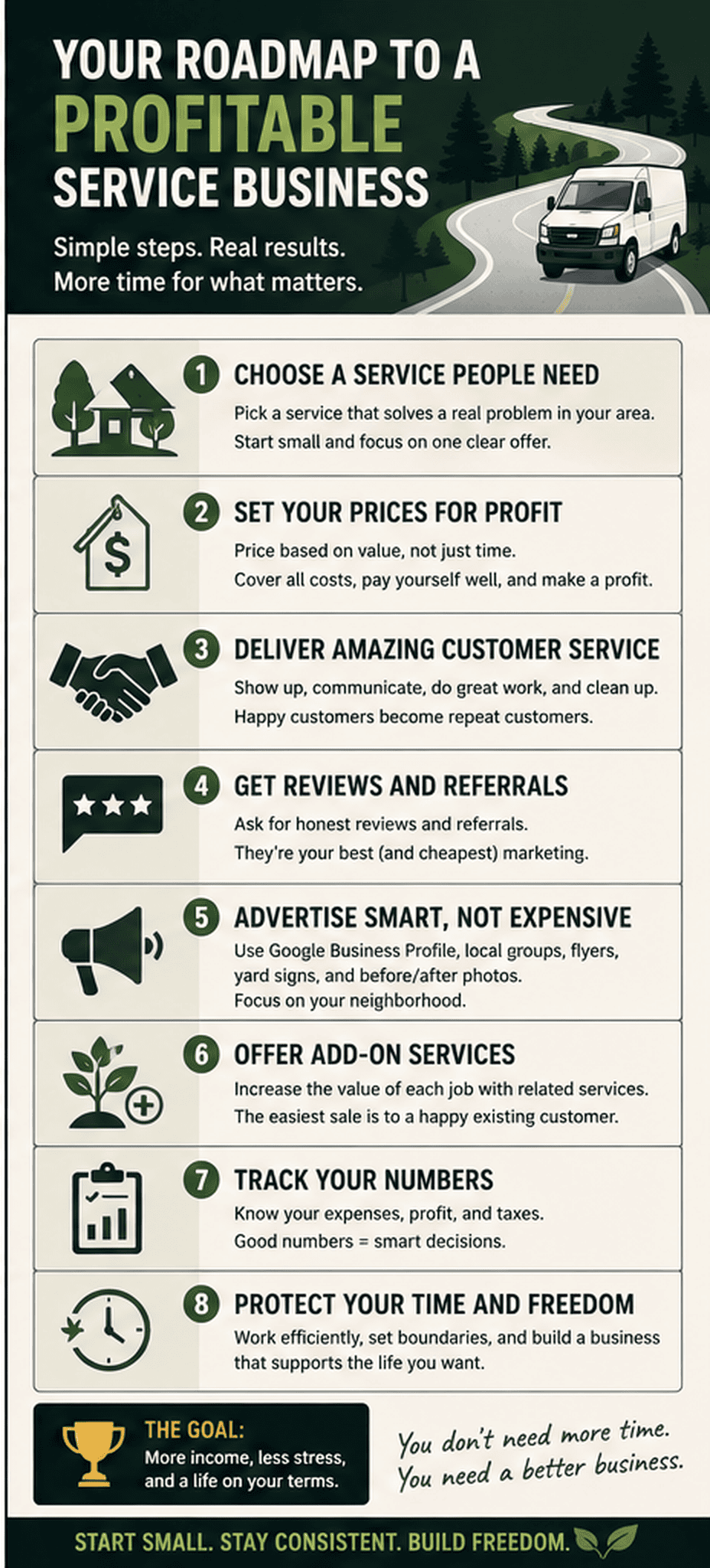
Avoid Creating a Job That Consumes Your Entire Life
A business is not freedom if the owner works 80 hours every week, answers messages at midnight and never takes a day off.
It is easy to become so focused on earning more that every improvement in efficiency is used to squeeze another job into the day. That can increase revenue while making life noticeably worse.
A better business is designed around both profit and boundaries. That may involve setting a minimum job price, limiting the service area, grouping appointments by neighbourhood and maintaining clear operating hours.
The owner also needs permission to reject bad work. A distant, low-paying job for a difficult customer may occupy time that could have been used for a better opportunity or simply spent with family.
The greatest benefit of a profitable service business is not necessarily the ability to work constantly. It is the possibility of earning enough in fewer high-value hours to regain control of the rest of the week.
A person who earns $1,000 from 18 productive hours will still have some sales, administration and travel to manage. Even so, that can produce a far better life than earning the same amount through 50 physically and mentally exhausting hours.
The reward for becoming more efficient does not always have to be more work. Sometimes the reward should be getting part of your life back.
A Practical First Month
During the first week, choose one service that solves a clear and visible problem. Speak with potential customers, study local competitors and determine what equipment, insurance and skills are actually required.
During the second week, create a simple offer and begin promoting it. A basic flyer, a Google Business Profile and a few local social-media posts may be enough to test whether people are interested.
The third week should be focused on delivering the first jobs properly. Record every hour and expense, take photographs with permission and pay attention to the questions customers ask.
During the final week, review the numbers honestly. Determine which jobs were profitable, which tasks took longer than expected and whether the price needs to change. Ask satisfied customers about repeat work and request honest reviews.
After 30 days, the important question is not whether the business looks impressive. The important questions are whether somebody paid, whether the job produced a profit and whether the result can be repeated.
Those answers reveal far more than a business card ever will.
Why Local Service Businesses Still Have an Advantage
Small businesses remain a major part of the Canadian economy. As of 2024, they employed approximately 5.8 million people, representing 46.6% of the private-sector workforce. (ised-isde.canada.ca)
Local services also have one powerful advantage: many of them cannot easily be outsourced.
A customer’s lawn still needs cutting. Their furniture still needs moving, their gutters still need cleaning and their deck still needs repairing. Technology may change how customers find a company, but somebody still needs to arrive and complete the physical work.
That does not mean every service idea will succeed. It means practical skills, reliable communication and local trust can create a legitimate opportunity without requiring investors, a revolutionary product or a massive social-media audience.
Final Verdict: Ownership Changes the Economics of Work
A small service business can earn more than a full-time job in fewer hours because the owner controls the customer relationship, the price and the delivery of the service. More of the value created by the job remains with the person doing the work.
That opportunity comes with genuine costs and uncertainty. Revenue is not profit, one successful week does not guarantee the next and many businesses struggle because they underprice, overspend or fail to attract enough customers.
The safest path is not to gamble everything on a vague dream of entrepreneurship. It is to begin with one useful service, prove that customers will pay and measure the numbers carefully.
Provide unusually dependable customer service. Show up when promised, communicate clearly and leave the property better than it was found. Build repeat business before spending heavily to chase strangers.
Use referrals, reviews and before-and-after photographs to demonstrate value. Advertise in the neighbourhoods where the business can work efficiently, and charge enough to operate professionally.
Most importantly, do not create a business merely to remain permanently busy.
Build one that earns well, solves real problems and gives its owner more control over both money and time.
One useful service, prove that customers will pay and measure the numbers carefully. I love this article, being able to set your own hours and not have to follow directives from a boss could make all the difference between hating your job and being okay with it.
Not to mention making the same amount of money with less hours. Imagine working 20 hours per week and making the same as working for a company at 40 hours per week. Time is $$$ and those extra 20 hours could be spent actually finding balance and enjoying your life¡