
Is the World Drowning in Debt? Why Almost Every Country Owes Money—and Whether a Financial Reset Is Coming
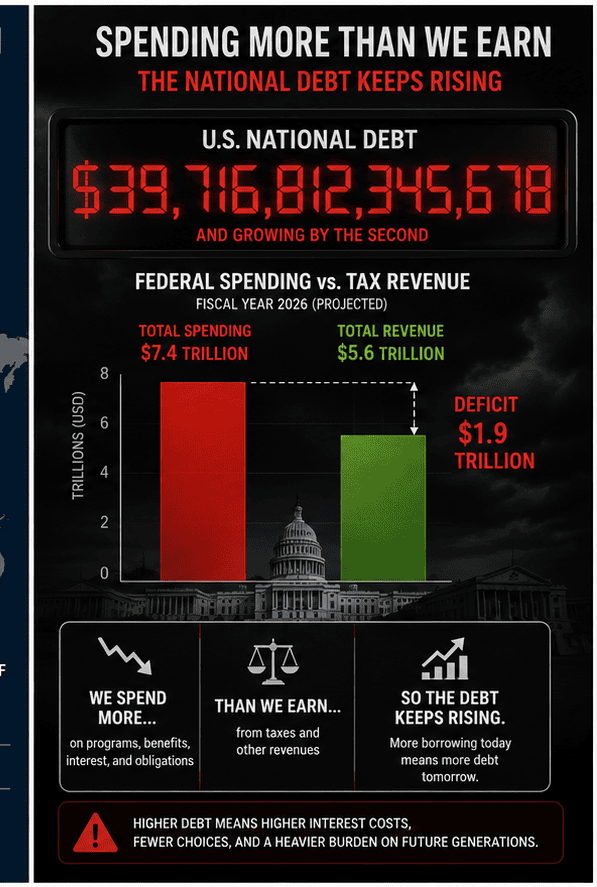
Open the U.S. Debt Clock and the numbers move so quickly that they barely seem real. America’s national debt is approaching US$40 trillion, interest costs are passing US$1 trillion a year, and the total rises by millions of dollars in less time than it takes to read a paragraph.
Look beyond the United States and the picture becomes even more disturbing. The International Monetary Fund estimates that global public debt reached just under 94% of worldwide gross domestic product in 2025. It projects that the figure will reach 100% by 2029, meaning government debt around the world could soon equal an entire year of global economic production.
That naturally raises a frightening question: if the United States, Canada, Europe, Japan and many developing countries are all deeply indebted, who exactly are they indebted to? Are governments genuinely capable of repaying these obligations, or are wars, inflation and political crises preparing the world for some kind of financial reset?
The debt problem is real. However, the most popular explanations often misunderstand how government debt works, who owns it and what a “reset” would actually look like.
The Numbers Are Enormous—But What Do They Mean?
As of late July 2026, the official U.S. national debt was approximately US$39.7 trillion. Of that amount, roughly US$31.9 trillion was debt held by the public, while approximately US$7.8 trillion represented intragovernmental holdings—money that one part of the federal government owes to another government account or trust fund.
Debt held by the public includes Treasury securities owned by American households, banks, pension funds, mutual funds, insurance companies, corporations, the Federal Reserve and foreign investors. Intragovernmental debt includes Treasury securities held by programs and trust funds that have accumulated surpluses and invested them in government obligations.
This distinction matters because the government does not owe the entire US$39.7 trillion to China, bankers or one mysterious global organization. Government debt is spread throughout the domestic and international financial system. Foreign investors own a substantial share of U.S. Treasury securities, but American institutions and government accounts own most of the total debt.
If Every Country Owes Money, Who Is Lending It?
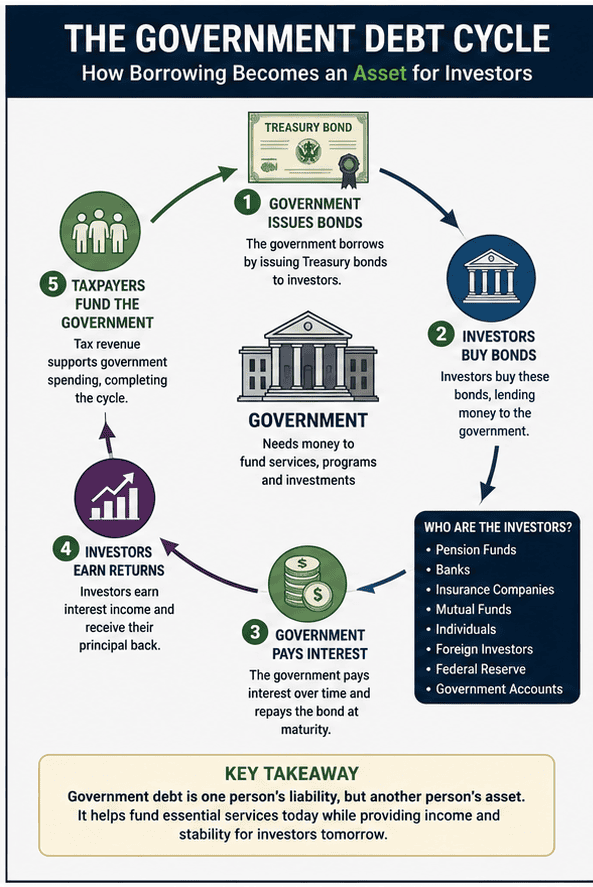
Governments borrow by selling bonds. A bond is essentially an agreement under which an investor gives the government money today in exchange for interest payments and repayment on a specified date.
Those investors are not limited to wealthy individuals or foreign governments. Pension plans buy government bonds because they need relatively stable, long-term assets to help fund future retirement payments. Banks, insurance companies and investment funds also hold government bonds as liquid, comparatively safe investments.
This creates a strange-looking but perfectly real situation: one institution’s debt is another institution’s asset. The government records a liability, while a pension fund records an investment. A Canadian worker may therefore indirectly own Canadian or American government debt through a pension plan, mutual fund, exchange-traded fund or insurance policy.
That does not make government borrowing harmless. It simply explains why the world can collectively hold so much debt without owing it all to an outside master creditor.
Why Do Governments Borrow Instead of Simply Balancing Their Budgets?
Government revenues and expenses rarely line up perfectly. Tax collections fall during recessions at the same time that spending on unemployment benefits and other supports may rise. Governments also borrow during wars, pandemics, natural disasters, banking crises and major infrastructure programs.
Borrowing can be sensible when it finances assets that will serve the public for decades. A bridge, electrical system, transportation corridor or water-treatment plant may benefit several generations, making it reasonable to spread part of the cost over time.
Borrowing can also prevent a recession from becoming worse. If tax revenue collapses and the government immediately cuts health care, education, benefits and infrastructure spending by the same amount, the cuts can remove even more demand from an already weak economy.
The danger begins when emergency borrowing becomes permanent. A government that routinely spends more than it collects—even during reasonably strong economic periods—creates a structural deficit. It must continually issue new debt to cover both current programs and the growing interest bill from previous borrowing.
Debt and Deficit Are Not the Same Thing
The national debt is the accumulated amount a government owes. The annual deficit is the additional amount it borrows because spending during that year exceeds revenue.
Imagine a household with a $400,000 mortgage that spends $20,000 more than it earns this year. The $400,000 is its existing debt, while the $20,000 is its new annual deficit. If that pattern continues, the total debt rises year after year.
The Congressional Budget Office projects that the U.S. federal government will collect approximately US$5.6 trillion in revenue during fiscal 2026 while spending about US$7.4 trillion. The resulting deficit is projected at roughly US$1.9 trillion, or 5.8% of the country’s GDP.
That is why the debt clock continues rising despite tariffs, spending cuts or occasional months with stronger tax collections. Unless the government eliminates the entire deficit, it is still adding new debt.
Why Tariff Revenue Is Not Solving America’s Debt Problem
The Trump administration can accurately say that tariffs have generated substantial government revenue. U.S. customs duties rose dramatically during fiscal 2025, reaching approximately US$210 billion, and the Congressional Budget Office estimates that higher tariffs could reduce cumulative deficits by about US$3 trillion over the 2026–2035 period compared with a scenario without those tariffs.
That is not trivial. However, it does not mean tariffs are paying off the national debt.
The United States is projected to run a deficit of approximately US$1.9 trillion in 2026 alone. Even hundreds of billions of dollars in tariff collections cannot eliminate a spending-and-revenue gap measured in the trillions.
There is another point that political speeches often blur: tariffs are initially paid by importers bringing goods into the United States. American companies may pass the cost to consumers, pressure foreign suppliers to lower prices, absorb part of the cost through reduced profits or change where they purchase goods.
Tariffs can improve federal revenue and protect selected industries, but they are still taxes on international trade. They are not giant cheques voluntarily mailed to Washington by Canada, China or Europe.
Is the Iran War Causing the U.S. Debt Crisis?
The war is adding to federal spending, but it is not the central cause of America’s debt problem.
In July 2026, the Pentagon estimated that the U.S. war in Iran had cost approximately US$37.5 billion, including certain projected expenses through September 30. The administration was also seeking tens of billions of dollars in additional funding to replenish weapons and continue operations.
US$37.5 billion is a staggering amount of money. Yet it equals only about 2% of the US$1.9 trillion federal deficit projected for 2026.
Even if every direct Iran-war expense disappeared immediately, the United States would still face an enormous shortfall. The underlying pressure comes from long-term spending commitments, tax policy, health-care costs, Social Security, defence, veterans’ programs and interest on previously accumulated debt.
Net federal interest costs are projected to reach about US$1 trillion in 2026 and rise to US$2.1 trillion by 2036. The CBO expects federal debt held by the public to increase from approximately 101% of GDP in 2026 to 120% in 2036, exceeding the previous post-Second World War record.
The war worsens the situation. It did not create it.
Are Wars Being Started to Trigger a Financial Reset?
This theory has become popular in discussions about Ukraine, Iran, central banks, digital currencies and the so-called New World Order. Supporters argue that Western governments know their debts cannot be repaid and are intentionally creating chaos so the existing financial system can be replaced.
There is no publicly verified evidence that the Ukraine war or the Iran war was deliberately started to erase Western sovereign debt. Wars normally increase public debt because governments must finance military equipment, personnel, fuel, reconstruction, veterans’ care, security measures and economic assistance.
History does, however, explain why the theory sounds plausible to many people. Major wars have repeatedly been followed by changes in currencies, borders, financial institutions and international economic arrangements. The Bretton Woods monetary system emerged during the closing stages of the Second World War, while wartime debt influenced taxation, interest-rate policy and financial regulation for decades afterward.
So the historical connection between wars and financial change is real. The leap from that observation to “the wars were deliberately created to reset the debt” is where the evidence breaks down.
The Evidence Supporters of a Reset Theory Point To
People expecting a reset are not wrong about every underlying pressure. They see debts rising faster than political leaders appear willing to address them. They see governments funding wars and large programs while promising that ordinary taxpayers will not have to sacrifice anything.
They also see central banks expanding their balance sheets during crises, governments discussing digital currencies, inflation reducing purchasing power and international organizations warning that current fiscal paths are unsustainable. The IMF itself says global debt markets face rising risks from interest burdens, defence spending, social demands and changes in the market for government securities.
Several genuine historical patterns make the theory more compelling:
- Wars and financial crises frequently produce sharp increases in public debt.
- Inflation can reduce the real value of fixed-rate government obligations.
- Governments sometimes pressure domestic institutions to hold public debt.
- Currency systems and international institutions can change after major crises.
- Highly indebted governments may eventually restructure or default.
Those facts justify concern. They do not establish a coordinated secret plan.
What Would a Real Financial Reset Actually Look Like?
A sudden cancellation of all government debt would be catastrophic because government bonds are assets held by pensions, banks, insurers, investment funds and ordinary savers. Erasing the debt would simultaneously erase trillions of dollars in investments and could destabilize the entire banking and retirement system.
A genuine debt adjustment is more likely to happen slowly and unevenly. Governments have several basic ways to reduce their debt burdens:
- Grow the economy faster than the debt.
- Raise taxes or reduce spending to produce budget surpluses.
- Allow inflation to reduce the real value of fixed-rate debt.
- Hold borrowing costs below inflation through financial regulation or monetary policy.
- Restructure the debt by extending maturities or reducing payments.
- Default outright when no workable alternative remains.
Inflation and “financial repression” can reduce domestic-currency debt, but these methods transfer wealth away from savers and can worsen poverty and inequality. The World Bank describes them as costly approaches that have historically been used when more conventional solutions became politically or economically difficult.
A modern reset may therefore never be announced as a reset. It could appear as a decade of prices rising faster than savings, taxes gradually increasing, retirement ages changing, benefits growing more slowly, currencies losing purchasing power and governments directing more of the financial system toward their bonds.
That is less dramatic than a secret meeting where world leaders replace every currency overnight. It is also far more realistic.
Didn’t America Reduce a Huge Debt After the Second World War?
Yes, but the debt was not simply cancelled.
The U.S. public debt-to-GDP ratio fell from approximately 106% in 1946 to 23% in 1974. Strong economic growth played an important role, but IMF research also points to primary budget surpluses, unexpected inflation and interest rates that were held down during the early postwar period.
This is a critical lesson. A country does not necessarily need to repay every dollar of debt with one enormous cheque. It can make the debt smaller relative to its expanding economy.
However, recreating the postwar experience would not be easy. The United States then benefited from younger demographics, rebuilding demand, rapid productivity growth and an unusually powerful position within the global economy. Today it faces an aging population, expensive health programs, persistent structural deficits and interest costs that are already approaching US$1 trillion annually.
Is Every Country Actually Broke?
No. Debt alone does not determine whether a country is solvent.
A country with large debt may also have valuable financial assets, productive infrastructure, natural resources, a strong tax base and a growing economy. A country with less debt may still be vulnerable if its debt is owed in a foreign currency, its government cannot collect taxes effectively or investors no longer trust its institutions.
Economists therefore pay close attention to debt sustainability rather than searching for one universal maximum debt number. The IMF considers debt sustainable when a government can meet its present and future obligations without default, exceptional outside assistance or an unrealistically damaging economic adjustment.
The most useful warning signs include:
- Debt rising persistently faster than GDP
- Interest consuming a growing share of government revenue
- Large deficits continuing outside recessions or emergencies
- Heavy dependence on short-term refinancing
- Debt denominated in a currency the country cannot create
- Falling investor confidence and rapidly rising bond yields
The United States has more borrowing capacity than most countries because Treasury securities remain central to the global financial system and the dollar is the dominant reserve currency. But that privilege is not unlimited, and the IMF has warned of vulnerability from changes in Treasury-market demand and a weakening safety premium.
How Serious Is Canada’s Debt?
Canada’s numbers are substantial, but they must be interpreted carefully because different debt clocks and government reports measure different things.
The latest finalized federal annual accounts showed an accumulated federal deficit—commonly called federal debt—of C$1.266 trillion as of March 31, 2025. Public debt charges reached C$53.4 billion during the 2024–25 fiscal year, up 13% from the previous year and equal to 10.5% of federal revenue.
Statistics Canada uses broader measures that include federal, provincial, territorial and local governments, along with social-security funds. At the end of the first quarter of 2026, Canadian general-government net debt equalled 16.5% of GDP when the assets of the Canada Pension Plan and Quebec Pension Plan were included. Excluding those social-security funds, the ratio was 45.6%.
That enormous difference does not mean one number is fake. It means gross debt, net debt, federal debt and total-government debt are different measurements.
Canada does have a national debt clock operated by the Canadian Taxpayers Federation. It is useful for visualizing how quickly estimated federal debt is changing, but it is produced by an advocacy organization rather than being the official federal accounting record. The Department of Finance and Statistics Canada should be used when exact definitions and official comparisons matter.
Is Norway Debt-Free?
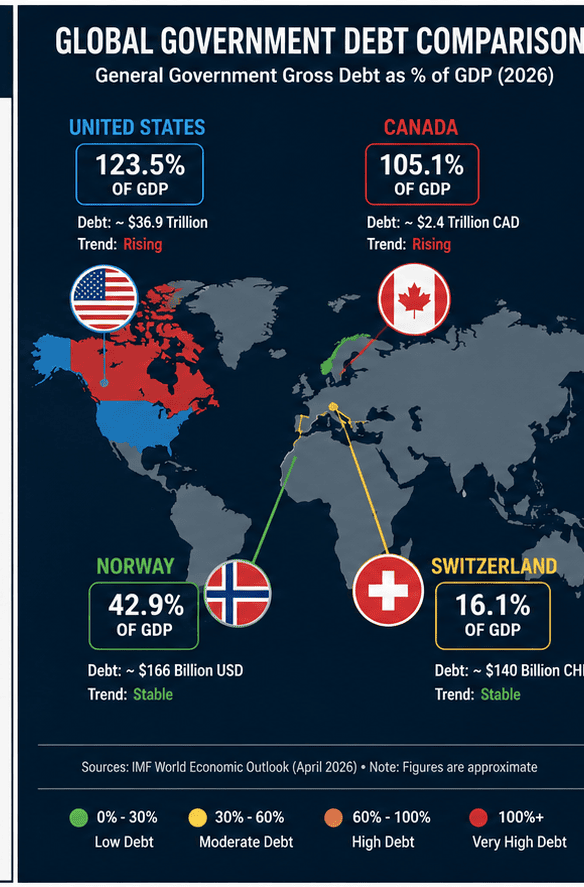
No. Norway is often described online as having no national debt, but IMF figures place its 2026 general-government gross debt at approximately 42.9% of GDP.
What makes Norway extraordinary is not the absence of debt. It is the enormous value of the assets on the other side of its national balance sheet.
Norway’s Government Pension Fund Global was worth 21.268 trillion Norwegian kroner at the end of 2025. More than half of that value came from investment returns, and the fund held shares in roughly 7,200 companies around the world, along with bonds, real estate and renewable-energy infrastructure.
Norway converted a large share of its petroleum wealth into a diversified investment portfolio instead of treating every year’s oil revenue as ordinary spending money. Its fiscal guideline links withdrawals over time to the fund’s expected real return, currently estimated at approximately 3%, and normal-year spending is intended to remain below that level.
Norway has debt—but it owns far more than it owes.
Why Can’t Canada Simply Copy Norway?
Canada can still learn from Norway, but it cannot recreate decades of accumulated investment returns overnight.
One complication is constitutional. Canadian provinces have jurisdiction over the exploration, development and taxation of many natural resources within their boundaries. Resource revenues are therefore divided across provincial governments rather than automatically flowing into one national sovereign wealth fund.
Alberta created the Heritage Savings Trust Fund in 1976 to save part of its non-renewable resource wealth. Its value reached approximately C$31.9 billion by December 31, 2025—an important asset, but tiny compared with Norway’s fund.
Canada and its provinces historically chose to use much of their resource revenue for current spending, tax reductions, infrastructure and public services. Norway consistently invested a much larger share and restricted how quickly the capital could be spent.
Canada could build larger sovereign wealth funds from future resource royalties, infrastructure returns or other public revenues. The hard part is not inventing the fund. It is maintaining political discipline across decades and resisting pressure to spend the principal whenever budgets become difficult.
What About Switzerland?
Switzerland is not debt-free either, but its federal finances are comparatively disciplined.
Net Swiss federal debt stood at CHF 140 billion at the end of 2025, equal to approximately 16.1% of GDP. The country’s federal government recorded a small CHF 0.3 billion financing surplus in 2025, although officials still expect budget pressure later in the decade.
Switzerland’s constitutional debt brake, introduced in 2003, generally limits spending according to expected revenue across the economic cycle. It allows emergency borrowing, as demonstrated during the pandemic, but requires extraordinary deficits to be dealt with over time.
The Swiss lesson is not that borrowing must never happen. It is that normal spending should not produce endless deficits simply because balancing the budget is politically uncomfortable.
Why the Debt Problem Matters Even Without a Dramatic Collapse
The greatest danger may not be a sudden morning when the dollar dies and the entire financial system resets. It may be a slow loss of national flexibility.
Every dollar devoted to interest is a dollar that cannot be spent on health care, defence, infrastructure, tax relief or emergency response without additional borrowing. Canada devoted C$53.4 billion to federal public debt charges in 2024–25, while the United States is approaching US$1 trillion annually.
High debt can also make governments more vulnerable to interest-rate changes. When older bonds mature, they must be refinanced at prevailing rates. If those new rates are higher, the interest bill can continue growing even without a dramatic increase in programs.
Eventually, the adjustment reaches the public. It may arrive through higher taxes, reduced services, delayed infrastructure, weaker retirement benefits, inflation or slower economic growth.
Final Verdict: Is a Global Financial Reset Coming?
There is no strong public evidence that governments are deliberately starting wars to erase their debts or secretly preparing one coordinated global cancellation of money.
The underlying concern, however, should not be dismissed. Global public debt is approaching 100% of worldwide GDP, the United States is adding deficits approaching US$2 trillion a year, and interest costs are consuming growing amounts of public revenue. Canada’s debt is more manageable than America’s by several measures, but its interest burden has also risen sharply.
Wars make this situation worse rather than solving it. They may accelerate political and monetary changes, but they also create new expenses, destroy productive assets and increase pressure on taxpayers.
A future debt reckoning is more likely to be gradual than theatrical. Governments will attempt to combine economic growth, moderate inflation, higher revenues, slower spending growth and financial regulation. Weaker countries may restructure or default, while stronger countries may continue refinancing their obligations for many years.
The debt clocks are not counting down to a known explosion time. They are warning that governments are steadily surrendering more of their future choices to promises and borrowing decisions made in the past.
The world is not universally bankrupt. But it is increasingly leveraged, increasingly expensive to finance and increasingly dependent on investors continuing to believe that tomorrow’s taxpayers will honour yesterday’s commitments.
That is serious enough without inventing a secret reset.