
Is a 2027 Recession Coming? Private Credit, AI, and Rising Power Costs
Economic predictions usually become popular for one of two reasons: they promise extraordinary prosperity or warn that disaster is approaching. Forecasts involving artificial intelligence, hidden financial leverage, and soaring electricity costs are particularly compelling because they connect three genuine areas of uncertainty. If all three deteriorated together, the resulting shock could reach far beyond technology investors.
Professor Jiang Xueqin, known for his geopolitical and historical commentary, has argued that vulnerabilities including private credit, inflated AI valuations, and energy constraints could become increasingly dangerous around 2027. He is not alone in identifying these pressure points. Central banks, financial regulators, and energy agencies are also examining them, although they do not generally claim that a recession will definitely begin in a particular year.
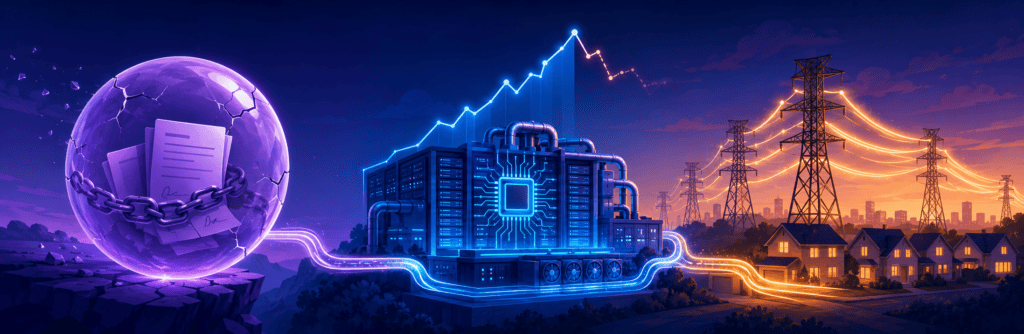
There is a credible adverse scenario: AI companies and data-centre projects fail to produce enough revenue, heavily financed borrowers struggle, private-credit losses rise, technology valuations fall, and expensive electricity weakens household purchasing power. That combination could reduce investment, restrict lending, eliminate jobs, and contribute to a recession.
It is possible—but possible is not the same as inevitable.
Quick Answer
A recession in 2027 is plausible, but it is not currently the baseline expectation of major economic forecasters. The concerns behind the prediction are nevertheless legitimate:
- Private credit has expanded rapidly and remains relatively opaque.
- AI investment and technology valuations may be assuming unusually strong future profits.
- Data centres are creating substantial new electricity demand in certain markets.
- Debt is increasingly connecting AI infrastructure with banks, private funds, utilities, and institutional investors.
- A failure in one area could intensify problems in the others.
The sensible response is not to predict the exact date of a crash. It is to improve household liquidity, reduce expensive debt, diversify investments, strengthen income security, and prepare for higher essential expenses.
What Would Count as a 2027 Recession?
A recession is a broad and sustained decline in economic activity, not merely a stock-market correction or several disappointing corporate earnings reports. Falling output, declining employment, reduced household spending, weak business investment, and tightening credit conditions are common recessionary features. A technology sell-off could occur without producing a national recession, just as rising electricity prices could hurt households without collapsing the broader economy.
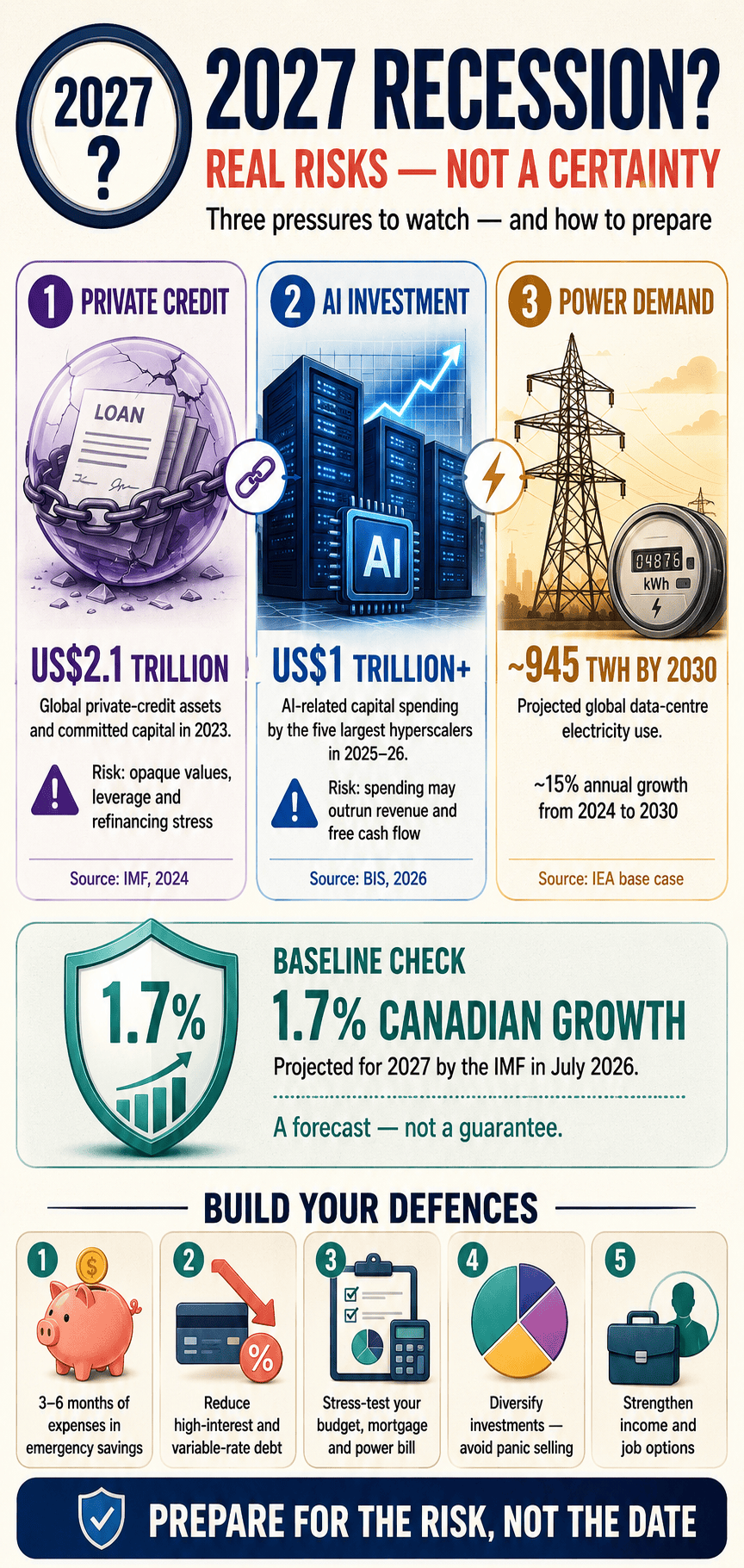
Current forecasts do not treat a 2027 Canadian recession as the most likely outcome. The IMF’s July 2026 outlook projects global growth of 3.4% in 2027 and Canadian growth of approximately 1.7%. The OECD also projects Canadian growth of 1.7% in 2027. These are forecasts rather than guarantees, but they demonstrate that the professional baseline is slow-to-moderate growth—not a predetermined collapse. International Monetary Fund
That distinction matters. An article declaring that a crash will happen could encourage readers to sell investments, stop retirement contributions, or make major purchases based on fear. A more useful question is whether enough vulnerabilities are accumulating to justify preparing for a recession, even if the exact timing remains unknowable.
Risk One: The Private-Credit Market
Private credit generally refers to loans made by investment funds and other non-bank lenders directly to businesses. Unlike a publicly traded bond, a private-credit loan is individually negotiated and usually cannot be bought or sold easily. Borrowers may include mid-sized companies, private-equity-owned businesses, real estate operators, and infrastructure projects.
The market serves a legitimate purpose. Private lenders can finance companies that are too complicated, risky, or specialized for conventional bank lending. They may also offer faster decisions, customized repayment terms, and longer capital commitments.
The concern is what happens after years of rapid growth.
Why Private Credit Can Hide Stress
Publicly traded bonds are continuously priced by markets. Private loans are valued less frequently and may rely partly on internal models. This can make a portfolio appear stable even as the borrower’s underlying financial condition deteriorates.
Many private-credit loans also carry floating interest rates. The interest charged rises when benchmark rates rise, protecting the lender’s income in theory but increasing pressure on the borrower. A company that could comfortably service debt at a lower rate may struggle when its interest expense increases while sales remain flat.
Other vulnerabilities include:
- Loans made to highly leveraged companies
- Limited information available to outside investors
- Valuations based on models rather than frequent market transactions
- Payment-in-kind arrangements that add unpaid interest to the loan balance
- Banks providing credit facilities to private-credit funds
- Insurers and pension funds investing in private-credit assets
- Several lenders holding exposure to the same borrower or corporate group
The Bank of Canada’s 2026 Financial Stability Report says the global private-credit market has become more connected to the broader financial system. It identifies complex structures, limited transparency, and the sector’s lack of experience through a major downturn as important vulnerabilities. However, it also notes that direct private-credit lending in Canada remains limited and Canadian institutional exposures appear manageable. Bank of Canada
That is not an “all clear.” Canadian banks, pensions, insurers, businesses, and markets are connected to global finance. A serious American credit event could tighten lending conditions in Canada even if Canadian loans were not the original source of the problem.
What a Private-Credit Bust Might Look Like
A private-credit crisis would not necessarily begin with dramatic bank runs. It could start quietly, with several borrowers missing payments, restructuring loans, or adding unpaid interest to their balances. Funds might gradually write down assets while limiting redemptions or delaying distributions.
The economic damage would spread if lenders became more defensive. Refinancing would become harder, weak companies would reduce investment, and highly leveraged businesses could cut workers to conserve cash. Banks exposed to private funds or related borrowers might tighten their own standards, making loans more difficult or expensive for otherwise healthy businesses.
That credit contraction—not the failure of one fund—is what could help turn financial stress into a recession.
Risk Two: An AI Investment Bubble
Calling AI a bubble does not mean the technology is useless. The internet transformed commerce, media, and communication even though the dot-com bubble destroyed enormous amounts of investor capital. A revolutionary technology and an investment bubble can exist simultaneously.
The difficult question is whether current valuations and infrastructure spending can be justified by future cash flow. Companies are purchasing specialized chips, leasing computing capacity, constructing data centres, and committing to long-term power arrangements. These projects must eventually generate sufficient revenue to cover equipment, financing, electricity, cooling, staffing, maintenance, and the rapid depreciation of computing hardware.
The Bank for International Settlements reported that the five largest hyperscalers were expected to spend more than US$1 trillion on AI-related capital expenditures during 2025 and 2026. Some of that spending exceeds internally generated free cash flow, increasing reliance on debt and outside financing. The BIS has also observed a tension between exceptionally optimistic equity valuations and more cautious credit-market pricing. Bank for International Settlements
What Could Cause AI Valuations to Break?
An AI correction would not require the technology to stop working. Expectations merely need to decline.
Possible triggers include:
- Revenue growing more slowly than infrastructure expenses
- Customers resisting higher subscription or usage prices
- Expensive AI features failing to produce measurable productivity gains
- Competition making models and computing services less profitable
- Data-centre construction exceeding practical demand
- Grid connections or power generation arriving later than expected
- New chips making recently purchased hardware obsolete faster
- Copyright, privacy, cybersecurity, or regulatory costs increasing
- Highly leveraged projects becoming difficult to refinance
The first losses would likely be uneven. Profitable technology companies with diverse revenue streams are not identical to speculative startups or debt-financed data-centre ventures. Some companies could emerge stronger after weaker competitors disappear.
For ordinary investors, this is why “AI will change everything” is not a complete investment thesis. A company can lead an important industry and still be a poor investment if its shares were purchased at a price requiring nearly flawless future performance.
Risk Three: Data Centres and Rising Electricity Costs
AI requires physical infrastructure. Model training and everyday inference—the process of using a trained model to produce an answer—both consume electricity. Data centres also require cooling systems, networking equipment, backup power, transformers, substations, and transmission capacity.
The International Energy Agency projects that global data-centre electricity consumption could roughly double to approximately 945 terawatt-hours by 2030. Its base case estimates data-centre demand growing around 15% annually from 2024 through 2030, considerably faster than other electricity demand. AI-optimized facilities are expected to represent a major portion of that increase. International Energy Agency
Those numbers are significant, but they do not prove that every Canadian household’s power bill will skyrocket in 2027. Electricity prices are determined regionally. Generation capacity, regulated rates, wholesale markets, fuel costs, transmission projects, public subsidies, utility contracts, weather, and government policy all affect what consumers pay.
Ontario is already planning for growing electricity demand from data centres, electrification, population growth, and industrial development. The Independent Electricity System Operator expects data centres to become a substantially larger part of provincial demand over the coming decades. Its high-demand scenario estimates commercial data-centre use rising from about 4.5 terawatt-hours in 2027 to 28.4 terawatt-hours in 2050. Independent Electricity System Operator
The pressure is therefore real, but the timeline is longer and more complicated than a single-year price shock. Electricity costs could increase because utilities must add generation and grid infrastructure. They could also be moderated by new supply, efficiency improvements, contracts requiring data centres to fund connections, or policies that prevent residential consumers from subsidizing large industrial loads.
How the Three Risks Could Reinforce One Another
The most important part of the 2027 argument is not any individual bubble. It is the connection among them.
Imagine a company borrows heavily to construct AI data centres. Its lenders include private-credit funds, while banks provide those funds with additional financing. The project assumes strong demand for computing capacity, predictable electricity costs, and a timely grid connection.
If construction costs rise, the grid connection is delayed, and customers purchase less computing capacity than expected, the project’s anticipated return falls. Investors mark down the company’s shares, lenders question the value of their collateral, and refinancing becomes more expensive. The company delays another project and cuts jobs.
If this pattern occurs across many companies, AI investment falls, private-credit losses increase, and financial institutions become more cautious. At the same time, households facing higher electricity expenses reduce discretionary spending. That combination could weaken several parts of the economy at once.
This is a credible recession mechanism. What cannot be known is whether it begins in 2027, occurs later, or remains a contained correction within technology and private markets.
How an Ordinary Person Can Prepare
A useful recession plan should protect a household without depending on the prediction being correct. The goal is financial resilience, not hiding from the economy.
1. Build a Real Emergency Fund
The Financial Consumer Agency of Canada recommends working toward three to six months of regular expenses. Someone with irregular income, one household earner, specialized employment, or a small business may need a larger reserve. Financial Consumer Agency of Canada
Start by calculating essential monthly expenses:
- Housing payments
- Utilities and basic communications
- Groceries and household supplies
- Transportation
- Insurance
- Minimum debt payments
- Medication and unavoidable health expenses
- Essential child or dependent costs
Keep emergency money protected and accessible. It should not depend on selling volatile investments during a market decline. A high-interest savings account or suitable cash-equivalent product is generally more appropriate than speculative shares, although account protection, access restrictions, fees, and tax treatment should be confirmed.
2. Create a Recession Budget Before You Need It
A recession budget is not the household’s current budget. It is the reduced spending plan that would begin after a layoff, business slowdown, or major expense.
Separate spending into three categories: essential, reducible, and removable. Insurance and groceries are essential, restaurant spending may be reducible, and unused subscriptions may be removable. Record exactly how much could be cut within one week, one month, and three months.
This prevents panicked decisions during an emergency. It also reveals whether the emergency fund truly covers three months or only appears to because discretionary spending was underestimated.
3. Reduce Fragile Debt
High-interest debt creates a guaranteed drain on cash flow. Credit cards, payday loans, and expensive unsecured balances deserve particular attention. Variable-rate debt also requires stress testing because payments or interest costs can change.
This does not mean using every dollar of savings to eliminate a low-rate loan while leaving no emergency cash. Liquidity matters during a recession. A balanced approach usually maintains a starter reserve while directing surplus income toward the most expensive debt.
Homeowners should also examine their next mortgage-renewal date. Estimate payments at several interest rates and confirm what the household could support after a reduction in income. Avoid assuming refinancing or a home-equity line of credit will always be available; lenders can become more cautious precisely when borrowers need credit most.
4. Examine Investment Concentration
A diversified investor does not need to abandon the market because an AI correction is possible. Selling everything creates a different risk: missing a recovery, triggering taxes, or holding excessive cash while inflation erodes purchasing power.
Instead, determine how much of the portfolio depends on the same underlying story. Technology ETFs, broad American indexes, employer shares, semiconductor stocks, data-centre investments, and private-credit funds may overlap more than their labels suggest.
Ask four questions:
- How much would the portfolio fall if technology shares dropped sharply?
- Is money needed within the next few years exposed to equities?
- Does one company, industry, country, or investment theme dominate?
- Would a decline cause an emotional decision that violates the plan?
A registered financial professional can help when the portfolio is large, concentrated, tax-sensitive, or close to retirement. Verify credentials, compensation, conflicts of interest, and product fees before accepting recommendations.
5. Strengthen Income Security
A recession is usually more dangerous to a household through lost employment than through a temporary portfolio decline. Update the résumé, maintain professional contacts, document accomplishments, and keep required licences or certifications current. People in rapidly changing fields should identify skills that remain useful even if one employer or technology cycle weakens.
A second income stream can help, but it should be tested carefully. Taking on major debt to launch an unproven business shortly before a possible downturn creates another vulnerability. A modest service, freelance skill, repair business, or digital product validated with paying customers is different from an expensive speculative startup.
Workers should also understand their employment benefits, unused vacation arrangements, severance terms, pension options, and eligibility rules for government support. Do not wait for a termination meeting to discover what documents are required.
6. Prepare for Higher Power Costs Sensibly
Begin with the electricity bill. Compare usage across seasons, identify peak-demand habits, and confirm whether the household is billed under time-of-use, tiered, or another rate structure. The most effective improvements depend on the home, heating system, climate, and local program.
Low-risk measures may include air sealing, appropriate insulation, smart thermostat schedules, efficient lighting, and reducing unnecessary standby consumption. Larger investments such as heat pumps, new windows, solar panels, or batteries require a property-specific payback calculation.
Do not spend tens of thousands of dollars solely because someone predicted a 2027 power-price surge. Obtain multiple quotes, confirm available incentives, review warranties, and calculate savings using several electricity-price assumptions.
7. Prepare a Small Business for Tight Credit
Business owners should assume that customers may pay more slowly during a downturn. Monitor accounts receivable, customer concentration, gross margin, debt-service obligations, and monthly cash burn. A company dependent on one customer or one lender has a hidden concentration risk.
Preserve access to financing before a crisis, but do not borrow unnecessarily. Document procedures, reduce low-value subscriptions, renegotiate suppliers where appropriate, and distinguish essential investments from projects driven by optimism.
A business with accurate records and a clear cash-flow forecast can respond earlier than one managed by its bank balance alone.
What Not to Do Because of a 2027 Prediction
Preparation can become destructive when fear replaces analysis. Avoid:
- Selling a diversified retirement portfolio solely because of a dated forecast
- Shorting AI companies without understanding potentially unlimited losses
- Hoarding excessive physical cash
- Cancelling essential insurance to increase savings
- Purchasing gold, cryptocurrency, generators, or survival equipment without a defined need
- Borrowing heavily to purchase supposedly recession-proof assets
- Delaying every useful investment in education, equipment, or a sound business
- Assuming a recession will automatically produce cheap homes or stocks at the exact moment cash is available
The objective is not to win a bet against the economy. It is to remain functional under several possible outcomes.
Warning Signs Worth Monitoring
Instead of obsessing over a countdown to 2027, watch indicators connected to the actual theory:
- Rising defaults and restructurings among private-credit borrowers
- Funds reporting more non-accrual loans or material valuation reductions
- Banks tightening business and consumer lending standards
- AI infrastructure spending continuing to rise while revenue disappoints
- Data-centre cancellations, construction delays, or unused capacity
- Utility rate applications and grid-upgrade costs in the local province
- Increasing unemployment and consumer-payment delinquencies
- A sustained reduction in business investment and household spending
One weak indicator does not confirm a recession. Several deteriorating together would make the scenario more concerning.
Prepare for the Risk, Not the Date
Private credit deserves scrutiny because it is opaque, highly connected, and largely untested in a severe downturn. AI deserves scrutiny because transformative technology does not guarantee that every investment or valuation is reasonable. Electricity demand deserves scrutiny because data centres, electrification, and aging grid infrastructure require costly expansion.
Those concerns make a 2027 recession possible. They do not make it certain, and current institutional forecasts continue to project economic growth rather than contraction.
Fortunately, ordinary households do not need a perfect economic forecast. Accessible savings, manageable debt, diversified investments, lower fixed expenses, stronger employment options, and sensible energy efficiency are useful in a recession, a market correction, or an ordinary year. The person best prepared for 2027 will not necessarily be the one who predicted the economy correctly. It will be the one whose finances can absorb being wrong.
- Bank of Canada Financial Stability Report 2026 — Review the Bank of Canada’s assessment of private credit, household finances, banking resilience, and other financial vulnerabilities.
- International Energy Agency: Energy Demand from AI — Explore projections for data-centre electricity use and the factors shaping future AI-related energy demand.
I think the Chinese will flood the AI market with cheaper and cheaper and capable models. This means the big ai tech giants may find revenue harder to get at. This could be the spark that tips the economy into a recession.