
U.S. Tariffs, Zonos, and the New Reality for Canadian Sellers
Selling to the United States used to feel straightforward for many Canadian small businesses. You listed an item, packed it, filled out a basic customs form, paid for postage, and sent it across the border. The United States was still an international market, technically speaking, but it often felt close enough to be part of the same online marketplace.
That has changed.
Canadian sellers shipping parcels to U.S. customers now face more customs steps, more item details, more tariff uncertainty, and more costs that can quietly eat into a sale. For occasional sellers, Etsy shops, eBay sellers, tradespeople, creators, resellers, and small product businesses, the change can feel especially frustrating because the extra work often shows up on small orders where there is not much profit to begin with.
The important thing is to separate the headlines from the practical reality. Tariffs between Canada, the United States, China, and Mexico affect huge industries such as steel, vehicles, machinery, electronics, and agriculture. But those policies also trickle down into the everyday world of online selling: customs declarations, country-of-origin questions, duties, processing fees, product pricing, returns, and confused American buyers.
At a Glance: What Canadian Sellers Need to Know
For a Canadian business shipping goods to the United States by Canada Post, the biggest immediate changes are practical rather than political.
- You now need a Zonos Prepay Declaration ID for U.S.-bound Canada Post parcels.
- You must provide a truthful item description, value, country of origin, and other customs information.
- The Zonos app can charge duty, a remittance charge, and a processing fee.
- Even a product made in Canada may not receive normal CUSMA or USMCA preference when sent through the postal channel.
- Small, low-priced orders are often hit hardest because fixed cross-border fees take a larger share of the profit.
- Metal-heavy products, imported components, Chinese-made goods, and products that cross North American supply chains deserve extra attention.
The main lesson is simple: do not price a U.S. sale based only on materials, labour, and postage. Price it based on the full landed cost of getting the product into your customer’s hands.
What Zonos Is and Why It Is Suddenly Part of the Process
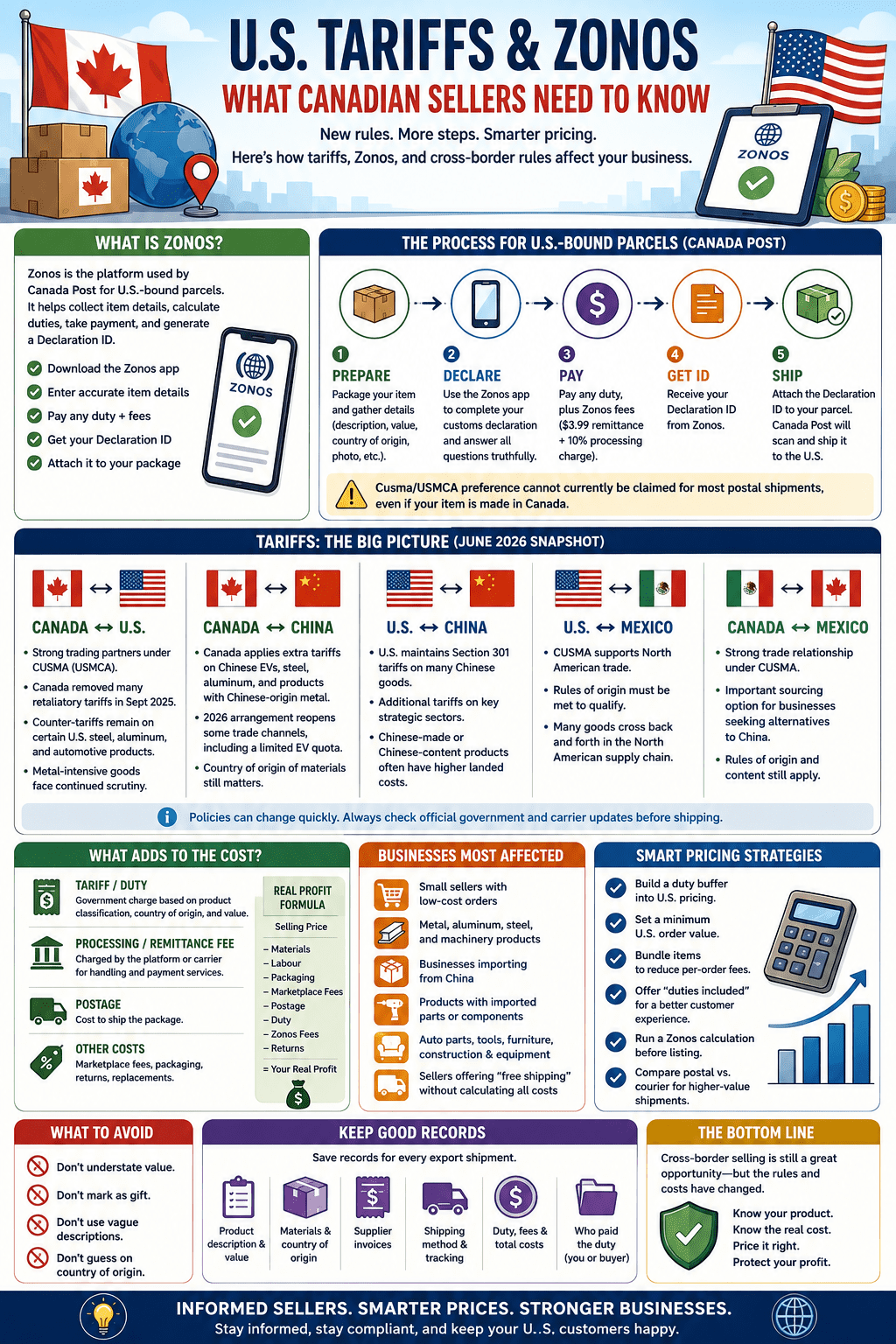
Zonos is a cross-border trade platform used by Canada Post for U.S.-bound parcels. It is not simply another shipping app. Its job is to collect item information, help assign a customs classification, calculate duties, take payment where required, and produce a Declaration ID that Canada Post can scan.
That explains why the app asks for exact information about the item. It may ask for a photo, a description, the value, the country where the product was made, and the type of shipment. The system is trying to determine what the item is for customs purposes, not merely what you call it in your online listing.
For a seller, this means “wooden box” is not always a strong enough description. “Handmade wooden keepsake box,” “cotton T-shirt,” “used cordless drill,” or “ceramic planter” gives customs systems more useful information. You should also keep the description honest and specific without trying to get clever with vague wording.
Zonos is free to download, but using it can still cost money. The app may collect any duty payable on the shipment, along with remittance and processing costs. That is why a relatively inexpensive item can suddenly feel much less profitable after the declaration is completed.
Duty, Tariff, Tax, Postage, and Fees Are Not the Same Thing
A lot of people use the word “tariff” to describe every extra cost at the border. That is understandable, but it makes it harder to see where the money is actually going.
A tariff is a type of import duty set by a government. It is usually based on the product classification, country of origin, and declared value. The importer or the party handling the import ultimately pays it, even though the seller often builds it into the price.
A customs duty is the border charge calculated on the shipment. In everyday conversation, duty and tariff are often used interchangeably.
A processing or remittance fee is different. That is a charge for handling the payment, currency conversion, compliance process, or transfer of funds. It can be especially painful on low-value sales because it is not tied directly to how much profit you made.
Postage is simply the shipping cost. It pays to move the package, but it does not necessarily include all duties, taxes, or processing charges.
The full cost of a U.S. sale can look like this:
Selling price
minus materials
minus labour
minus packaging
minus marketplace fees
minus postage
minus duty
minus Zonos remittance and processing fees
minus any cost of returns or replacements
equals your real profit
That is the number you need to protect.
Why the U.S. $800 Threshold No Longer Feels Like a Free Pass
For years, small cross-border sellers paid close attention to the United States’ de minimis threshold. In plain language, this was the rule that allowed many lower-value imports to enter without duties. The widely known figure was US$800, which made it easier to sell affordable goods to American customers.
That convenience has been disrupted.
The United States suspended duty-free de minimis treatment for many imports, including postal shipments. Under the current postal system, Canada Post requires a Zonos declaration for U.S.-bound packages. For goods under US$800, duty is generally prepaid through the process. For shipments above US$800, a Declaration ID is still required, but the customer may be responsible for duty when the item arrives.
That change matters because a small product can now face border costs even when the order value is nowhere near luxury-goods territory. A CAD $35 item that once made sense to ship can become hard to justify when customs-related charges take a noticeable bite out of the margin.
For a casual seller, that can feel ridiculous. For a business, it means the old “just ship it and hope for the best” approach is no longer good enough.
Why CUSMA or USMCA Does Not Automatically Save a Postal Shipment
CUSMA, also called USMCA in the United States, is the trade agreement linking Canada, the United States, and Mexico. It gives many qualifying North American goods preferential tariff treatment. That sounds like it should solve the problem for a Canadian-made product heading to an American customer.
Unfortunately, the postal process is not that simple.
Canada Post explains that CUSMA or USMCA preference cannot currently be claimed for certain lower-value postal shipments through this system. That is not because your item is necessarily ineligible under the trade agreement. It is because a postal shipment does not use the same documentation and entry process as a larger commercial import.
This is a critical distinction for sellers. A product can genuinely be made in Canada and still produce a duty calculation when sent through the postal channel. A courier or commercial shipping option may have a different customs process, but it may also carry higher shipping, brokerage, or paperwork costs.
Do not assume that “made in Canada” automatically means “duty-free everywhere.” Check the shipping method, declared country of origin, product category, and current rules before setting your U.S. price.
The Canada–United States Tariff Picture: The Big Sectors Still Matter
Canada and the United States remain deeply connected trading partners, and many goods still move under CUSMA rules. But the relationship is no longer as predictable as it once felt.
Canada removed many of its broad retaliatory tariffs on U.S. goods in September 2025. However, Canadian counter-tariffs remain on certain U.S. steel, aluminum, and automotive products. On the U.S. side, tariffs on specific strategic sectors, especially metals and metal-heavy derivative products, continue to affect Canadian exporters.
That is not just a problem for large steel mills. It can affect companies making:
- Metal brackets, fasteners, tools, and fabricated parts.
- Machinery, construction equipment, and industrial products.
- Aluminum products, storage systems, trailers, and automotive components.
- Furniture, cabinets, fixtures, and products containing significant metal parts.
- Consumer goods that use imported hardware, frames, rails, handles, or metal packaging.
The lesson is not that every seller should become a trade lawyer. The lesson is that the product’s material composition and country of origin now matter more than they used to.
A Canadian-made wooden product with a few imported screws may be treated very differently from a metal storage box, a steel tool, or a product made mostly from imported aluminum. The more metal-intensive the item is, the less safe it is to rely on simple assumptions.
Canada and China: Why Chinese Inputs Still Affect Canadian Businesses
The Canada–China tariff relationship matters even for businesses that do not sell directly to China.
Canada has taken measures aimed at Chinese electric vehicles, steel, aluminum, and certain products containing Chinese-origin metal. At the same time, Canada and China reached a 2026 arrangement that reopened some trade channels, including a limited quota for Chinese electric vehicles at the standard most-favoured-nation tariff rate.
That does not mean the tariff issue disappeared. Canada still applies special measures to certain products containing steel melted and poured in China or aluminum smelted and cast in China. This is important because the country where you bought a product is not always the same as the country of origin of every material inside it.
For example, a seller may source a product from a U.S. distributor, a Canadian wholesaler, or a Mexican manufacturer. But the steel, aluminum, hardware, electronics, batteries, or components inside that product may have originated somewhere else.
That is why businesses that import inventory should keep purchase invoices, supplier specifications, and country-of-origin records. You may not need the information for every single sale today, but you will be glad to have it when a platform, carrier, customs authority, or customer asks.
The United States and China: Still the Biggest Supply-Chain Pressure Point
The U.S.–China trade relationship remains the biggest tariff story for global manufacturing. The United States continues to use Section 301 measures against many Chinese imports, alongside separate national-security tariffs on selected sectors.
The practical result is that Chinese-made goods, parts, and inputs can face a different cost structure than goods made in Canada, Mexico, Europe, or the United States. This affects major importers, but it also affects small sellers buying inventory from overseas marketplaces or North American suppliers that rely heavily on Chinese manufacturing.
A product may look like a simple household item, tool accessory, décor piece, electronic part, or replacement component. But if it is made in China, contains Chinese-origin material, or falls into a targeted product category, the landed cost can rise quickly.
Do not build a business around the assumption that inexpensive imported inventory will always remain inexpensive. The cost can change because of tariffs, freight, currency, customs enforcement, supplier price increases, or changes to the de minimis system.
Where Mexico Fits Into the Picture
Mexico matters because North American manufacturing is now tightly linked. Vehicles, appliances, electronics, furniture, building materials, food products, and industrial parts often cross the Canada–U.S.–Mexico supply chain more than once before reaching the final customer.
CUSMA is supposed to encourage North American production, but it does not create a magic loophole. A product shipped from Mexico is not automatically a Mexican-origin product. It must meet the agreement’s rules of origin.
That matters for businesses looking for alternatives to Chinese sourcing. Mexico can be an excellent sourcing option, especially for products made genuinely within North America. But a product routed through Mexico without meaningful production there may not receive the trade benefits you expect.
The 2026 CUSMA review will likely keep attention on automotive rules, metals, regional content, supply-chain security, and trade enforcement. For small businesses, the smart move is to buy from suppliers who can clearly explain where the product is made and where its major materials come from.
Which Businesses Are Most Exposed?
Not every business will be hit equally. The most exposed businesses are usually those with thin margins, low order values, imported inputs, or products caught in politically sensitive sectors.
The businesses most likely to feel the pressure include:
- Small Canadian online sellers shipping low-cost goods to U.S. customers.
- Etsy, eBay, Shopify, and marketplace sellers with many small orders.
- Companies selling metal, aluminum, steel, copper, automotive, or machinery-related products.
- Retailers importing goods or components from China.
- Canadian makers using imported hardware, electronics, batteries, or specialty materials.
- Auto-parts, construction-supply, tool, furniture, and equipment businesses.
- Sellers who offer “free shipping” without calculating customs-related costs first.
The businesses least exposed are usually those with strong margins, higher average order values, simple products, clear Canadian origin, and customers willing to pay for premium handmade or specialized goods.
That does not mean low-priced products are impossible to sell. It means the seller needs to be disciplined about minimum order sizes and pricing.
A Better Pricing Strategy for U.S. Orders
The first practical move is to stop treating U.S. orders exactly like Canadian orders.
You may need a separate U.S. pricing structure. That does not have to be dramatic or complicated. It simply needs to reflect the actual cross-border cost.
Consider these approaches:
- Build a U.S. duty buffer into the price.
Raise the U.S. price enough to cover the typical duty and processing cost without needing to scramble after every sale. - Set a minimum U.S. order value.
A fixed fee hurts a CAD $20 order far more than a CAD $150 order. Minimum-order rules can protect your margin. - Bundle items together.
Selling two or three related products in one parcel may make more sense than shipping each low-value item separately. - Use a clear “U.S. duties included” message.
American buyers dislike surprise charges. A transparent price can be a selling advantage. - Run a Zonos calculation before listing the product.
Use the tool to estimate the duty, classification, and total cost before you promise a price to a customer. - Compare postal and courier options for higher-value orders.
A courier may cost more upfront but could offer a more suitable customs process for qualifying goods.
Do Not Guess on Customs Declarations
The temptation is to save time by using vague descriptions, low values, or a generic country of origin. That is a bad business habit.
Never mark a commercial sale as a gift. Never understate the value. Never describe a product in a way that hides what it really is. Customs systems are becoming more data-driven, and inconsistent information can create delays, refusals, customer disputes, or worse.
For every export shipment, keep a simple record of:
- Product name and detailed description.
- Sale price and currency.
- Materials used.
- Country of origin.
- Supplier invoice or proof of purchase.
- Shipping method and tracking number.
- Duty, remittance, and processing cost.
- Whether you absorbed the cost or passed it on.
That record will make future pricing much easier. It will also help you identify which products are still worth selling to the United States and which ones should stay Canada-only.
What Happens Next? Realistic Predictions for Sellers
Tariffs can change quickly, but the pressure behind them is not likely to disappear overnight.
The United States is focused on domestic manufacturing, supply-chain resilience, metals, advanced technology, and reducing reliance on foreign production. Canada is trying to protect domestic industries while keeping access to the U.S. market. China remains central to global manufacturing and a major source of political and trade tension. Mexico is becoming even more important as North American companies look for regional manufacturing alternatives.
A future change in political leadership could change the tone, the tariff rates, or the negotiating style. But businesses should not assume it will restore the old low-friction system automatically. Trade policy now involves national security, industrial policy, clean energy, critical minerals, technology, and supply-chain control. Those issues are bigger than one politician.
The safer prediction is that Canadian sellers will need better product data, clearer country-of-origin records, more careful pricing, and more flexible shipping strategies. The sellers who adapt early will have an advantage over competitors still treating customs costs as an annoying surprise.
The Bottom Line
Zonos is not the real problem. It is a visible part of a much bigger shift in how cross-border trade is handled.
For Canadian sellers, the old way of pricing U.S. orders is no longer reliable. A product may now involve postal duty prepayment, service fees, tariff exposure, country-of-origin questions, and customer expectations around landed cost. That is frustrating, but it is also manageable once you treat it as part of the business model.
Know what you are selling. Know where it was made. Calculate the true landed cost before you list it. Build a buffer into your U.S. price. And do not let a small sale cross the border only to discover that the profit disappeared at the post office.
Related External Links
- Canada Post: How to Use the Zonos Prepay App — Official instructions for creating a U.S. customs declaration, paying duty, and getting a Declaration ID.
- Government of Canada: Tariffs on Steel and Aluminum — Current federal information on Canadian tariff measures affecting steel, aluminum, and Chinese-origin metal content.