
Spotting Counterfeit Canadian and U.S. Money: What to Look For
Most people do not think much about counterfeit money until they are handed a strange-looking $20 at a garage sale, paid in cash for a job, or dealing with someone through an online marketplace. Then suddenly, the question becomes very real: is this bill genuine, or am I about to take a loss?
Counterfeit cash is not just a problem for banks and stores. It can hit anyone who accepts cash for tools, vehicles, collectibles, side jobs, handmade products, restaurant tips, or local classified sales. The good news is that you do not need expensive equipment or expert training to catch many suspicious notes. You just need to know what genuine money is supposed to feel, look, and behave like.
Canadian polymer banknotes and modern U.S. bills use very different materials and security systems. Canada’s notes are smooth plastic polymer with clear windows and colour-shifting metallic details. U.S. notes still have their familiar cloth-like paper feel, but they contain raised printing, embedded security threads, watermarks, and colour-shifting ink. Once you know the basics, a quick check can become second nature.
Quick Answer: How to Check a Suspicious Bill
The best way to spot counterfeit money is to check more than one feature. Do not trust colour, a serial number, or a counterfeit pen by itself.
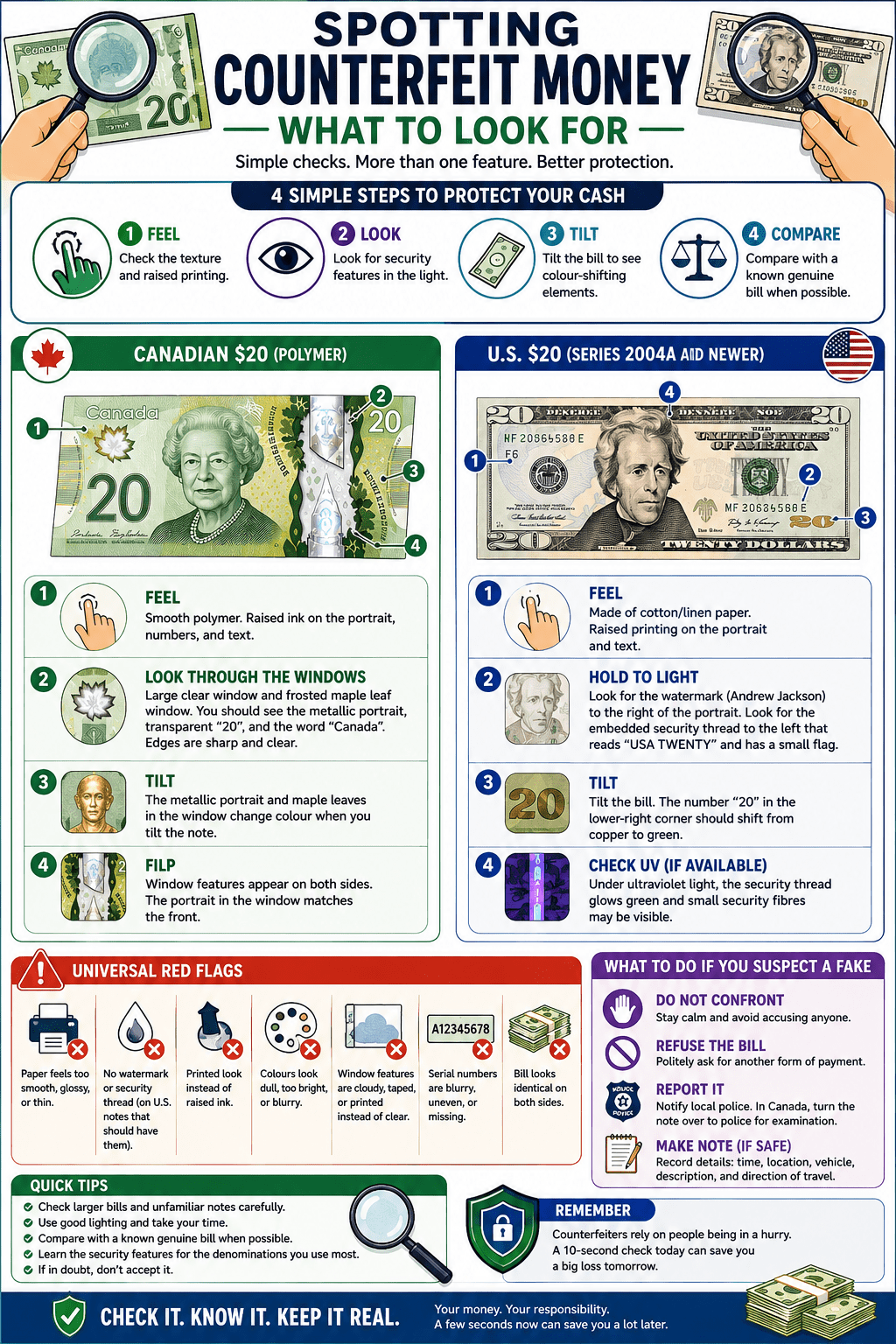
For Canadian polymer notes, use this quick routine:
- Feel the smooth polymer and raised printing.
- Look through the transparent windows.
- Tilt the note to see colour-shifting metallic details.
- Flip it over and make sure the window features remain sharp and match.
For modern U.S. notes, use this routine:
- Feel for raised printing and the cloth-like paper texture.
- Hold it to light to find the watermark and embedded security thread.
- Tilt larger notes to see colour-shifting ink.
- Compare it with another bill of the same denomination when possible.
One failed feature does not automatically prove a bill is fake, especially if it is old, damaged, stained, or from a different series. But when several details look wrong, do not accept it.
Counterfeit Money Is Different From Damaged Money
A beat-up bill is not automatically counterfeit. Real money can be wrinkled, taped, stained, washed, folded, faded, or worn out from years of circulation. Canadian polymer notes can get scratched, bent, punctured, or heat-damaged, while U.S. paper notes can become soft, grimy, or torn around the edges.
What matters is whether the important security features are still present and believable. A genuine Canadian polymer note should still have its transparent window and detailed metallic elements, even if it is worn. A genuine U.S. $20 should still have its watermark and embedded security thread when held up to light, even if the bill has seen better days.
Counterfeiters often depend on people reacting too quickly. They may try to create urgency by saying they are in a rush, offering a deal that seems too good to pass up, or handing over several notes at once. Slow the transaction down. A person who is legitimate should not be offended by a calm, professional cash check.
Why Canadian and U.S. Money Feel So Different
Canada moved to polymer banknotes because polymer allows for clear windows, metallic holographic-style details, and other features that are difficult to copy convincingly. The notes are more resistant to everyday wear than old paper notes, although they are not indestructible. They can still be cut, punctured, melted, or damaged by heat.
The Canadian $5, $10, $20, $50, and $100 polymer notes share a general family of security features. The vertical $10 note has a different layout and artwork, but it still follows the same basic idea: smooth polymer, transparent sections, raised printing, sharp metallic details, and colour changes when tilted.
The United States has taken a different route. U.S. currency remains made from a durable cotton-and-linen blend rather than polymer. Modern American bills have been redesigned over the years to add security features while keeping the familiar size, feel, and overall appearance that people recognize.
That does not mean U.S. currency is “old-fashioned” or easy to fake. A real American bill has multiple layers of security built into it. The key is knowing which features apply to the particular denomination and series you are holding.
A Famous Counterfeiting Story: Operation Bernhard
Counterfeit money has been used for fraud for centuries, but one of the most notorious examples was Operation Bernhard during the Second World War. Nazi Germany created a massive operation intended to flood Britain with forged British pounds and damage confidence in the British economy.
The operation relied on prisoners forced to work under horrific conditions producing highly convincing counterfeit notes. By late 1943, the operation was reportedly producing nearly one million counterfeit British notes per month. The forged money was used in espionage and covert operations, and the scale of the scheme showed governments around the world why banknote security matters so much.
Modern banknotes are designed around that lesson. A bill should not depend on just one detail, such as a portrait or a coloured number. The hardest notes to counterfeit combine material, printing, transparent features, embedded security elements, tactile details, and visual effects that change when the note moves.
How to Check a Canadian Polymer $20 Bill
The Canadian $20 bill is one of the most common notes used in everyday transactions, which makes it a smart note to learn first. You may see the regular polymer $20 or a legitimate commemorative variation, so focus on security features rather than assuming every real note must look identical.
Feel the Polymer and Raised Printing
A genuine Canadian polymer note is made from one smooth piece of plastic-like material. It should feel different from regular printer paper, magazine paper, or a laminated sheet. The bill may feel slightly slicker than old paper money, but it should not feel like a flimsy clear plastic sleeve.
Run your fingers over the large number, the shoulders of the main portrait, and the words “Bank of Canada” and “Banque du Canada.” These areas should have raised ink that you can feel. The text and images should feel intentionally printed, not flat and blurry.
Look at the Transparent Windows
The large transparent window is one of the most important Canadian security features. You should be able to see clearly through it. The window contains detailed metallic imagery, transparent numbers matching the bill’s denomination, and the word “Canada.”
Look closely at the frosted maple leaf window as well. It should have a clean, transparent outline rather than looking like a cloudy blob or a printed imitation.
A genuine note should have sharp details around the window. Blurred edges, fuzzy printing, uneven colour, or a window that looks pasted on are red flags.
Tilt the Bill
Tilt the top of the note toward you and away from you. The metallic portrait and other metallic elements inside the large transparent window should shift in colour. This is one of the fastest checks you can perform during a cash transaction.
The colour shift should look clean and deliberate, not like a dull shiny sticker. Counterfeit notes may imitate metallic ink, but they often fail to recreate the sharp colour changes and fine details found on a real polymer note.
Flip It Over
Flip the bill and look at the large transparent window from the back. The metallic portrait and details should repeat with the same colours and sharpness. The portrait inside the window should match the large portrait printed on the front of the note.
Do not reject a bill simply because it has a design detail you have not seen before. Canada has issued commemorative notes that can look different from the standard version. When in doubt, compare the note to an official image or ask for another form of payment.
How to Check a U.S. $20 Bill
A U.S. $20 bill is common in cross-border travel, tourist areas, online marketplace sales, and Canadian businesses near the border. It is also a note worth checking carefully because it is used frequently enough that a fake can slip through when people are in a hurry.
Feel the Paper and Raised Printing
A genuine U.S. bill does not feel like ordinary printer paper. Modern U.S. currency is made from a cotton-and-linen blend, giving it a cloth-like, slightly rough texture. It should not feel glossy, slick, overly smooth, or thin like standard copy paper.
Move your finger over the portrait, particularly around the clothing and detailed print lines. Genuine notes have raised printing that gives them a slight roughness. This is helpful, but do not rely on feel alone because worn notes may feel less distinct.
Hold It Up to Light
On a modern U.S. $20 bill, hold the note up to a bright light. You should see a faint watermark portrait of Andrew Jackson to the right of the printed portrait. The watermark should be visible from both sides of the note.
You should also see an embedded security thread to the left of the portrait. The thread reads “USA TWENTY” and includes a small flag. Under ultraviolet light, that thread glows green.
These features are built into the bill itself. They should not look like something printed on the surface.
Tilt the Lower-Right Number
Tilt the $20 bill and look at the numeral in the lower-right corner on the front. On the current-style $20, the number should shift from copper to green as you move the bill.
This is a quick and useful check, especially when you are accepting a few larger notes. If the number stays flat and does not change colour at all, take that seriously.
Do Not Forget Older Bills
Not every genuine U.S. bill looks exactly like the newest version. Older U.S. designs can still be legal tender, and people may legitimately use them. A real older bill may not have every feature found on a newer note.
That is especially important with $1 and $2 bills. You should not expect the same watermark-and-security-thread checklist used on modern $5, $10, $20, $50, and $100 notes. Learn the features for the denomination you handle most often instead of assuming every American bill should work the same way.
What About U.S. $100 Bills?
When a transaction involves U.S. $100 bills, slow down and check more carefully. The modern $100 has distinctive security features, including a blue 3-D security ribbon and a colour-shifting bell in the copper inkwell. It also has a watermark, raised printing, and an embedded security thread.
For a large cash deal, there is nothing wrong with asking to meet at a bank, using an ATM withdrawal, accepting e-transfer, or verifying cash before handing over expensive items. A person buying a vehicle, premium tool, collector item, or several hundred dollars’ worth of merchandise should understand why you are being careful.
Tools That Actually Help
You do not need to turn every transaction into a forensic investigation. A few simple habits and tools are usually enough.
Useful options include:
- A known genuine bill of the same denomination for comparison.
- Good overhead lighting or daylight.
- A small ultraviolet flashlight for a fixed cash-handling location.
- A magnifying glass for checking fine printing.
- Official banknote guides saved on your phone.
- A calm routine that checks every larger bill before completing the sale.
Counterfeit pens can be useful as one quick screening tool, but they are not proof that a note is genuine. A pen cannot replace checking the bill’s actual security features. The best habit is always to use multiple checks.
Common Mistakes People Make
The biggest mistake is checking only one feature. A fake bill might have a convincing colour, a believable serial number, or a decent-looking portrait. That does not make it genuine.
Another mistake is rushing because the buyer seems impatient. This is especially common in cash sales arranged through classified ads, social media, or marketplace apps. Check the cash before the item leaves your hands, not after the buyer drives away.
People also sometimes assume that a damaged bill must be fake or that a crisp new bill must be real. Neither assumption is safe. A worn genuine note can still pass its important security checks, while a clean-looking counterfeit can fail under light or when tilted.
What to Do If You Suspect Counterfeit Money
Do not accuse the person of committing a crime. They may have received the note themselves and may not know it is suspicious. Stay calm, be polite, and say that the bill does not pass your normal checks.
If someone is trying to pay you with a suspicious note:
- Politely refuse the bill and ask for another form of payment.
- Do not complete the sale until you are comfortable with the payment.
- Do not create a confrontation or physically try to hold the person there.
- Make note of useful details if it is safe to do so, such as the time, location, vehicle, or description.
- Contact local police if you believe someone may be intentionally trying to pass counterfeit cash.
If you have already accepted a note and later suspect it is fake, do not try to spend it somewhere else. In Canada, suspected counterfeit notes should be given to local police for assessment. You may lose the value of the note, but knowingly passing it onward can create a much bigger problem.
For U.S. currency, follow your workplace procedure if you handle cash for a business. Individuals can contact local law enforcement or the appropriate U.S. authorities if they are in the United States.
A Smart Cash Habit for Everyday Life
You do not need to inspect every $5 bill like a detective. But you should make a habit of checking higher-value notes, unfamiliar bills, and cash received in private sales. The more often you handle real notes and deliberately notice their features, the easier it becomes to spot something that feels wrong.
Canadian polymer notes make this especially practical. Feel the raised printing, look through the clear windows, tilt the metallic features, and flip the note over. For U.S. bills, feel the texture, hold the note to light, check the watermark and thread, and tilt the colour-shifting number.
A counterfeit bill is not just fake money. It is a direct loss to the person who accepts it. A 10-second check is a lot cheaper than discovering later that the $20, $50, or $100 in your wallet is worthless.
- Bank of Canada: Counterfeit Prevention — Learn the official Canadian feel, look, tilt, and flip method, plus what to do with suspicious banknotes.
- U.S. Currency Education Program — Explore official security features for modern and older U.S. banknotes by denomination.
Marketplace seller hate me. Everytime I accept cash I check each bill with my magnifying glass, infrared light and flashlight against a real bill. Each transaction takes 45min longer than it should haha.