
Insider Buying, Small Caps, and Alternative Investing Signals
The average investor usually sees the market after the story has already become obvious. A stock runs, headlines appear, YouTube starts talking about it, newsletters start pitching it, and by the time regular people hear the “big opportunity,” the easy money may already be gone. That does not mean regular investors are doomed. It means they need to learn how to read quieter signals before the crowd gets loud.
That is where insider buying, small caps, alternative data, spin-offs, merger activity, and unusual capital flows become useful. These are not magic tricks. They do not guarantee returns. But they can help investors understand where informed money, patient money, and opportunistic money may be quietly moving before the broader market fully reacts.
Mid-2026 is an especially interesting moment for this kind of analysis. The economy is being pulled in different directions at once. AI infrastructure is booming, oil and inflation risks are pressuring households, interest rates remain a major concern, and consumers are becoming more selective. In that kind of environment, the best opportunities are not always the obvious mega-cap winners. Sometimes they are hidden in smaller companies, neglected sectors, corporate breakups, insider filings, and market corners most people are too busy to study.
The key is discipline. “Smart money” signals are useful only if you treat them as clues, not commandments. A CEO buying stock, a small cap getting more website traffic, or a spin-off ETF outperforming does not mean you blindly throw money at it. It means you slow down, investigate, and ask whether the signal matches the fundamentals.
What Does “Smart Money” Actually Mean?
“Smart money” is one of those phrases that gets abused in finance. It can mean institutional investors, hedge funds, private equity firms, corporate insiders, successful founders, sophisticated traders, or just anyone with better information and more experience than the average retail investor. The danger is assuming smart money is always smart. It is not.
Large investors make mistakes. Insiders can be early. Hedge funds can be wrong. Billionaires can average down into losing positions. Institutions can chase trends just like everyone else. The difference is that smart money usually leaves tracks, and those tracks can be studied.
For regular investors, the useful version of smart money is not hero worship. It is pattern recognition. Where are insiders buying with their own money? Where are companies spinning off assets? Where are unusual traffic, hiring, and revenue signals appearing? Where are strategic buyers accumulating positions? Where is capital rotating when the market gets nervous?
Small caps with strong alternative data often share a pattern: under-followed fundamentals, a catalyst the market has not fully digested, and improving signals such as hiring velocity, web traffic, social media growth, insider buying, and fundamental performance. That is a useful framework, even if every individual stock still needs serious skepticism.
Why Small Caps Matter in 2026
Small caps are important because they are often where mispricing lives. Mega-cap stocks are watched by thousands of analysts, institutions, algorithms, and financial media outlets. A tiny company with a few hundred million in market value may be ignored until something changes. That neglect can create opportunity.
This is why small caps investing can be attractive. A smaller company does not need to become the next Apple or Nvidia to produce meaningful returns. It may only need to grow revenue, improve margins, win a contract, complete a facility, get analyst coverage, or prove that its business model is real. Small improvements can move small companies more dramatically than large ones.
But small caps are also dangerous. Smaller companies often have weaker balance sheets, less access to capital, lower liquidity, narrower customer bases, and less margin for error. The SEC warns that microcap stocks are among the riskiest investments, partly because many have limited operating history, low trading volumes, and greater vulnerability to fraud or manipulation.
That is the trade-off. Small caps can create wealth faster than large caps, but they can also destroy capital faster. In a high-rate, inflation-sensitive, consumer-stressed environment, investors need to be even more careful. A small company with real cash flow and insider buying is very different from a tiny promotional stock with no revenue and a slick newsletter pitch.
The Real Secret: Look for Multiple Signals at Once
One signal is interesting. Multiple signals are stronger. This is one of the most useful investing insights a regular person can learn.
Insider buying alone is useful, but not enough. Revenue growth alone is useful, but not enough. A cheap valuation alone is useful, but not enough. Website traffic growth alone is useful, but not enough. The best setups often happen when several signals point in the same direction.
For example, a small company becomes more interesting if insiders are buying, revenue is growing, job postings are rising, customer demand is visible, debt is manageable, and the stock has not yet become a crowded trade. That does not make it safe, but it makes it worth studying.
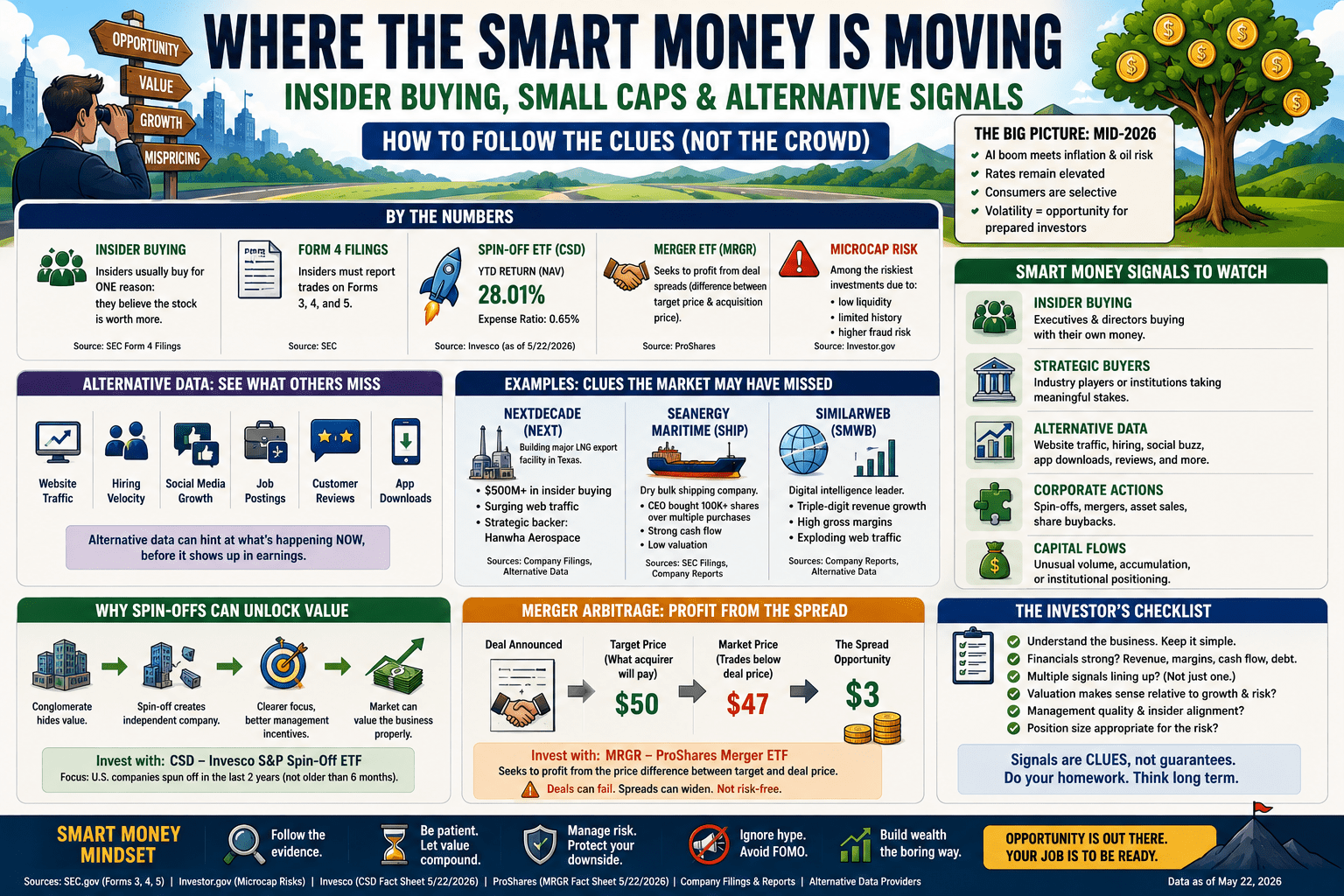
Small caps where alternative data, web traffic, hiring, insider buying, and fundamentals are should all be used together to identify possible momentum before it appears fully in the stock price. It also mentioned NextDecade, Seanergy Maritime, and Similarweb as examples of companies where different kinds of signals were being tracked.
That is the real lesson. Do not buy because of one flashy claim. Build a checklist. The more independent signals that agree, the stronger the case becomes.
Insider Buying: One of the Cleanest Signals
Insider buying is powerful because insiders already have exposure to their own companies. Executives and directors often receive salaries, bonuses, stock grants, options, and reputation risk tied to the business. When they voluntarily buy more shares with their own money, that can be meaningful.
The SEC explains that insiders report ownership and transactions through Forms 3, 4, and 5. In most cases, when an insider executes a transaction, they must file a Form 4, which makes the transaction visible to the public.
The reason insider buying gets attention is simple: insiders may sell for many reasons, but they usually buy for one reason. They believe the stock is worth more than the market price. That does not mean they are always right, but it does mean their actions deserve attention.
Insider selling can be routine, but insider buying is more meaningful because there is usually only one reason to buy: the buyer thinks the stock will go up. It also highlighted examples such as KKR co-CEOs buying, a shipping CEO buying repeatedly, and a billionaire accumulating synthetic exposure to a beaten-down stock.
The strongest insider buying patterns usually involve multiple insiders buying around the same time, large purchases relative to personal wealth or prior holdings, purchases after a major drawdown, and buyers with direct knowledge of the business. A single tiny purchase by one director may be symbolic. A cluster of large open-market purchases by several senior executives is much harder to ignore.
How Insider Buying Can Fool You
Insider buying is useful, but it can still fool investors. An insider can be emotionally attached to a company. A founder can underestimate competitive threats. A director can buy too early. An executive can make a confidence gesture to calm the market. A wealthy insider can afford to be wrong longer than you can.
This is why context matters. If insiders are buying while revenue collapses, debt matures, and customers disappear, the buying may not be enough. If insiders are buying after a temporary earnings miss but the long-term business remains strong, that may be more interesting.
You also need to watch whether the insider buying is open-market buying or part of a prearranged plan. Open-market buying with fresh capital is often more meaningful than routine stock compensation or automatic purchases. The filing details matter.
The best way to use insider buying is as a starting point. It should trigger research, not replace research. Ask why the stock is down, what insiders may be seeing, whether the balance sheet can survive, whether free cash flow is improving, and whether the business has a realistic path to growth.
Alternative Data: The New Investing Edge
Alternative data is information that goes beyond traditional financial statements. It can include website traffic, app downloads, hiring trends, satellite images, credit card data, social media growth, job postings, product reviews, shipping data, search trends, and customer behavior. Used properly, it can help investors spot momentum before it appears clearly in quarterly earnings.
This matters because financial statements are backward-looking. They tell you what happened last quarter. Alternative data can sometimes hint at what is happening right now. If a company’s website traffic is rising, job postings are increasing, customer reviews are improving, and social engagement is growing, that may suggest business momentum before Wall Street fully notices.
But alternative data has limits. Traffic can rise for bad reasons. Hiring can reflect overexpansion. Social media growth can be low-quality. Job postings can be recycled or misleading. One viral moment does not make a durable business.
The best use of alternative data is confirmation. If management says demand is improving, and alternative data supports it, the case gets stronger. If management sounds bullish but alternative data is weakening, investors should be cautious. The goal is not to predict perfectly. The goal is to reduce blind spots.
Spin-Offs: Where Hidden Value Can Appear
Spin-offs are another area regular investors should understand. A spin-off happens when a parent company separates part of its business into an independent public company. These situations can create opportunity because the new company may be ignored, misunderstood, or dumped by investors who owned the parent but do not want the spin-off.
Spin-offs can work because independence changes incentives. Management gets a clearer mission. Investors can value the business more directly. Capital allocation may improve. A division that was buried inside a conglomerate can suddenly become easier to analyze.
The Invesco S&P Spin-Off ETF, ticker CSD, is one way investors can track this theme. Invesco says the fund’s index is composed of U.S. companies that have been spun off within the past two years, but not more recently than six months. Invesco’s current product page shows a net expense ratio of 0.65% and a YTD return at NAV of 28.01%, though both performance and fund data can change over time.
CSD is a way to target companies that have recently gone through spin-offs, noting that spin-offs can appeal to investors because they may unlock value in companies that were previously hidden inside larger businesses. It also warned that the fund has a relatively narrow basket, which can make it riskier than broader ETFs.
That is a good balanced takeaway. Spin-offs can be powerful, but they are not automatically bargains. Some parent companies spin off weaker assets. Some new companies begin life with debt. Some are cyclical. Some are misunderstood for good reason.
Merger Arbitrage: A Different Kind of Signal
Merger arbitrage is a more specialized strategy. It tries to profit from the spread between a target company’s trading price after a deal is announced and the price the acquirer has agreed to pay. If a company agrees to buy another company for $50 per share, and the target trades at $47 because investors worry the deal might fail, the arbitrage opportunity is that $3 gap.
The ProShares Merger ETF, ticker MRGR, is designed around this type of strategy. ProShares explains that merger arbitrage seeks to profit from the price difference, or “spread,” between a target company’s stock price after a deal is announced and the acquisition price. ProShares also says the key drivers of merger arbitrage returns are different from equities, so performance is not expected to be correlated to equity markets over time.
This is useful in a volatile market because merger arbitrage does not depend purely on whether the S&P 500 goes up. It depends on whether deals close, whether regulators approve them, whether financing holds, and whether spreads narrow. That makes it a different tool from normal stock picking.
But merger arbitrage is not risk-free. Deals can collapse. Regulators can block acquisitions. Financing can get expensive. Market panic can widen spreads. Investors can lose money quickly if they assume every announced deal is guaranteed.
For common investors, the lesson is not necessarily to rush into a merger ETF. The lesson is to understand that different market conditions reward different strategies. In a roaring bull market, spin-offs and small caps may shine. In choppy markets, strategies less tied to market direction may become more interesting.
Strategic Buyers: When Big Players Quietly Validate a Theme
Another smart money signal is strategic buying. This happens when an industry player, large institution, or sophisticated long-term investor takes a meaningful position in a company for strategic reasons. This can be more informative than a random hedge fund trade because the buyer may understand the industry deeply.
Examples include: strategic purchases in energy, insurance, shipping, and financial companies. One example discussed W.R. Berkley and a major Japanese insurer taking a strategic stake, framing it as validation from a sophisticated institutional buyer rather than a normal insider purchase.
Strategic buying matters because it can reveal how industry insiders view long-term value. If a competitor, supplier, customer, or major financial partner is willing to commit serious money, they may see something the public market is underestimating.
But again, this is not automatic. Strategic buyers can overpay. Partnerships can disappoint. Regulatory conditions can change. A strategic stake is a signal, not a guarantee.
The 2026 Market Backdrop: Why Signals Matter More Now
Signals matter more when the market becomes uncertain. In easy bull markets, almost everything rises. In difficult markets, investors become more selective. That is where research starts to matter again.
Mid-2026 is not a simple market. AI infrastructure is booming, but valuations are high in parts of tech. Oil and inflation risks are pressuring consumers. Interest rates remain a major force. Retail earnings suggest households are bending, not breaking. Small caps may offer opportunity, but financing conditions are not easy.
This is the kind of environment where investors need to separate stories from evidence. A promotional newsletter can make almost any stock sound like the next big thing. A disciplined investor asks whether the company has revenue, margins, cash, customers, insider support, and a realistic catalyst.
The real opportunity over the next couple of years may come from companies that are quietly improving while the market focuses elsewhere. That could include small caps with real earnings growth, spin-offs with better management focus, infrastructure suppliers tied to durable demand, defense technology firms with government contracts, and value businesses that survive inflation pressure.
The Common Investor’s Research Checklist
A regular investor does not need a Bloomberg terminal to think clearly. A simple checklist can prevent a lot of bad decisions.
Start with the business. What does the company actually sell? Who buys it? Is demand growing? Is the company essential, replaceable, or speculative? If you cannot explain the business in plain language, you probably should not invest in it.
Then look at the financials. Is revenue growing? Are margins improving? Is free cash flow positive? How much debt does the company have? Does it need to raise money soon? Is dilution likely? A company can have a great story and still be a bad investment if the balance sheet is weak.
Next, check the signal stack. Are insiders buying? Is institutional ownership improving? Are job postings rising? Is website traffic increasing? Are customers talking positively? Are analysts revising estimates upward? The more signals that align, the better.
Then study valuation. Is the stock cheap because investors are ignoring it, or cheap because the business is deteriorating? A low price-to-sales ratio means nothing if sales are low-quality. A low P/E means little if earnings are about to collapse.
Finally, size the position properly. Even a good idea can go wrong. Small caps, spin-offs, and special situations should usually be satellite positions, not your entire financial future. Wealth is built by compounding, not by needing one risky bet to save you.
How This Helps People Build Wealth
The purpose of studying smart money signals is not to become a gambler. It is to become harder to fool. The average person is constantly being pushed toward emotional investing: fear, hype, urgency, FOMO, panic, and miracle promises.
Investor.gov lists red flags of fraud that include promises of high returns with little or no risk, pressure to act now, fear of missing out, fake testimonials, and promises of great wealth. That warning is especially relevant in small caps, pre-IPO pitches, crypto-linked promotions, and newsletter-driven stock ideas.
Real wealth building is slower and sturdier. You improve your income. You control spending. You invest consistently. You study opportunities. You avoid scams. You buy quality when fear creates discounts. You take calculated risks, not desperate ones.
For someone worried about finances, this is empowering. You do not have to know everything. You just need to avoid obvious traps and build a process. A process beats hype.
Final Verdict: Follow the Clues, Not the Crowd
The smart money is not always right, but it often leaves clues worth studying. Insider buying, small caps, alternative data, spin-offs, merger spreads, strategic stakes, and unusual capital flows can all help investors understand where opportunity may be forming before the mainstream narrative catches up.
The mistake is treating any single clue as proof. A CEO buying stock does not guarantee success. A small cap with rising website traffic is not automatically a winner. A spin-off is not always undervalued. A merger spread is not free money. Every signal has to be tested against fundamentals, valuation, risk, and timing.
The better mindset is simple: follow the clues, but do your own work. Look for multiple signals lining up. Respect balance sheets. Avoid promotional traps. Do not chase every hot story. Keep your position sizes sane. Stay patient enough to let real businesses compound.
Mid-2026 feels like a market where big changes are building under the surface. AI infrastructure, energy constraints, consumer pressure, higher rates, defense modernization, small caps, and corporate restructuring are all creating new winners and losers. That can feel scary, but it also means opportunity is not dead. It is just becoming more selective.
The common investor who learns to read these signals carefully has an edge over the person who only reacts to headlines. That edge may not make you rich overnight, but it can help you avoid bad bets, find better ones, and build wealth with more confidence over time.
SEC guide to Forms 3, 4, and 5 for insider ownership reporting
SEC Investor.gov guide to microcap stock risks
Those are important factors that are often overlooked: website views increasing or decreasing and social media popularity of companies going up or down. By paying attention to these stats you can better judge whether a company is buzzing or not.