
The idea of Universal Basic Income (UBI) has shifted from a theoretical concept to a serious economic discussion. As automation, artificial intelligence, and robotics accelerate, the traditional relationship between work and income is beginning to change. Governments, economists, and citizens are starting to ask a fundamental question: if machines generate a growing share of wealth, how should that wealth be distributed?
To understand what is possible, we can look at two real-world systems that already exist. Alaska distributes direct cash payments to its residents through oil revenues, while Norway has built one of the largest sovereign wealth funds in the world using similar resources. These two models represent different philosophies of shared wealth, and together they provide a framework for understanding how countries like Canada could approach UBI in the future.
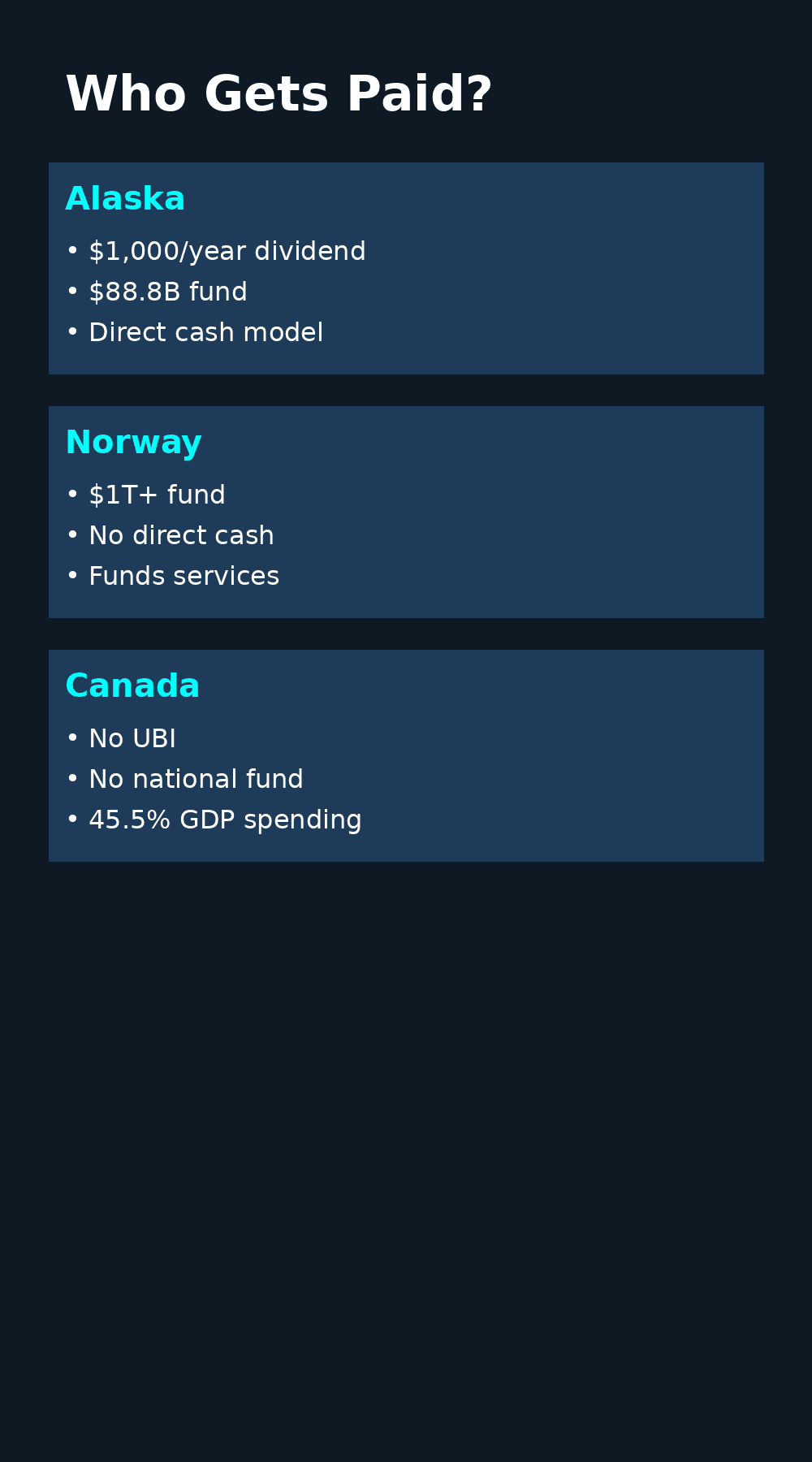
Alaska’s Dividend: A Practical Example of Shared Resource Income
Alaska offers one of the clearest real-world examples of a system that resembles a simplified version of UBI. Through the Alaska Permanent Fund Corporation, the state distributes annual payments to its residents based on oil revenues.
The system was established in 1976, when Alaska decided to set aside a portion of its oil income rather than spending it immediately. These funds were invested into a permanent portfolio, designed to grow over time and provide long-term benefits to residents.
Each year, the state distributes a portion of the investment returns to eligible citizens. This payment is known as the Permanent Fund Dividend (PFD), and it has become a defining feature of Alaska’s economic identity.
In practical terms, the dividend typically ranges between $1,000 and $2,000 USD per person annually. In stronger years, when investment returns are higher, the payout has exceeded $2,500. Every eligible resident receives the same amount, including children, which means a family of four can receive several thousand dollars per year.
This system works because it is tied directly to a physical resource. Oil revenue is treated as shared public wealth, and the investment fund ensures that this wealth continues to generate returns long after the oil itself is gone. It transforms a finite resource into a long-term income stream.
There are important limitations, however. The Alaska dividend is not a full UBI. It is paid once per year, the amount fluctuates, and it is not sufficient to cover basic living expenses. However, it proves a crucial point: governments can distribute money directly to citizens in a sustainable and politically stable way.
- The dividend is universal within the state, reinforcing fairness and simplicity
- It avoids complex bureaucracy since there are no work requirements
- It creates a sense of shared ownership over natural resources
Alaska demonstrates that a resource-backed dividend system is not just theoretical—it is already functioning at scale.

Norway’s Wealth Fund: Building Long-Term National Prosperity
While Alaska distributes cash directly, Norway has taken a more indirect but significantly larger approach. Through the Government Pension Fund Global, Norway has built a financial system that captures and preserves oil wealth for future generations.
Rather than distributing money to individuals, Norway invests its oil revenues into a global portfolio. This fund has grown to exceed $1 trillion USD, making it one of the largest sovereign wealth funds in the world.
The Norwegian government follows a fiscal rule that allows it to spend a small percentage of the fund’s value each year, typically around 3%. This spending supports public services such as healthcare, education, infrastructure, and pensions.
The result is a system where citizens benefit indirectly. Instead of receiving cash payments, they experience a higher standard of living through strong public services and long-term economic stability.
Norway’s approach is often considered more sustainable than direct payouts because it avoids sudden increases in consumer spending that could destabilize the economy. It also ensures that wealth is preserved for future generations rather than being consumed in the present.
- The fund invests globally, reducing dependence on domestic economic conditions
- Only a small portion is spent annually, preserving long-term value
- Citizens benefit through services rather than direct payments
This model represents a different philosophy: instead of giving citizens money, it builds a system where essential needs are already covered.
Canada’s Position: Between Alaska and Norway
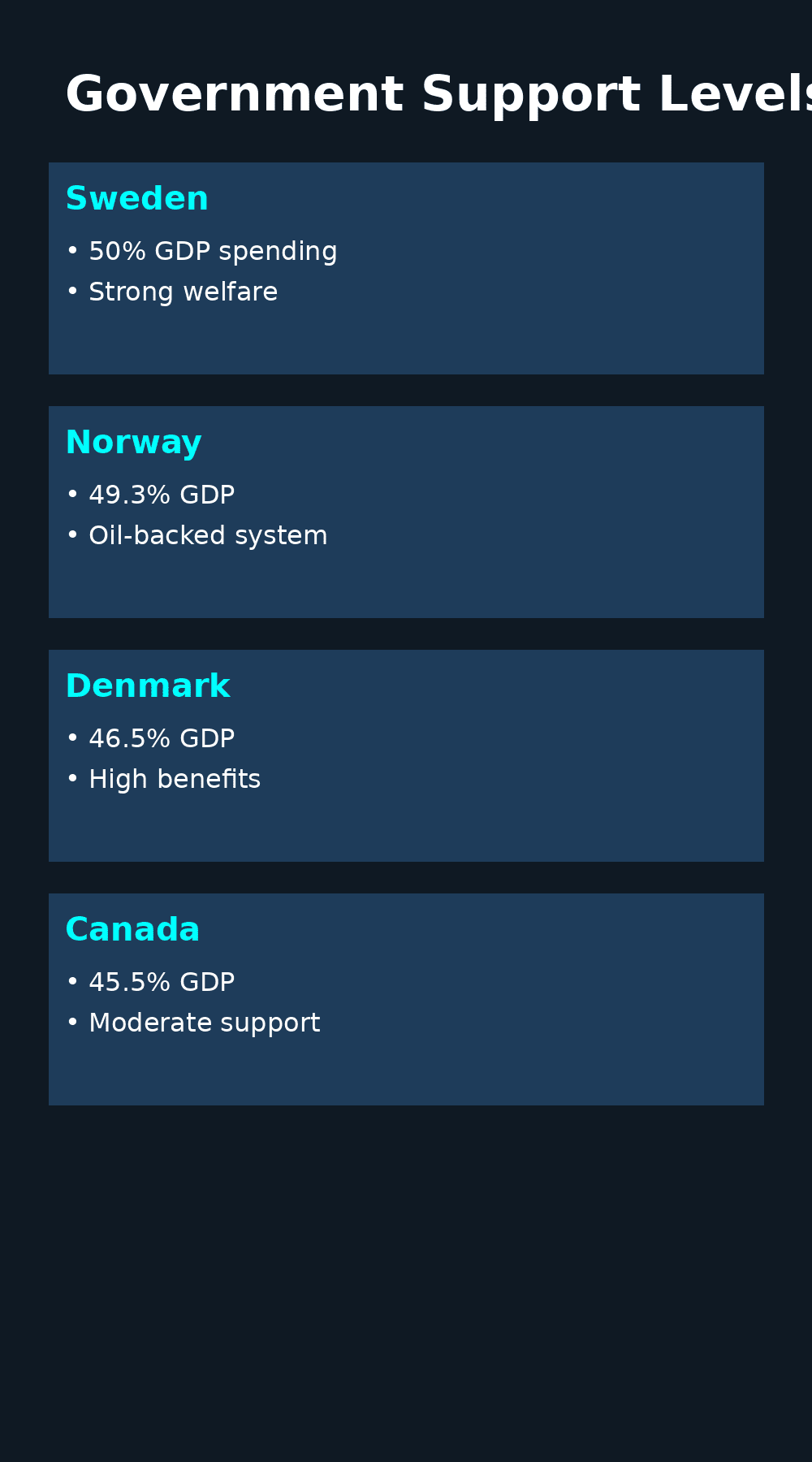
Canada occupies an interesting middle ground between these two approaches. Like Norway, it has significant natural resources, including oil, gas, and minerals. Like Alaska, some provinces generate substantial revenue from these resources. However, Canada has not fully implemented either a direct dividend system or a unified national wealth fund on the scale of Norway.
Canada already operates elements of indirect wealth distribution, including public healthcare, pension systems, and social transfers. These resemble Norway’s approach more than Alaska’s. However, there is no large centralized fund that captures and invests resource wealth at a national level.
One of the main challenges is that natural resources in Canada are largely controlled by provinces rather than the federal government. This makes coordination difficult and creates competing interests between regions.
If Canada were to adopt an Alaska-style system, it would likely need to start at the provincial level. Alberta, for example, has previously explored similar ideas due to its oil revenues. A national system would require significant political alignment, which is historically difficult to achieve.
If Canada were to follow Norway’s model more closely, it could expand its investment funds and use resource revenues more strategically. This would involve long-term planning and disciplined fiscal policy.
The Cost of UBI in Canada: A Financial Reality Check
A full Universal Basic Income is significantly more expensive than either the Alaska or Norway models.
Providing a basic income of $15,000 CAD per adult would cost hundreds of billions of dollars annually. This level of funding would require major structural changes, including higher taxes, reallocation of existing programs, or new sources of revenue.
The scale of this challenge is why most economists do not view UBI as a simple policy change. It represents a transformation of the economic system.
- Funding could require increases in income, corporate, or consumption taxes
- Existing welfare programs might need to be replaced or consolidated
- New revenue streams, such as automation taxes, could become necessary
Despite these challenges, the conversation continues to grow, especially as technological change accelerates.
AI, Automation, and the Changing Nature of Work
Artificial intelligence is beginning to reshape the labor market in ways that were previously difficult to imagine. Unlike past technological shifts, which primarily affected manual labor, AI is increasingly impacting white-collar jobs.
Industries such as software development, customer service, marketing, and data analysis are already seeing early signs of automation. Companies are becoming more efficient, requiring fewer employees to produce the same output.
Hiring slowdowns in the technology sector and other industries reflect this shift. Entry-level roles are becoming more competitive, and some positions are disappearing entirely.
This does not mean that all jobs will vanish immediately. However, it does suggest a gradual decoupling of employment from productivity.
- AI tools can perform tasks that previously required specialized training
- Fewer workers are needed to achieve the same results
- Productivity gains are increasingly driven by technology rather than labor
This trend raises a critical question: if fewer people are needed to generate economic output, how will income be distributed?
The Road to 2030: A Period of Transition
Looking ahead to the next five to ten years, the global economy is likely to experience a transition period. AI capabilities are improving rapidly, and businesses are adopting these tools at an accelerating pace.
By 2026 and 2027, we can expect to see deeper integration of AI into everyday operations. Automation will continue to expand beyond routine tasks into more complex decision-making roles.
By 2030, it is reasonable to expect a significantly different labor market. While predictions of extreme unemployment levels, such as 50%, remain speculative, the direction of change is clear. The nature of work will shift, and some traditional roles will decline.
At the same time, new opportunities will emerge. However, these opportunities may not be evenly distributed, and not everyone will transition easily.
Funding the Future: AI Taxes and Shared Productivity
As AI-driven productivity increases, new funding models are being explored. These models aim to capture a portion of the wealth generated by automation and redistribute it more broadly.
Some of the most discussed ideas include:
- Automation taxes, where companies pay based on the extent to which machines replace human labor
- AI profit taxes, targeting the gains generated by highly automated systems
- Data dividends, compensating individuals for the use of their personal data
These approaches attempt to align economic systems with technological realities. If machines are producing value, that value must be integrated into the broader economy in a way that benefits society.
A Future Scenario: High Automation, High Potential
In a highly automated future, the economy could look very different from today. Productivity could increase dramatically, while the cost of goods and services decreases. Basic needs could become more affordable, and the overall standard of living could rise.
However, without effective distribution mechanisms, wealth could become concentrated among those who control the technology.
This is where systems like UBI, sovereign wealth funds, and resource dividends become relevant. They provide ways to ensure that the benefits of automation are shared.
- Automation could reduce the need for human labor in many industries
- Economic output could increase even as employment decreases
- Redistribution systems could stabilize income and maintain demand
The outcome depends on policy decisions. The same technology that creates inequality can also support a more balanced and inclusive economy.
Final Thoughts: The Direction of Shared Wealth
Alaska demonstrates that direct payments to citizens are feasible and sustainable on a smaller scale. Norway demonstrates that large-scale wealth can be built and preserved through disciplined investment. Canada has the resources and institutional capacity to pursue either path, but has yet to fully commit.
As artificial intelligence continues to evolve, the urgency of these questions will increase. The relationship between work, income, and value is changing, and economic systems must adapt accordingly.
The future of UBI in Canada will likely not emerge overnight. Instead, it will develop through a combination of resource management, technological taxation, and policy experimentation.
The key question is not whether wealth can be generated. It is whether that wealth will be shared.
And that decision will define the economic landscape of the coming decades.
For readers who want to go deeper:
- Norway’s oil fund, official overview: Norges Bank Investment Management’s “About the fund” page explains why the Government Pension Fund Global exists, how it is invested, and how it fits into Norway’s long-term fiscal model.
- UBI in Canada: UBI Works is one of the main Canadian advocacy and education groups pushing for basic income, with explainers, research, and policy material focused on Canada.
- Alaska’s dividend, official source: Alaska’s Permanent Fund Dividend site is the best direct source for how the payment works, current payment schedules, and yearly payout history. The state’s summary page also shows recent dividend amounts, applications, and total disbursements.
I like this idea of automation tax. Once a human job is replaced this automation process gets taxed.